Xue Er (學而), Chapter 13 | Is Keeping a Promise Enough?
Traditional Chinese
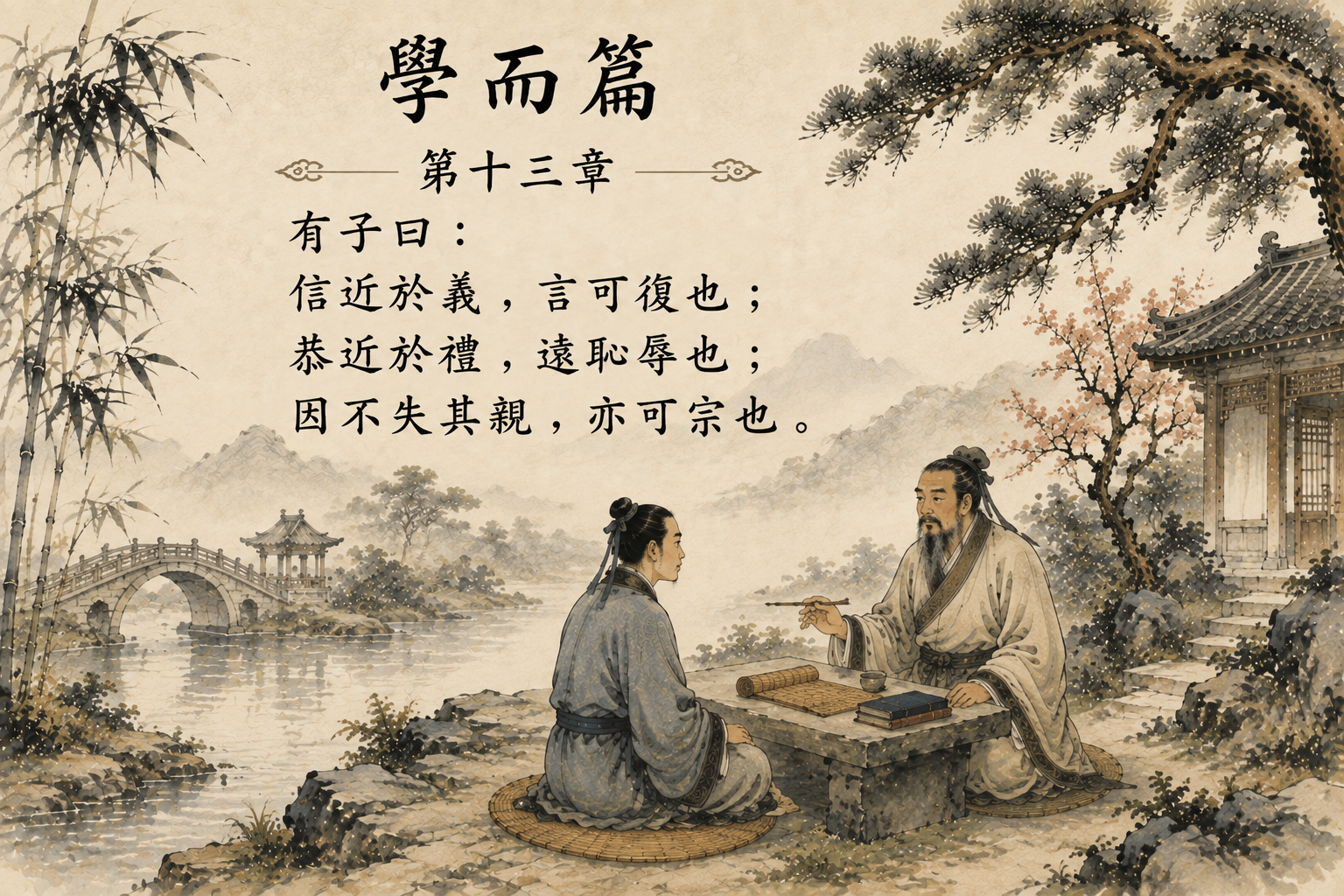
有子曰:「信近於義,言可復也;恭近於禮,遠恥辱也;因不失其親,亦可宗也。」
Simplified Chinese
有子曰:“信近于义,言可复也;恭近于礼,远耻辱也;因不失其亲,亦可宗也。”
Pinyin
Yǒu Zǐ yuē: “Xìn jìn yú yì, yán kě fù yě; gōng jìn yú lǐ, yuǎn chǐrǔ yě; yīn bù shī qí qīn, yì kě zōng yě.”
Reading the Passage Literally
Youzi said:
“When trustworthiness is close to what is right, one’s words can be fulfilled. When respectfulness is close to Li (禮), one can keep far from shame and humiliation. If the person on whom one relies does not cease to be someone worthy of closeness, that person may also be honored and followed.”
Reading the Grammar
At first glance, this passage appears to place three different topics side by side: keeping one’s word, being respectful, and choosing the people on whom one relies. Read together, however, the three statements share a common structure. Each begins with something generally regarded as good—trustworthiness, respectfulness, or a human relationship—and then asks whether it rests on a sound standard.
The chapter therefore does not merely praise good intentions. It asks whether the choices we make at the beginning will still be defensible and sustainable later.
1. 信近於義,言可復也
Xìn jìn yú yì, yán kě fù yě
The first important term is 信 (Xin). It is often translated as “trust,” “trustworthiness,” or “faithfulness.” In this context, it refers especially to being true to one’s word and keeping promises. In 近於義, 近 (jìn) means “to be close to,” while 於 (yú) means “to” or “with respect to.” 義 (Yi) refers to what is right, appropriate, or morally fitting.
Thus:
信近於義
means literally:
“Trustworthiness is close to what is right.”
The wording is important. Youzi does not say that Xin and Yi are identical. A promise may be sincere and yet still be wrong. One can faithfully keep a promise that should never have been made in the first place.
This distinction is also emphasized in the traditional commentary. Xin concerns not deceiving others and remaining faithful to one’s word, while Yi concerns whether an action itself is appropriate and right. A promise does not become morally right simply because it was made.
In 言可復也, 言 (yán) means one’s words or promise. 可 (kě) means “can” or “may.” 復 (fù) here does not simply mean “again” or “to return.” In this context, it is traditionally understood in the sense of carrying out or fulfilling what one has said. Zhu Xi explains 復 as 踐言, putting one’s words into practice.
The structure can be seen as:
信 / 近於 / 義
trustworthiness / is close to / what is right
言 / 可 / 復 / 也
one’s words / can / be fulfilled / indeed
The point, then, is not only that we should keep our promises. It is that we should make promises that are right and appropriate enough to be kept.
Key Characters and Meanings
信 (xìn, trustworthiness; faithfulness to one’s word) · 近 (jìn, to be close to) · 於 (yú, to; with respect to) · 義 (yì, rightness; what is appropriate) · 言 (yán, words; promise) · 可 (kě, can; may) · 復 (fù, to fulfill; to carry out one’s word) · 也 (yě, sentence-final particle)
2. 恭近於禮,遠恥辱也
Gōng jìn yú lǐ, yuǎn chǐrǔ yě
恭 (gōng) means respectful, courteous, or deferential conduct. It describes a manner that does not treat others carelessly or arrogantly.
近於禮 follows exactly the same grammatical pattern as 信近於義:
信 → 義
trustworthiness → measured against what is right
恭 → 禮
respectfulness → measured against Li
Here 禮 (Li) refers not merely to etiquette, but to appropriate norms, proper conduct, and the boundaries that give respectful behavior its proper form. Youzi therefore does not say that being respectful is automatically sufficient. Respectfulness must itself be appropriate.
Excessive deference can become servility. A person may lower himself so far in trying to please another that he loses dignity. At the opposite extreme, outward politeness without genuine respect may become little more than empty form.
In 遠恥辱也, 遠 (yuǎn) functions as a verb meaning “to keep at a distance” or “to avoid.” 恥辱 (chǐrǔ) means shame, disgrace, or humiliation.
The structure is:
恭 / 近於 / 禮
respectfulness / is close to / Li
遠 / 恥辱 / 也
keeps far from / shame and humiliation / indeed
Properly guided respect therefore helps a person avoid both discourtesy and self-degrading submission.
Key Characters and Meanings
恭 (gōng, respectful; courteous) · 近 (jìn, to be close to) · 於 (yú, to; with respect to) · 禮 (lǐ, ritual; propriety; appropriate conduct) · 遠 (yuǎn, to keep distant from) · 恥 (chǐ, shame) · 辱 (rǔ, humiliation; disgrace) · 也 (yě, sentence-final particle)
3. 因不失其親,亦可宗也
Yīn bù shī qí qīn, yì kě zōng yě
This is the most difficult of the three statements and has received more than one interpretation in the commentarial tradition. In Zhu Xi’s reading, 因 (yīn) carries the sense of relying on or depending upon someone. 親 (qīn) here is not restricted to a blood relative. It can refer to someone worthy of closeness or someone with whom one has an appropriate close relationship.
不失其親 therefore suggests that the person on whom one relies remains someone who is properly worthy of closeness.
宗 (zōng) literally carries meanings connected with an ancestral line or a central object of reverence, but here it can be understood as to honor, esteem, or follow as someone worthy of respect.
The structure can be seen as:
因 / 不失 / 其親
one’s reliance / does not lose / one worthy of closeness
亦 / 可 / 宗 / 也
also / can / honor and follow / indeed
On this interpretation, the sentence means approximately:
“If the person on whom one relies remains someone properly worthy of closeness, that person may continue to be respected and followed.”
Why does a discussion of choosing people appear after promises and respectful behavior? The connection becomes clearer when all three statements are read together. The passage asks us to consider the quality of our beginnings.
The promise we make at the beginning matters.
The way we show respect at the beginning matters. The person on whom we choose to rely at the beginning matters.
Zhu Xi reads the chapter as a reminder that in speech, conduct, and human relationships we should begin carefully, with an awareness of where that beginning may eventually lead.
Other early commentarial traditions understand 因 somewhat differently, including in the sense of forming or maintaining close relations. The precise wording therefore remains open to interpretation, but the broader concern with forming appropriate relationships is clear.
Key Characters and Meanings
因 (yīn, to rely on; to depend upon) · 不 (bù, not) · 失 (shī, to lose; to fail) · 其 (qí, one’s; that) · 親 (qīn, close; one worthy of closeness) · 亦 (yì, also) · 可 (kě, may; can) · 宗 (zōng, to honor; to esteem; to follow) · 也 (yě, sentence-final particle)
Understanding the Meaning
Chapter 13 may initially look like a collection of three separate lessons: keep your promises properly, be respectful in the right way, and choose your relationships carefully.
Yet a common idea links all three:
Good intentions are not enough. A good beginning also requires a sound standard.
Keeping one’s word is ordinarily a sign of trustworthiness. Human relationships depend on it. But Youzi asks us to go one step further. Before asking whether a promise should be kept, we should ask whether it was right to make that promise in the first place.
Suppose someone promises a friend to participate in something clearly wrong or harmful. Would keeping that promise become virtuous merely because breaking one’s word is normally undesirable?
The logic of this passage suggests otherwise.
Xin (信) needs the guidance of Yi (義).
The same is true of respectfulness.
Treating other people politely and with consideration is good, but respectfulness without an appropriate standard can become excessive submission. One may become so concerned with pleasing another person that one abandons judgment, dignity, or necessary boundaries.
That is why:
Gong (恭) needs the guidance of Li (禮).
The third statement turns toward relationships. The people with whom we become close, and especially those on whom we depend, can shape our choices over time. A relationship that begins casually may later involve loyalty, obligation, recommendation, influence, and responsibility.
The relevant question therefore becomes not merely:
“Do I like this person now?”
but also:
“Is this someone I will still be able to respect later?”
Seen this way, Chapter 13 is not simply telling us to keep promises, be polite, and associate with good people.
It asks something more demanding:
Is the choice I am making now one that I will still be able to stand by later?
If we make promises that are consistent with what is right, practice respectfulness within proper boundaries, and form close relationships with people we can continue to respect, we are less likely to find ourselves forced later to undo our own words and choices.
The deeper theme of the chapter is therefore care at the beginning, with the end already in view.
Background and Context
The speaker in Chapter 13 is again Youzi (有子), also known as You Ruo (有若). His statements occupy an important place in the opening book of the Analects. He appears in Chapter 2, Chapter 12, and now Chapter 13.
In Chapter 2, Youzi connects filial devotion and respect for elders with the root of practicing Ren (仁). In Chapter 12, he discusses the balance between Li (禮) and He (和), harmony. Chapter 13 again works through a series of paired concepts:
Xin (信) and Yi (義)
Gong (恭) and Li (禮)
The connection between Chapters 12 and 13 is especially revealing.
In Chapter 12, harmony is valuable, but harmony that is not regulated by Li cannot function properly.
In Chapter 13, the same pattern appears again:
Trustworthiness matters, but it must remain close to Yi.
Respectfulness matters, but it must remain close to Li.
This shows that the virtues discussed in the Analects are not isolated rules that can simply be applied without qualification.
A virtue can become distorted when separated from other standards that guide it.
Keeping promises does not justify injustice. Respectfulness does not require humiliation. Harmony does not require the abandonment of principle. The virtues qualify, balance, and correct one another.
The Lunyu Zhushu emphasizes precisely this distinction. Xin and Yi are not identical, just as Gong and Li are not identical. Faithfully carrying out a wrong commitment cannot be justified merely by calling it trustworthiness, and lowering oneself outwardly does not automatically make one’s conduct proper according to Li.
Zhu Xi develops another important dimension by reading all three statements as guidance about making careful beginnings. If one’s original promise is appropriate, it can later be fulfilled. If one’s respectful conduct begins within proper limits, one can avoid humiliation. If one forms attachments to appropriate people, those relationships can continue to deserve respect.
This fits the larger movement of Xue Er. The opening book is not primarily concerned with how much information a person possesses. Again and again it asks how learning becomes visible in family life, friendship, promises, speech, conduct, and the people one chooses to remain close to.
Chapter 13 therefore reminds us that moral cultivation also requires judgment.
It is not enough merely to mean well. We must learn to judge what promises should be made, where respect should find its limits, and which relationships deserve our lasting commitment.
Dr. Ryu’s Reflection
Reading this chapter, I first think of a sentence most of us have heard since childhood:
“A promise must be kept.”
I have always regarded trust as important in human relationships, and throughout my life I have tried, as far as possible, to keep the commitments I make. But Youzi asks a question that comes before that. Was this a promise I should have made in the first place?
That question changes the way I think about promises. We sometimes make commitments too easily because of the mood of the moment or because we do not want to disappoint another person. Someone asks us for something, and rather than saying no, we answer, “All right, I’ll do it.” At that moment, the answer may seem generous and may help preserve the relationship.
The problem often comes later. We discover that the promise is difficult to keep, that circumstances have changed, or even that fulfilling it would create a problem for someone else. Then the choice becomes much harder. If I keep the promise, something wrong may happen. If I break it, I may lose the other person’s trust.
Reading 信近於義,言可復也, I am reminded that perhaps the real difficulty did not begin when I had to decide whether to keep the promise. It began when I made the promise without thinking carefully enough. If we think first about whether something is right, whether we can take responsibility for it, and whether we are genuinely capable of doing what we say, we may have far fewer promises to undo later.
The longer we live, the more clearly we also see how much responsibility can lie behind a few casual words. When we are young, “I’ll try” or “I’ll take care of it” may come easily. With experience, however, we begin to see the chain of expectations and consequences that can follow a single sentence. Especially in organizations, one person’s promise may affect many others.
For that reason, I increasingly find a person who makes only promises that can be kept more trustworthy than a person who makes promises easily and often. The same kind of balance appears in 恭近於禮. Respecting another person matters. It is especially important when living and working with people from different cultural backgrounds. Courtesy and respect often create the conditions in which a relationship can begin.
But over the years I have also learned that respectfulness and unconditional concession are not the same thing.
Respecting another person does not mean accepting every request. There are times when opinions differ and when it is necessary to say clearly, “I cannot agree to that,” or “That will be difficult.”
If our only goal is never to make another person uncomfortable, we can gradually lose our own standards.
To be courteous without becoming servile, and to express one’s own view without treating the other person with contempt—this is a much more difficult balance than it sounds.
The final phrase, 因不失其親,亦可宗也, also seems to become more meaningful with age. The people we choose to remain close to matter more than we sometimes realize. When we are young, we may not think very consciously about standards for friendship or association. We meet people, enjoy spending time together, work together, and relationships develop naturally.
As years pass, however, relationships begin to carry responsibilities. We help one another in difficult times. We introduce people to others. We recommend someone for an opportunity. We seek advice, and sometimes important decisions are influenced by the people around us. That means the choice of whom we allow close to us may eventually become more than a matter of personal preference.
I have learned throughout my life not only from people older than I am or from those with higher positions. I have learned from younger people as well, and sometimes from the character and attitude of people whose fields were entirely different from mine. For that reason, I do not want to understand “choosing people carefully” as ranking people according to status, age, or ability.
I would rather ask:
Will I still be able to respect this person after a long time has passed?
That seems to me a much more useful standard. Zhu Xi reads this chapter as encouraging care at the beginning of speech, conduct, and human relationships while thinking ahead to their eventual consequences. I find that interpretation remarkably practical.
We often spend great effort deciding how to repair things after they have gone wrong.
But perhaps one of the deeper forms of wisdom is making a slightly more careful choice at the beginning so that less repair will be necessary later. Make promises you can stand behind. Practice courtesy without surrendering dignity. Build relationships with people you can continue to respect.
For me, Youzi’s brief words finally become one question:
Am I making a choice today that I will still be able to honor tomorrow?
References
- The Analects (論語), Xue Er (學而), Chapter 13.
- Zhu Xi (朱熹), Sishu Zhangju Jizhu (四書章句集注), commentary on Lunyu, Xue Er.
- He Yan (何晏), collected commentary; Xing Bing (邢昺), subcommentary, Lunyu Zhushu (論語注疏), Xue Er.
- Chinese Text Project, The Analects: Xue Er.
- Edward Slingerland, Confucius: Analects: With Selections from Traditional Commentaries. Hackett Publishing, 2003.
- Burton Watson, The Analects of Confucius. Columbia University Press, 2007.