Xue Er (學而), Chapter 1 | The Joy of Learning and Growing
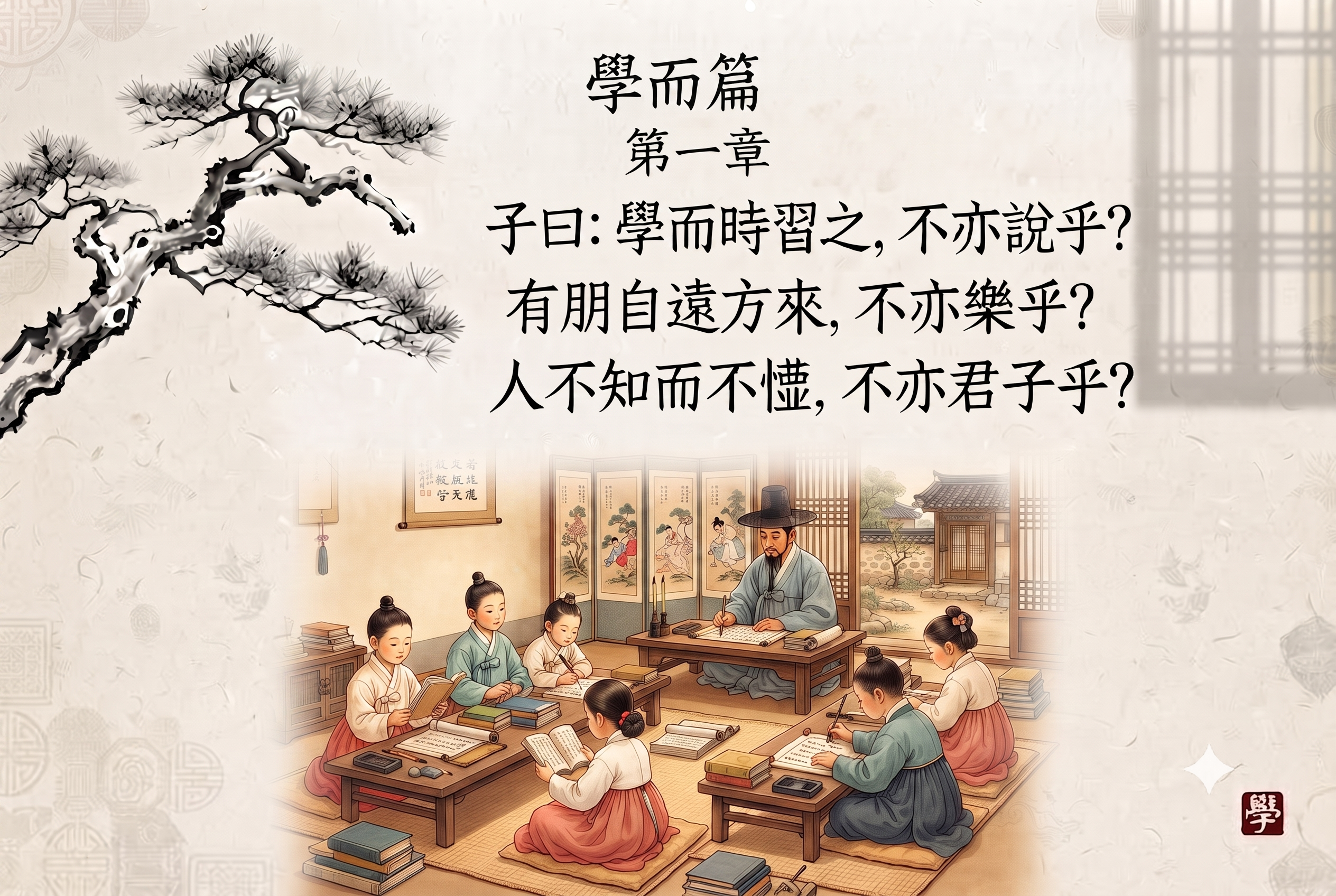
Traditional Chinese
子曰:「學而時習之,不亦說乎?有朋自遠方來,不亦樂乎?人不知而不慍,不亦君子乎?」
Simplified Chinese
子曰:“学而时习之,不亦说乎?有朋自远方来,不亦乐乎?人不知而不愠,不亦君子乎?”
Pinyin
Zǐ yuē: “Xué ér shí xí zhī, bù yì yuè hū? Yǒu péng zì yuǎnfāng lái, bù yì lè hū? Rén bù zhī ér bù yùn, bù yì jūnzǐ hū?”
Reading the Whole Passage
Confucius said:
“To learn and, at the proper times, put what one has learned into practice—is this not a pleasure? To have friends come from afar—is this not a joy? To remain unresentful when others do not recognize you—is this not the mark of a junzi?”
The opening passage of the Analects moves through three closely connected ideas: the satisfaction of learning and practice, the joy of sharing life and learning with like-minded companions, and the inner steadiness to remain free of resentment even when others fail to recognize one’s worth.
Reading through Grammar
The passage consists of three parallel questions. Each ends with 不亦~乎 (bù yì … hū), a rhetorical pattern that can be understood as “Is it not also …?” or, more naturally in English, “Is this not …?”
Rather than asking for information, the questions invite the listener to recognize something that Confucius presents as worth affirming.
1. 學而時習之,不亦說乎?
Xué ér shí xí zhī, bù yì yuè hū?
學 (xué) means “to learn” or “to study.” 而 (ér) connects what follows with what precedes it and can be understood here along the lines of “and” or “and then.”
In 時習之, 時 (shí) conveys the idea of doing something at appropriate or recurring times, 習 (xí) means to practice, review, or become familiar with something through repetition, and 之 (zhī) refers back to what has been learned.
The final expression, 不亦說乎, follows the recurring rhetorical pattern 不亦~乎. The character 說 is read yuè in this context and means “pleased” or “delighted.”
The structure can be seen as:
學 / 而 / 時習之 / 不亦說乎
to learn / and / practice it at appropriate times / is this not a pleasure?
The important point is that Confucius does not stop at 學, learning. He immediately follows it with 習, repeated practice. Learning something and gradually making it one’s own are not quite the same process. The very first sentence of the Analects therefore locates part of the pleasure of learning not simply in acquiring new knowledge, but in returning to what has been learned and allowing it to become part of oneself.
2. 有朋自遠方來,不亦樂乎?
Yǒu péng zì yuǎnfāng lái, bù yì lè hū?
有 (yǒu) means “there is” or “to have,” while 朋 (péng) means “friend” or “companion.” 自 (zì) marks the point of origin and can mean “from.” 遠方 (yuǎnfāng) means “a distant place,” and 來 (lái) means “to come.”
The second half, 不亦樂乎, uses the same rhetorical construction as the first sentence. Here 樂 (lè) means joy or enjoyment.
The structure is:
有朋 / 自遠方 / 來 / 不亦樂乎
a friend / from afar / comes / is this not a joy?
In this context, 朋 can be understood as more than simply a casual friend. It may suggest someone with whom learning, interests, or aspirations can be shared. The first sentence begins with the individual's learning; the second opens that experience outward toward companionship and exchange.
3. 人不知而不慍,不亦君子乎?
Rén bù zhī ér bù yùn, bù yì jūnzǐ hū?
This sentence requires particular care with 人不知. Literally, the characters mean that “people do not know,” but the expression is generally understood here to mean that others do not know or recognize oneself.
而 (ér) again connects the two parts of the sentence, while 慍 (yùn) refers to anger, displeasure, or resentment. Thus 人不知而不慍 describes someone who does not become resentful when others fail to recognize him.
The structure is:
人不知 / 而 / 不慍 / 不亦君子乎
others do not recognize me / yet / I do not resent it / is this not the mark of a junzi?
君子 (jūnzǐ) originally had associations with a person of elevated social standing, but in the Analects it develops an important ethical meaning: a person of cultivated character, often translated as “gentleman,” “noble person,” or “exemplary person.”
The first two sentences describe welcome experiences—learning and meeting friends. The third shifts to a more difficult situation. A person may learn, practice, and cultivate himself without receiving recognition from others. Confucius turns attention to what happens then: the ability to remain free from resentment becomes a measure of character.
Understanding the Meaning
The opening chapter of the Analects is brief, but it unfolds in three stages: the pleasure of learning and practice, the joy of companionship, and the ability to remain inwardly steady when others fail to recognize us.
In 學而時習之, learning is not something completed the moment information has been acquired. We learn, return to what we have learned, practice it, and gradually make it our own. The pleasure described here can therefore be understood not simply as the satisfaction of knowing more, but as the deeper satisfaction of seeing what we have learned become part of the way we think and act.
The second sentence widens the circle. Learning may begin with the individual, but it does not have to remain solitary. Meeting someone who shares our interests or aspirations allows ideas to be exchanged, questioned, and deepened. The friend who comes “from afar” represents not merely the pleasure of receiving a visitor but the joy of having someone with whom learning and understanding can be shared.
The third sentence moves further inward. Learning and self-cultivation do not guarantee recognition. Other people may overlook our efforts, misunderstand our intentions, or simply fail to notice what we have done. Confucius suggests that character becomes visible precisely at this point. The person whose sense of worth depends entirely on the recognition of others will easily fall into resentment; the junzi is able to continue cultivating himself without allowing that resentment to take control.
These are therefore not three unrelated observations. They can be read as a single movement: from learning, to relationship, and finally to the cultivation of one's own character.
Background and Context
The Analects is generally understood not as a book written personally by Confucius from beginning to end, but as a collection of sayings, conversations, and recollections associated with Confucius and his disciples, compiled and transmitted by later followers.
The received text consists of twenty books. Xue Er (學而) is the first, and its name comes from the opening words of this first passage, 學而時習之. Like the titles of many books in the Analects, “Xue Er” is therefore best understood primarily as a conventional title taken from the opening words rather than as a formal philosophical heading created to summarize the entire book.
Even so, generations of readers have found it significant that the Analects begins with 學—learning. And the learning introduced here is not confined to accumulating knowledge. It moves immediately toward practice, companionship, and finally the ability to maintain one's character in the absence of recognition.
For that reason, this short opening passage can be read as an introduction to several themes that will continue throughout the Analects: learning, self-cultivation, human relationships, and the formation of the junzi.
Dr. Ryu’s Reflection
Reading the first passage of the Analects again, the character that catches my attention most is not 學, “to learn,” but 習, “to practice.”
When we are young, it is easy to think of learning mainly as acquiring something new. We enter a new school, study a new subject, learn another language, or master a new skill. Looking back, however, I have come to think that what matters more than having learned something once is how often we return to it, use it, reconsider it, and gradually make it part of our lives.
This feels even more relevant as we grow older. Sometimes we have to study again what we once thought we knew. Sometimes familiar ways of doing things no longer work, and we have to begin again as learners. And very often, something that seemed clear in theory turns out to require another round of learning when we actually try to put it into practice. In that sense, 時習之 feels to me like more than simple review. It suggests returning to what we have learned at different moments in life and discovering it anew.
I also read 有朋自遠方來 differently now. Learning can be a solitary activity, but sustaining it over many years is often easier when there are people with whom we can exchange ideas. A question from someone else can make us reconsider what we thought we understood. Another person's experience can reveal something we had never noticed. A “friend” in this sense does not necessarily have to be someone we have known for many years. If two people can share a question and think about it together, distance need not prevent them from becoming companions in learning.
Yet the sentence that stays with me longest today is the last one: 人不知而不慍.
There are times in life when our work is not recognized as much as we hoped, when our experience is overlooked, or when others simply do not understand what we are trying to do. Such things once seemed much larger to me. With time, however, I have increasingly come to think that the more important question is not how much other people recognize us, but what we continue to learn and what kind of person we are becoming.
The Analects does not begin with a grand promise of success. It begins with a person who learns, practices, shares with others, and continues along his path without becoming resentful when recognition does not come.
Perhaps that is one reason the Analects is worth returning to in the second half of life. We open a sentence we may have encountered many years ago. The sentence has not changed, but the reader has.
To learn, and to return to what we have learned at the proper time.
More than 2,500 years later, the opening sentence of the Analects still seems an appropriate place to begin whenever we decide to become a learner again.
References
- The Analects, Xue Er (學而), 1.1.
- Confucius. Confucian Analects. Translated by James Legge, in The Chinese Classics, Vol. I.
- Slingerland, Edward. Confucius: Analects: With Selections from Traditional Commentaries. Hackett Publishing, 2003.
- Yang Bojun (楊伯峻). Lunyu Yizhu (論語譯注). Zhonghua Book Company.
- Chinese Text Project. The Analects (論語).