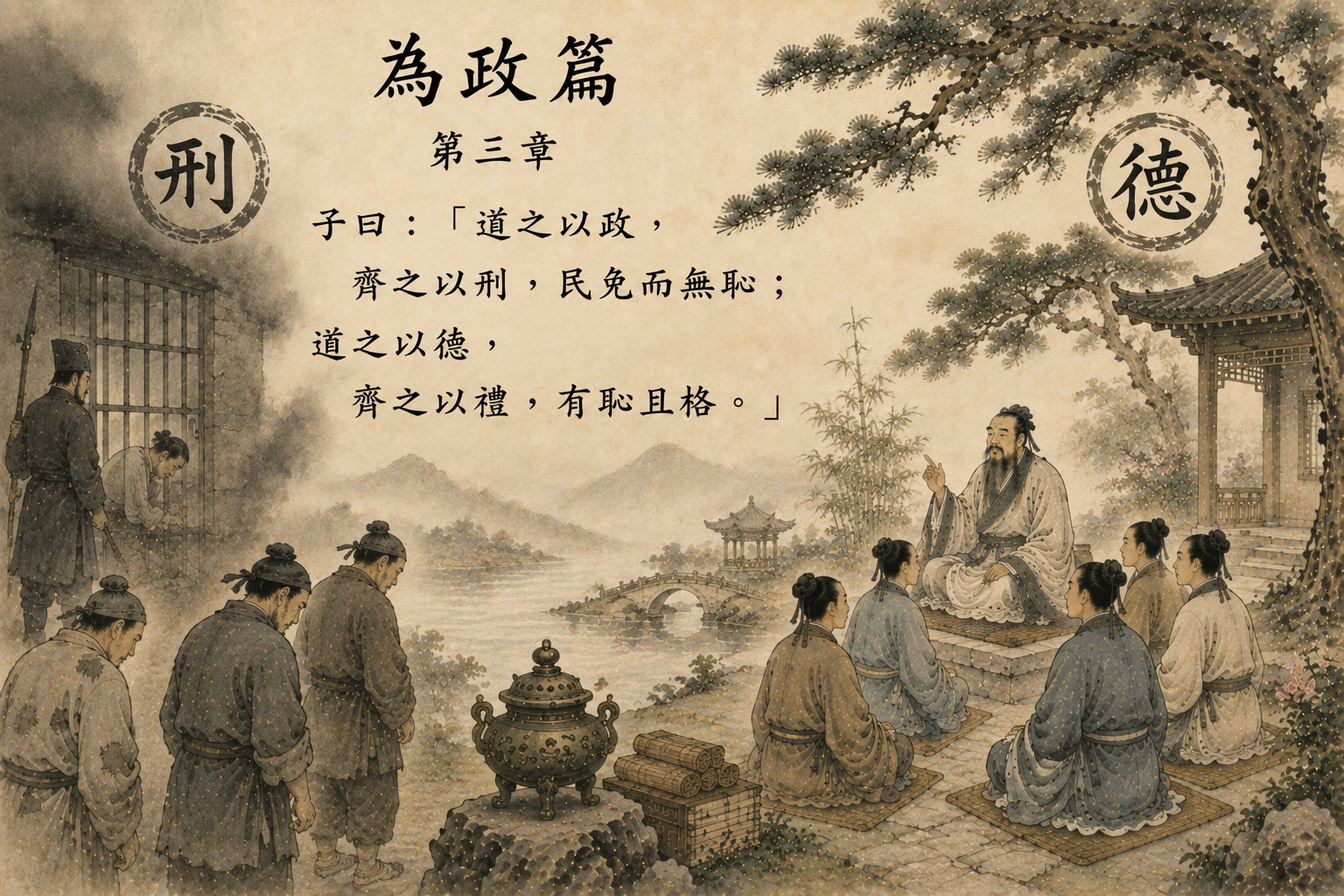
Wei Zheng (為政), Chapter 3 | Can Laws and Punishments Alone Make People Upright?
Traditional Chinese
子曰:「道之以政,齊之以刑,民免而無恥;道之以德,齊之以禮,有恥且格。」
Simplified Chinese
子曰:“道之以政,齐之以刑,民免而无耻;道之以德,齐之以礼,有耻且格。”
Pinyin
Zǐ yuē: “Dǎo zhī yǐ zhèng, qí zhī yǐ xíng, mín miǎn ér wú chǐ; dǎo zhī yǐ dé, qí zhī yǐ lǐ, yǒu chǐ qiě gé.”
Reading the Passage Literally
Confucius said:
“Lead the people through government directives and regulate them through punishments, and they will seek to avoid punishment but will have no sense of shame. Lead them through virtue and regulate them through Li (禮), and they will have a sense of shame and also come to what is right.”
Reading the Grammar
This chapter presents one of the clearest contrasts in the Analects between external control and internal moral formation. Confucius does not simply contrast bad government with good government. Rather, he compares two different ways of shaping human behavior. One relies primarily on administrative measures and punishment; the other relies on virtue and Li. The difference lies not only in what people do, but in why they do it.
1. 道之以政
Dǎo zhī yǐ zhèng
Here 道 (dào) is not the noun “the Way” but is used as a verb with the meaning of 導, “to lead” or “to guide.” 之 (zhī) refers to the people who are being led, while 以 (yǐ) indicates means or method: “by means of” or “through.”
政 (zhèng) in this passage does not simply mean politics in the broad modern sense. It refers more specifically to governmental directives, administrative measures, and the formal means by which rulers attempt to guide public behavior.
The structure is:
道 / 之 / 以政
lead / them / through government directives
Thus the phrase means:
“Lead the people through governmental measures.”
The emphasis is on shaping conduct by means of rules, directives, and formal political authority.
Key Characters and Meanings
道 (dǎo here, to lead; to guide) · 之 (zhī, them) · 以 (yǐ, by means of; through) · 政 (zhèng, government; administrative measures)
2. 齊之以刑
Qí zhī yǐ xíng
齊 (qí) means “to make even,” “to bring into order,” or “to regulate according to a common standard.” Once again, 之 refers to the people, while 以刑 means “through punishment.”
The structure is:
齊 / 之 / 以刑
regulate / them / through punishment
The phrase therefore means:
“Regulate the people through punishments.”
The point is that punishment can make behavior more uniform by giving people a clear external reason not to cross certain boundaries. It can restrain conduct and preserve outward order, even when inward understanding has not changed.
Key Characters and Meanings
齊 (qí, to regulate; to bring into order) · 之 (zhī, them) · 以 (yǐ, by means of) · 刑 (xíng, punishment; penal measures)
3. 民免而無恥
Mín miǎn ér wú chǐ
民 (mín) means “the people.” 免 (miǎn) means “to escape,” “to avoid,” or “to be spared.” The object is not repeated because it has already been supplied by the previous phrase: what the people seek to avoid is 刑, punishment.
而 (ér) connects the two parts of the statement, while 無恥 (wú chǐ) literally means “to have no shame,” or more naturally in context, “to lack a sense of shame.”
The structure is:
民 / 免 / 而 / 無恥
the people / avoid punishment / yet / have no sense of shame
Confucius is not claiming that laws and punishments have no effect. Fear of punishment can certainly restrain behavior, and a society can maintain outward order through strong enforcement. His concern is that if the reason for good behavior remains only “I will be punished if I do this,” then the person may never reach the deeper judgment “I should not do this because it is wrong.”
External behavior may therefore be controlled without the person’s moral understanding being transformed.
Key Characters and Meanings
民 (mín, the people) · 免 (miǎn, to avoid; to escape) · 而 (ér, and; yet) · 無 (wú, without) · 恥 (chǐ, shame; moral sense of shame)
4. 道之以德
Dǎo zhī yǐ dé
This phrase directly parallels 道之以政. In the first half of the sentence, the people are led through governmental measures. Here they are led through De (德).
德 should not be understood merely as teaching people moral slogans. It refers to the moral character embodied by the person who leads. The ruler first establishes a standard in his own conduct and influences others through the credibility that grows from that example.
The structure is:
道 / 之 / 以德
lead / them / through virtue
Thus:
“Lead the people through virtue.”
This directly recalls Chapter 1 of Wei Zheng: 為政以德, “to govern through virtue.”
The political logic is therefore consistent. The ruler does not begin by asking only how to control others. He begins by asking whether his own conduct gives people a reason to trust and follow him.
Key Characters and Meanings
道 (dǎo here, to lead) · 之 (zhī, them) · 以 (yǐ, through) · 德 (dé, virtue; moral character)
5. 齊之以禮
Qí zhī yǐ lǐ
This phrase parallels 齊之以刑, but punishment is replaced by Li (禮).
In the Analects, 禮 means much more than polite manners. It includes ritual, appropriate conduct, social roles, patterns of respect, and the norms that help people understand how they should act within relationships and communities.
The structure is:
齊 / 之 / 以禮
regulate / them / through Li
So the phrase means:
“Regulate the people through Li.”
Through Li, people do not merely learn which actions will bring punishment. They learn what kinds of conduct are considered appropriate within relationships and why certain forms of behavior are expected. The goal is therefore not only outward conformity but the gradual development of self-regulation.
Key Characters and Meanings
齊 (qí, to regulate; to bring into order) · 之 (zhī, them) · 以 (yǐ, through) · 禮 (lǐ, ritual; propriety; norms of appropriate conduct)
6. 有恥且格
Yǒu chǐ qiě gé
This is the conclusion of the chapter.
有恥 (yǒu chǐ) literally means “to have shame,” but in context it means to possess the ability to feel shame when one falls short of what is right. 且 (qiě) means “and also” or “furthermore.”
The most difficult character is 格 (gé). Traditional commentaries commonly explain it as 至, “to arrive” or “to reach.” Zhu Xi follows this interpretation, so 格 here can be understood as coming to what is right or reaching proper conduct.
The structure is:
有恥 / 且 / 格
have a sense of shame / and also / come to what is right
The contrast with 民免而無恥 is therefore profound. In the first model, people stop at avoiding punishment. In the second, they develop an inner awareness that allows them to recognize their own wrongdoing and move toward correction.
Key Characters and Meanings
有 (yǒu, to have) · 恥 (chǐ, shame; moral sense of shame) · 且 (qiě, and also; furthermore) · 格 (gé, to reach; to come to what is right)
Understanding the Meaning
At first reading, this chapter may sound as though Confucius is rejecting laws and punishments altogether and arguing that a country should be governed only through virtue and Li. But the deeper question is not whether rules or punishment are necessary. It is why people behave properly in the first place.
A person may obey the rules because punishment is feared. Such obedience can be effective. If surveillance is strong and penalties are certain, people may behave carefully, and outward order may be maintained. But if the only reason for that behavior is “I might get caught,” then the behavior may change as soon as the possibility of punishment disappears.
This is what Confucius describes as 民免而無恥. People may successfully avoid punishment without developing any inward sense that their conduct was wrong.
By contrast, De (德) and Li (禮) work in a different direction. When leaders first embody the standards they ask others to follow, and when people learn through shared norms what appropriate conduct means within relationships, the reason for behavior can gradually change.
The question moves from: “Will I be punished if I do this?”
to: “Is this something I should do at all?”
That difference lies at the heart of 恥, the sense of shame Confucius values here. This is not merely embarrassment at being publicly exposed. It is closer to an inward moral awareness: the ability to recognize that one has fallen below a standard one believes should be upheld.
From that recognition comes the possibility expressed in 有恥且格—to feel shame and then move again toward what is right. The chapter therefore asks a deeper question than how people can be controlled. It asks how people can become capable of governing themselves.
A society may succeed in reducing wrongdoing through strict enforcement, but is that the highest goal? Or should education, leadership, and political life also help form people who can distinguish right from wrong even when no one is watching?
The contrast between 政 and 刑 on one side and 德 and 禮 on the other is best understood as a contrast between these two levels of human conduct.
Background and Context
AN-019 is closely connected with the opening chapter of Wei Zheng, 為政以德. In Chapter 1, Confucius compares government through virtue to the North Star, which remains in its place while the other stars gather around it. Chapter 3 develops that idea more explicitly by contrasting two different ways of leading people and the different results they produce.
One side can be summarized as:
政 → 刑 → 免 → 無恥
Governmental directives and punishments can restrain conduct and help maintain external order, but people may remain focused primarily on avoiding penalties and never develop an inward sense of moral responsibility.
The other side is:
德 → 禮 → 有恥 → 格
When leaders guide through virtue and communities form behavior through Li, people may develop the ability to recognize wrongdoing inwardly, feel shame before their own standards, and move toward correction.
This contrast helps reveal what Confucius regarded as a deeper purpose of government. A well-ordered society is not merely one in which crime is low and commands are efficiently obeyed. Political and moral education should ultimately help form people who possess standards within themselves.
It would be a mistake, however, to turn this ancient passage directly into the modern claim that laws and punishments are unnecessary. Modern states depend upon law, institutional checks, formal procedures, and systems of accountability, and the political conditions of Confucius’s world were very different from those of contemporary societies.
What remains relevant is the question behind the contrast:
Can external regulation alone create internally responsible people?
That question extends well beyond politics. Families, schools, companies, and other organizations all need rules, but rules alone rarely create a strong community. When people understand why a rule exists and begin to regard its underlying principle as their own, the organization becomes less dependent on constant supervision.
In that sense, Chapter 3 can be read not only as an ancient theory of government but also as a reflection on education, leadership, organizational culture, and the deeper process by which human behavior changes.
Dr. Ryu’s Reflection
When I read this chapter, I find myself thinking about the difference between “following the rules” and “wanting to follow the rules because they make sense.” Schools have rules, companies have regulations, and nations have far more elaborate systems of law and procedure. Such rules are necessary. After living and working in different organizations, I have come to appreciate how important procedures and clearly defined responsibilities are for keeping institutions stable.
Yet there are always situations that rules cannot fully anticipate.
No rulebook can describe in advance every decision we will face. There will always be moments when no one is watching, when the regulation is unclear, when keeping a promise is personally inconvenient, or when accepting responsibility will come at a cost. At such moments, people eventually have to rely on their own judgment.
This is where I think Confucius’s idea of 恥 becomes important.
To have a sense of shame is not simply to fear being exposed. It is to be able to say to oneself, even when no one else knows: “This does not meet the standard I believe I should live by.”
A person with that kind of inner standard does not need constant surveillance. But when punishment is the only standard, the question can gradually shift from “Is this right?” to “Can I do this without getting caught?”
The difference becomes especially visible in organizations. When every new problem leads to another regulation, another approval procedure, and another layer of reporting, control may appear to be increasing. Yet there are situations in which the number of rules grows while trust inside the organization declines.
People are not trusted, so more rules are created. As more rules are created, people begin to feel that they are not trusted. That can become a cycle in which formal control increases while personal responsibility weakens.
For that reason, I think good leadership requires more than the ability to design regulations. It also requires the ability to create a culture in which people can make sound judgments on their own.
And here I return again to the opening of Wei Zheng:
為政以德.
If a leader ignores the rules himself while demanding strict compliance from everyone else, it is difficult for any system of regulations to create genuine trust. But when a person in authority follows the principles he asks others to follow, treats people fairly, admits mistakes, and accepts responsibility when responsibility is due, his behavior itself becomes a standard that others can see.
In that sense, De (德) and Li (禮) need not be understood only as grand philosophical ideals. They can also be seen in the accumulation of ordinary conduct: keeping a promise, behaving fairly, recognizing one’s own mistake, respecting appropriate boundaries, and accepting responsibility rather than avoiding it.
Of course, I would not take this chapter as a reason to say that morality matters more than law in modern society. Laws and institutions are indispensable, and a complex contemporary society cannot function through individual virtue alone.
Even so, Confucius’s question remains worth asking:
Do I act properly because there is a rule, or because I believe the action itself is right?
And if I am in a position to teach or lead others, another question follows: am I creating people who act only when they are watched, or am I helping them become people who can still make a sound judgment when no one is watching?
有恥且格.
Not merely avoiding punishment, but recognizing one’s own failure, feeling responsible for it, and moving again toward what is right.
These four characters are brief, but they point toward something that remains deeply relevant to education and leadership: the goal is not simply to produce compliant people, but people capable of governing themselves from within.
References
- The Analects (論語), Wei Zheng (為政), Chapter 3.
- Zhu Xi (朱熹), Sishu Zhangju Jizhu (四書章句集注), commentary on Lunyu, Wei Zheng. Zhu Xi explains 道 as “to lead” and 格 as “to arrive” or “to reach.”
- Lunyu Zhushu (論語注疏), Wei Zheng, on the contrast between government and punishment on the one hand, and virtue and Li on the other.
- Yang Bojun (楊伯峻), Lunyu Yizhu (論語譯注), Zhonghua Book Company.
- Chinese Text Project, The Analects: Wei Zheng.