Wei Zheng (為政), Chapter 4 | Set Your Direction, Pass Through Uncertainty, and Arrive at Freedom
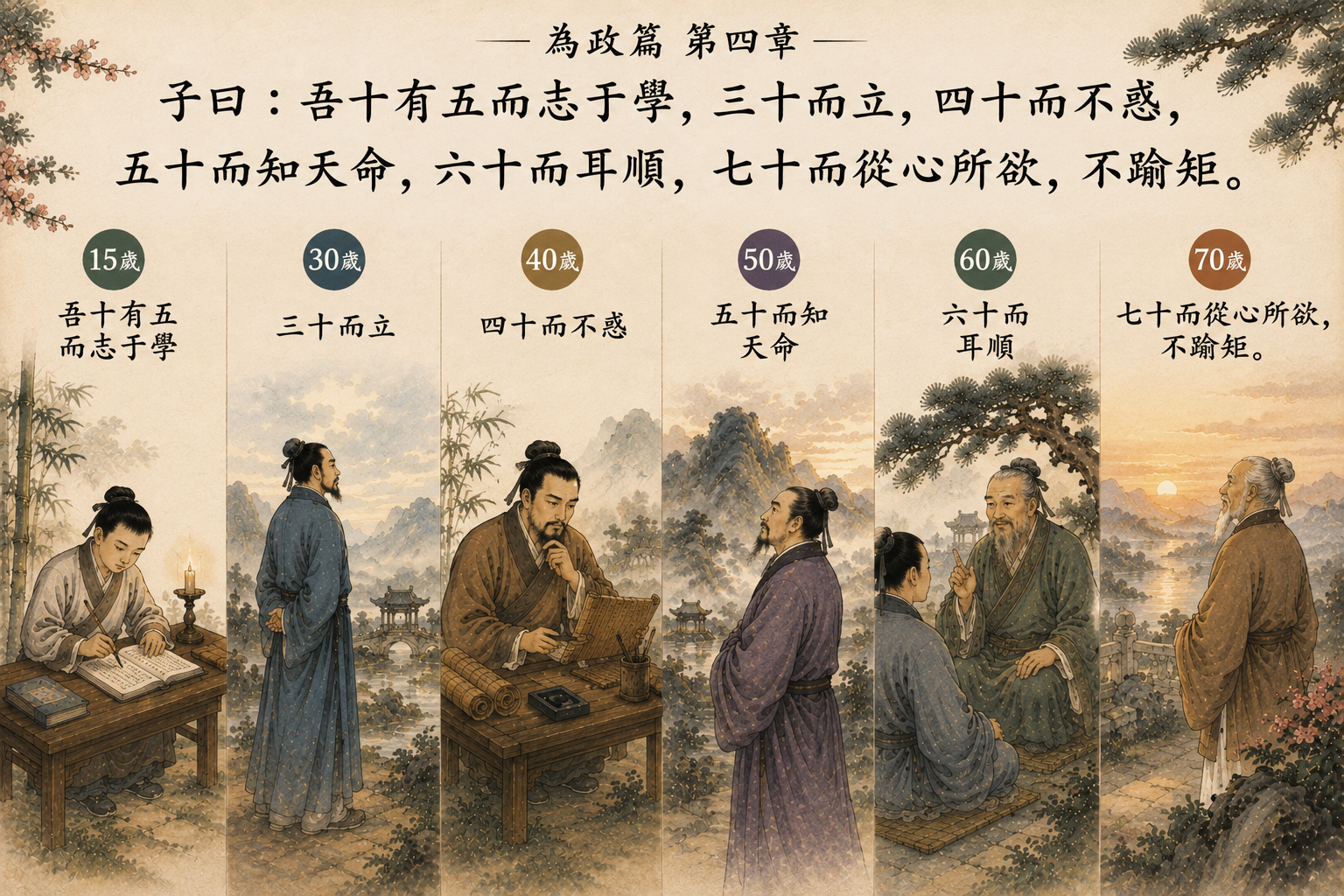
Traditional Chinese
子曰:「吾十有五而志于學,三十而立,四十而不惑,五十而知天命,六十而耳順,七十而從心所欲,不踰矩。」
Simplified Chinese
子曰:“吾十有五而志于学,三十而立,四十而不惑,五十而知天命,六十而耳顺,七十而从心所欲,不逾矩。”
Pinyin
Zǐ yuē: “Wú shí yǒu wǔ ér zhì yú xué, sānshí ér lì, sìshí ér bù huò, wǔshí ér zhī tiānmìng, liùshí ér ěr shùn, qīshí ér cóng xīn suǒ yù, bù yú jǔ.”
Reading the Passage Literally
Confucius said:
“At fifteen, I set my heart on learning. At thirty, I stood firm. At forty, I was no longer perplexed. At fifty, I understood the Mandate of Heaven. At sixty, my ear became receptive. At seventy, I could follow what my heart desired without overstepping the bounds.”
Reading the Grammar
This is one of the best-known autobiographical passages in the Analects. Confucius looks back over his life not by listing offices, achievements, wealth, or public recognition, but by describing how his inner orientation gradually changed through learning and cultivation. Each age marks a different stage, yet the passage is best read not as a rigid timetable that everyone must follow, but as a record of how a life of sustained learning can deepen over time.
1. 吾十有五而志于學
Wú shí yǒu wǔ ér zhì yú xué
吾 (wú) means “I.” 十有五 means “fifteen,” with 有 functioning here in an older numerical construction equivalent to the modern 十五.
The key expression is 志于學 (zhì yú xué). 志 means more than simply “to think about” or “to be interested in.” It refers to setting one’s intention, direction, or aspiration firmly toward something. 于學 means “toward learning” or “upon learning.”
The structure is:
吾 / 十有五 / 而 / 志于學
I / at fifteen / and / set my heart on learning
Thus:
“At fifteen, I set my heart on learning.”
The emphasis is not necessarily that Confucius first began studying at the age of fifteen. Rather, it is that learning became at that stage a conscious direction for his life.
Key Characters and Meanings
吾 (wú, I) · 十 (shí, ten) · 有 (yǒu, used here in a numerical construction) · 五 (wǔ, five) · 而 (ér, and; then) · 志 (zhì, aspiration; to set one’s intention) · 于 (yú, toward; in) · 學 (xué, learning; study)
2. 三十而立
Sānshí ér lì
立 (lì) literally means “to stand,” but here it does not refer to physical standing. Traditional interpretations understand it as reaching a condition in which one’s learning, principles, and direction in life have become established enough that one can stand on one’s own without being easily shaken.
The structure is:
三十 / 而 / 立
at thirty / and / stood firm
A natural interpretive rendering would be:
“At thirty, I had established a firm basis for my life.”
The familiar phrase 三十而立 should therefore not be reduced to the modern idea that by thirty everyone must be financially independent, professionally successful, or socially established. Confucius’s “standing” is more fundamentally about having a stable basis in learning and in one’s principles for living.
Key Characters and Meanings
三 (sān, three) · 十 (shí, ten) · 而 (ér, and; then) · 立 (lì, to stand; to become established)
3. 四十而不惑
Sìshí ér bù huò
惑 (huò) means “to be confused,” “to be perplexed,” or “to be led into uncertainty.” 不惑 therefore means “not to be perplexed” or “no longer to be easily confused.”
The structure is:
四十 / 而 / 不惑
at forty / and / was no longer perplexed
This does not mean that by forty Confucius knew everything or had no remaining questions. A more natural reading is that years of study and practice had given him a sufficiently clear basis for judgment that he was no longer easily thrown into confusion by competing claims or difficult circumstances.
Traditional commentary similarly treats 不惑 as a stage in which understanding has become more settled and the proper direction of things is seen with greater clarity.
Key Characters and Meanings
四 (sì, four) · 十 (shí, ten) · 而 (ér, and; then) · 不 (bù, not) · 惑 (huò, confused; perplexed)
4. 五十而知天命
Wǔshí ér zhī tiānmìng
知 (zhī) means “to know” or “to understand.” 天命 (tiānmìng) literally means “the Mandate of Heaven.”
This expression should not be understood too narrowly as merely accepting a predetermined personal fate. In traditional Confucian thought, Tianming (天命) can refer to a larger order that includes the conditions one has been given, the principles by which the world operates, and the responsibilities one ought to recognize within those conditions.
The structure is:
五十 / 而 / 知 / 天命
at fifty / and / understood / the Mandate of Heaven
Confucius’s statement can therefore be read as describing a stage in which he came to understand that life is not shaped by personal will alone. One begins to recognize both what can be changed and what must be accepted, and within those limits, what one is still called upon to do.
Key Characters and Meanings
五 (wǔ, five) · 十 (shí, ten) · 而 (ér, and; then) · 知 (zhī, to know; to understand) · 天 (tiān, Heaven) · 命 (mìng, mandate; decree; allotted condition)
5. 六十而耳順
Liùshí ér ěr shùn
耳 (ěr) means “ear,” and 順 (shùn) means “to follow,” “to be receptive,” or “to move without resistance.” Literally, 耳順 might be rendered as “the ear became compliant,” but the expression carries a much richer meaning in context.
Traditional interpretations often explain it as a stage in which, upon hearing what others say, one can naturally perceive what is reasonable or unreasonable without becoming unnecessarily disturbed or resistant. In modern terms, we might say that one can listen openly without surrendering discernment.
The structure is:
六十 / 而 / 耳順
at sixty / and / the ear became receptive
Thus the phrase can be understood as:
“At sixty, I could hear others with ease and discernment.”
This is not merely becoming tolerant with age. It suggests a mature ability to receive another person’s words without reacting too quickly, while still being able to judge their meaning clearly.
Key Characters and Meanings
六 (liù, six) · 十 (shí, ten) · 而 (ér, and; then) · 耳 (ěr, ear; hearing) · 順 (shùn, receptive; harmonious; to follow)
6. 七十而從心所欲,不踰矩
Qīshí ér cóng xīn suǒ yù, bù yú jǔ
從 (cóng) means “to follow.” 心所欲 means “what the heart desires,” so 從心所欲 means “to follow what the heart desires.”
If the sentence stopped there, it might sound like complete freedom to do whatever one wants. But the meaning is completed by the next phrase:
不踰矩 (bù yú jǔ).
踰 (yú) means “to cross” or “to overstep.” 矩 (jǔ) originally refers to a carpenter’s square, an instrument used to establish proper angles, but metaphorically it refers to standards, limits, or proper bounds.
The structure is:
七十 / 而 / 從 / 心所欲
at seventy / and / followed / what the heart desired
不 / 踰 / 矩
did not / overstep / the bounds
Thus:
“At seventy, I could follow what my heart desired without overstepping the proper bounds.”
The freedom Confucius describes is therefore not freedom from all standards. It is the result of long cultivation: his desires and the standards he had learned no longer stood in constant conflict. What he naturally wanted had become compatible with what was right.
Key Characters and Meanings
七 (qī, seven) · 十 (shí, ten) · 而 (ér, and; then) · 從 (cóng, to follow) · 心 (xīn, heart; mind) · 所 (suǒ, that which) · 欲 (yù, to desire) · 不 (bù, not) · 踰 (yú, to cross; overstep) · 矩 (jǔ, square; standard; proper bounds)
Understanding the Meaning
This passage has remained memorable for centuries partly because the ages—fifteen, thirty, forty, fifty, sixty, and seventy—form such a clear sequence. Yet the deeper significance lies not in the numbers themselves, but in the way Confucius describes a life gradually transformed by learning.
At fifteen, he chose learning as a direction. At thirty, a basis had been established. At forty, he was less easily confused. At fifty, he came to understand realities larger than his own wishes. At sixty, his relationship with the words and perspectives of others had matured. Only at seventy did desire and moral measure become so deeply integrated that he could follow his heart without crossing the proper bounds.
Read in this way, the passage is not a schedule telling everyone what must be achieved by a certain birthday.
In fact, it suggests almost the opposite.
Confucius himself continued to change into old age. 志學 was not completion. 立 was not completion. Neither were 不惑, 知天命, or 耳順. Each stage opened into another.
What changes is not simply the amount of knowledge one possesses, but the very character of learning. At first, learning requires conscious effort: deciding what is right, resisting impulses, correcting mistakes, and building habits. Over time, if cultivation becomes deeply rooted, what was once an external standard can become part of one’s inner disposition.
The final phrase, 從心所欲,不踰矩, reveals where the entire process is heading.
At first, a person may know the rule but not want to follow it. Discipline is required because desire and principle conflict. But after many years of learning and practice, what is right no longer feels only like something imposed from outside. The heart itself has been shaped.
Confucius’s freedom at seventy is therefore freedom achieved through cultivation.
He does not become free because standards disappear. He becomes free because the standards have been internalized so deeply that following his own heart no longer means violating them.
That is why this chapter, although it appears to be about age, is more fundamentally about how a human being can continue growing across an entire lifetime.
Background and Context
This passage appears in Chapter 4 of Wei Zheng, where Confucius unusually speaks in the first person and summarizes the development of his own life and learning. The sequence moves from fifteen to seventy and associates each age with a distinct stage: 志學, 立, 不惑, 知天命, 耳順, and 從心所欲不踰矩.
In later Chinese cultural tradition, these expressions became so familiar that several of them came to function almost as conventional names for particular ages. 志學 came to evoke fifteen, 而立 thirty, 不惑 forty, 知命 fifty, and 耳順 sixty.
Yet in the original context, the ages are less important than the development they describe.
Traditional interpretations, including those associated with Zhu Xi, read 志學 as setting the mind firmly on learning, 立 as becoming established, 不惑 as reaching greater clarity in judgment, 知天命 as understanding a deeper order beyond immediate circumstances, 耳順 as reaching a mature receptivity to what one hears, and 從心所欲不踰矩 as a final stage in which cultivated understanding and spontaneous desire are no longer opposed.
There is also an interesting connection with the preceding chapter of Wei Zheng. Chapter 3 contrasts people who behave properly because they fear punishment with those who develop a sense of shame and move toward what is right through virtue and Li. Chapter 4 then describes, through Confucius’s own life, what might be seen as the long internalization of standards.
In Chapter 3, the goal is to move beyond external coercion toward an inner moral sense. In Chapter 4, Confucius eventually reaches a state in which even his spontaneous desires no longer exceed proper bounds.
One might therefore see a conceptual movement from 有恥且格—having an inner sense of shame and moving toward what is right—to 從心所欲,不踰矩—following one’s own heart without departing from what is right.
This is only one way of reading the relationship between the two chapters, but it highlights an important feature of the opening of Wei Zheng: a discussion that begins with government continually returns to the inner formation of the person.
Dr. Ryu’s Reflection
This passage feels very different when read in youth and when read again later in life. When we are younger, expressions such as 三十而立 and 四十而不惑 naturally attract attention. They can easily sound like milestones on a life schedule: by thirty, one should be established; by forty, one should no longer be confused. We are accustomed to measuring life by age, so we ask ourselves what we have achieved by thirty, why we are still uncertain at forty, or what direction remains when fifty or sixty approaches, and we often compare our own timetable with that of someone else.
But when I read the passage slowly now, what strikes me more than the achievement attached to any particular age is the fact that Confucius was still changing at seventy.
Setting his heart on learning at fifteen did not complete the journey. Standing firm at thirty did not complete it either. After 不惑 at forty came 知天命 at fifty, then 耳順 at sixty, and finally 從心所欲 at seventy. The very figure later remembered as a sage described his own life not as something perfected by one great realization, but as a process that continued to deepen over decades.
I find something reassuring in that.
The expression that has become especially interesting to me with age is 六十而耳順. When we are younger, we often place great value on the ability to express our own ideas clearly and confidently. But with experience, we may discover that listening well can be even harder than speaking well.
In fact, having more experience can sometimes make listening more difficult. The more we have seen, the easier it becomes to think, “I already know how this works.” We may judge another person’s argument before the person has finished speaking, especially when it challenges something we have believed for a long time.
For that reason, I would like to understand 耳順 as more than simply becoming mild or tolerant in old age. It suggests to me the maturity to possess one’s own experience and judgment while still remaining capable of genuinely hearing another person.
One does not have to agree with everything. The deeper achievement may be the ability to hear without immediately resisting, and then to discern clearly what is worth accepting and what is not.
The final phrase, 從心所欲,不踰矩, is even more striking.
When we are young, freedom often seems to mean being able to do whatever we want. Confucius’s freedom at seventy is quite different. He does not say that he abandoned standards or escaped all restrictions. He says that after decades of learning and cultivation, what his heart naturally desired no longer seriously conflicted with the standards by which he believed he should live.
He was free not because the rules had disappeared, but because the rules no longer stood outside him.
That seems to me a much deeper form of freedom.
This passage also offers a valuable way of thinking about growing older. Aging can certainly be viewed as a process in which some possibilities become narrower. But it can also become a period in which unnecessary uncertainty gradually decreases, one becomes clearer about what matters, and perhaps one learns to listen with greater patience than before.
Of course, age itself does not guarantee any of this.
Perhaps that is precisely why Confucius begins with 吾十有五而志于學. Time alone does not make a person mature. It is time spent learning, reflecting, correcting, and continuing to change that can do so.
For that reason, when I read this chapter now, I would rather ask not, “How old am I?” but:
“At this stage of my life, what am I still learning?”
My timetable does not need to be the same as Confucius’s. Failing to feel fully established at thirty does not mean that life has gone wrong. Remaining uncertain at forty does not mean that one has failed. Beginning something entirely new after sixty is certainly not too late.
What matters is not simply which age we have reached, but whether we are still capable of learning and changing at that age.
If Confucius’s learning began at fifteen and was still deepening at seventy, perhaps there was never a meaningful age at which one could simply say:
“It is too late for me to learn.”
References
- The Analects (論語), Wei Zheng (為政), Chapter 4.
- Zhu Xi (朱熹), traditional interpretations of 志學, 而立, 不惑, 知天命, 耳順, and 從心所欲, including discussions preserved in Zhuzi Yulei (朱子語類), on the Wei Zheng chapter.
- Lunyu Zhushu (論語注疏), Wei Zheng.
- Yang Bojun (楊伯峻), Lunyu Yizhu (論語譯注), Zhonghua Book Company.
- Chinese Text Project, The Analects: Wei Zheng.