Wei Zheng (為政), Chapter 7 | Filial Devotion Is More Than Providing for One’s Parents
Traditional Chinese
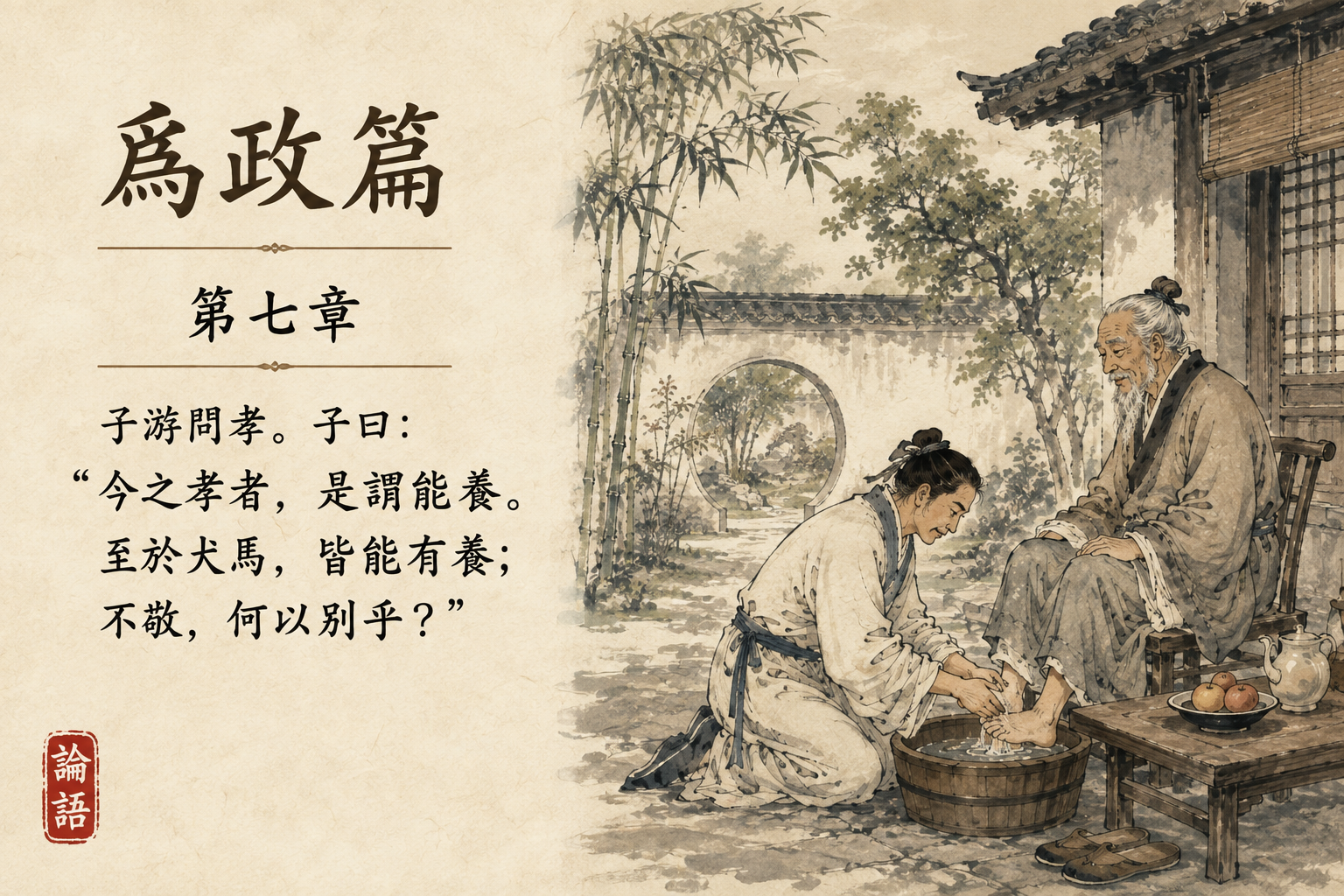
子游問孝。子曰:「今之孝者,是謂能養。至於犬馬,皆能有養;不敬,何以別乎?」
Simplified Chinese
子游问孝。子曰:“今之孝者,是谓能养。至于犬马,皆能有养;不敬,何以别乎?”
Pinyin
Zǐ Yóu wèn xiào. Zǐ yuē: “Jīn zhī xiào zhě, shì wèi néng yǎng. Zhì yú quǎn mǎ, jiē néng yǒu yǎng; bù jìng, hé yǐ bié hū?”
Reading the Passage Literally
Ziyou asked about filial devotion. Confucius said:
“Nowadays, what people call filial devotion is being able to provide for one’s parents. But even dogs and horses are provided for. Without respect, what is there to distinguish the two?”
Reading the Grammar
This passage develops through a sharp contrast between 養 (yǎng), providing material care, and 敬 (jìng), respect or reverence. Confucius does not deny that caring for the practical needs of one’s parents is part of Xiao (孝). His criticism is directed at reducing filial devotion to that alone. The sentence about dogs and horses is intentionally forceful, and traditional commentators have differed over its exact grammatical interpretation, but the concluding question makes the central point unmistakable: without Jing (敬), material provision by itself cannot fully define a human relationship of filial devotion.
1. 子游問孝
Zǐ Yóu wèn xiào
子游 (Ziyou) was one of Confucius’s disciples. His family name was Yan (言) and his personal name Yan (偃). 問 (wèn) means “to ask,” and 孝 (xiào) means filial devotion or filial piety.
The structure is:
子游 / 問 / 孝
Ziyou / asked / about filial devotion
Thus:
“Ziyou asked about filial devotion.”
This is the third consecutive question about Xiao in Wei Zheng. Meng Yizi had been answered in terms of Li (禮), and Meng Wubo through the worry parents feel for their children. When Ziyou asks the same question, Confucius changes the emphasis again, this time drawing a distinction between providing for parents and truly respecting them. The sequence shows that Confucius is not simply repeating a fixed definition of filial devotion, but highlighting a different weakness or misunderstanding in each conversation.
Key Characters and Meanings
子 (zǐ, master; son) · 游 (yóu, to travel; You) · 問 (wèn, to ask) · 孝 (xiào, filial devotion)
2. 今之孝者,是謂能養
Jīn zhī xiào zhě, shì wèi néng yǎng
今 (jīn) means “now” or “nowadays.” 之 (zhī) links 今 with 孝, while 者 (zhě) turns the preceding expression into a topic, giving the sense of “as for what is now called filial devotion.” 謂 (wèi) means “to call” or “to describe as,” and 養 (yǎng) here means not simply “to raise” but to support or provide for one’s parents, especially in terms of food and daily necessities.
The structure is:
今之 / 孝者 / 是謂 / 能養
nowadays / what is called filial devotion / is said to be / being able to provide
Thus:
“Nowadays, what people call filial devotion is being able to provide for one’s parents.”
Confucius is not dismissing material care. Parents need food, shelter, and practical support, and providing those things is clearly important. His concern is that people may mistake this visible form of care for the whole of filial devotion. The sentence therefore begins as an observation about a common understanding of Xiao, but already prepares the criticism that follows.
Key Characters and Meanings
今 (jīn, now; nowadays) · 之 (zhī, linking particle) · 孝 (xiào, filial devotion) · 者 (zhě, one who; that which) · 是 (shì, this; thus) · 謂 (wèi, to call; to say) · 能 (néng, to be able) · 養 (yǎng, to support; to nourish; to provide for)
3. 至於犬馬,皆能有養
Zhì yú quǎn mǎ, jiē néng yǒu yǎng
至於 (zhì yú) means “as for,” “even as far as,” or “when it comes to.” 犬馬 (quǎn mǎ) means “dogs and horses,” 皆 (jiē) means “all” or “both,” and 養 (yǎng) again carries the sense of feeding, maintaining, or providing for.
The structure is:
至於 / 犬馬 / 皆 / 能有養
even as for / dogs and horses / both / have provision or care
A representative rendering is:
“But even dogs and horses are provided for.”
This line has long been interpreted in more than one way. One traditional reading understands dogs and horses as themselves serving human beings—the dog guarding the home and the horse carrying burdens—and therefore as being capable, in some sense, of “providing.” Another reading, emphasized by Zhu Xi, understands the sentence as saying that human beings also feed and maintain dogs and horses, so merely feeding one’s parents cannot by itself distinguish filial care from the maintenance of animals.
The precise grammatical route differs between these interpretations, but both lead toward the same conclusion in the following sentence: material provision without respect is insufficient. The force of the comparison lies not in degrading parents, but in exposing the inadequacy of defining a human relationship solely in terms of feeding and maintenance.
Key Characters and Meanings
至 (zhì, to arrive; to reach) · 於 (yú, at; to; as for) · 犬 (quǎn, dog) · 馬 (mǎ, horse) · 皆 (jiē, all; both) · 能 (néng, to be able) · 有 (yǒu, to have) · 養 (yǎng, nourishment; provision; support)
4. 不敬,何以別乎
Bù jìng, hé yǐ bié hū
This is the decisive sentence of the passage. 敬 (jìng) means “respect,” “reverence,” or “to treat with seriousness and regard.” 不敬 therefore means “without respect” or “if there is no respect.” 何以 (hé yǐ) literally means “by what” or “by what means,” 別 (bié) means “to distinguish,” and 乎 (hū) marks the rhetorical question.
The structure is:
不敬 / 何以 / 別 / 乎
without respect / by what / distinguish / ?
Thus:
“Without respect, what is there to distinguish the two?”
The entire passage turns on this question. Providing food and practical support may be necessary, but if the parents themselves are treated without respect—if they are spoken to carelessly, dismissed, or regarded merely as dependents—then Confucius asks what makes that care genuinely filial. Jing is therefore the element that transforms material support from mere maintenance into a properly human relationship.
Key Characters and Meanings
不 (bù, not; without) · 敬 (jìng, respect; reverence) · 何 (hé, what) · 以 (yǐ, by; with) · 別 (bié, to distinguish) · 乎 (hū, interrogative particle)
Understanding the Meaning
Confucius begins this chapter by identifying a common understanding of filial devotion: people believe that being able to provide for their parents is enough. The word 養 points to something practical and necessary—food, material support, and care for daily life. Confucius does not reject any of this. What he challenges is the assumption that once those needs are met, Xiao (孝) has been fully achieved.
That is why the comparison with dogs and horses is deliberately uncomfortable. Traditional commentators have offered different explanations of the precise sentence structure, but the rhetorical purpose becomes clear in the final question: 「不敬,何以別乎?」— “Without respect, what is there to distinguish the two?” Feeding, supporting, and maintaining can occur in relationships that do not involve moral regard. What makes filial care distinctly human is not simply the act of provision, but the attitude toward the person receiving it.
The central word is therefore Jing (敬). It can be translated as respect, reverence, or serious regard, but none of these English words captures it perfectly. In this passage, Jing points to the way a son or daughter sees and treats a parent: not merely as someone whose needs must be managed, but as a person whose dignity, feelings, experience, and place in the relationship continue to deserve recognition.
This distinction remains important because practical care can sometimes hide a lack of respect. A person may pay every bill, arrange medical appointments, provide food, and make sure that nothing material is lacking while at the same time speaking impatiently, disregarding the parent’s wishes, or treating the parent as though age has erased his or her judgment and dignity. Confucius’s question asks whether that can really be called complete filial devotion.
The passage therefore does not oppose care and respect. It brings them together. Yang (養) without Jing (敬) is incomplete, while genuine filial devotion requires that practical care be accompanied by a way of relating to parents that preserves their human dignity.
Read alongside the preceding chapters, another pattern becomes visible. Chapter 5 speaks of Li (禮), Chapter 6 of understanding parental concern, and Chapter 7 now adds Jing. Xiao is gradually revealed not as a single action but as a relationship shaped by proper conduct, concern, and respect.
Background and Context
Ziyou (子游), whose family name was Yan (言) and personal name Yan (偃), was one of Confucius’s disciples. Traditional accounts identify him as a native of Wu and describe him as younger than Confucius. In the commentary tradition, this chapter is commonly understood as teaching that filial devotion requires more than simply providing food and material support: respect must accompany care.
The phrase 至於犬馬,皆能有養 has generated particular discussion because of its compressed Classical Chinese form. One traditional interpretation takes dogs and horses as animals that themselves perform useful service for human beings—the dog guarding the household and the horse carrying people or burdens. Another interpretation understands the sentence from the opposite direction: human beings also feed and maintain dogs and horses, and therefore feeding one’s parents without respect cannot be the defining mark of filial devotion. The Lunyu Zhushu preserves discussion of different readings, while Zhu Xi’s interpretation strongly emphasizes the latter comparison between providing for parents and feeding animals.
Despite the grammatical difference, the ethical conclusion is essentially the same. Confucius is not suggesting that parents and animals are morally equivalent. The comparison is intentionally provocative because it exposes the weakness of reducing Xiao to the provision of necessities. If food and material maintenance are the only criteria, something essential to a human relationship has disappeared.
This passage also becomes clearer when read as part of the continuing sequence on filial devotion in Wei Zheng. Meng Yizi is reminded of Li, Meng Wubo of parental concern, and Ziyou of Jing. Traditional commentators have often explained these different answers by pointing to Confucius’s tendency to teach according to the needs of the particular person or according to a misunderstanding that required correction. The differences therefore need not be treated as competing definitions. Instead, the passages build on one another, revealing several dimensions of Xiao.
The sequence will continue in the next chapter, where Zixia asks about filial devotion and Confucius emphasizes the difficulty of maintaining the right expression and attitude. By reading Chapters 5 through 8 together, filial devotion emerges as a complex ethical relationship involving Li, awareness of parental concern, Jing, and the manner in which respect is expressed in everyday behavior.
Dr. Ryu’s Reflection
When I was younger, the idea of being good to one’s parents often brought to mind something visible and practical. One might take them to a good restaurant, buy what they need, help them financially when one is able, or make sure that they are comfortable as they grow older. These things matter, especially when parents reach an age at which daily life becomes more difficult and practical help becomes increasingly necessary. Providing for them is certainly one important part of a child’s responsibility.
But Confucius does not stop with provision.
His question is sharp: 「不敬,何以別乎?」 — “Without respect, what is there to distinguish the two?”
It is possible to provide almost everything a parent needs while still failing to treat that parent with respect. A son or daughter may pay the bills, arrange medical care, prepare meals, and handle every practical matter, yet at the same time become impatient whenever the parent speaks, dismiss opinions as outdated, or behave as though providing financial or physical care gives the child the right to decide everything. From the outside, such care may look complete. Inside the relationship, however, something essential may be missing.
As I grow older, I also see this question from the other side. Parents naturally want to be respected by their children, but respect should not be confused with unconditional obedience. Growing older does not mean that every parental opinion must become a rule for an adult child’s life. If Jing is understood simply as submission, both generations can become trapped in expectations that make the relationship more difficult rather than more humane.
For me, respect within a modern family may be closer to treating the other person as a person in his or her own right. Parents need to recognize that their adult children have lives, responsibilities, and decisions of their own, while children need to recognize that aging parents remain people with their own history, feelings, preferences, and dignity. Even when opinions differ, the way we speak, listen, and respond can show whether the other person is still being taken seriously.
This becomes especially important as parents age, because children can gradually begin to see them mainly as people who need to be managed. There are medications to check, hospital appointments to arrange, meals to consider, finances to organize, and questions about safety that may require increasing attention. All of these are real and necessary concerns. Yet the more care a person requires, the easier it may become to forget that needing care does not erase the need to be respected.
A parent who can no longer do everything independently is still more than a list of needs. There may still be opinions to hear, preferences to consider, memories to respect, and choices that should remain his or hers whenever possible. The practical work of caring can become so demanding that efficiency begins to dominate the relationship, and it is precisely then that Confucius’s distinction between Yang and Jing seems especially important.
Perhaps that is why this chapter feels more demanding than it first appears. It is relatively easy to measure material support. We can count how much money we gave, how often we visited, how many appointments we arranged, or how many things we bought. Respect is much harder to measure because it appears in smaller places: the expression on our face, the tone of our voice, the patience with which we listen, and the willingness to treat someone as a person rather than merely as a responsibility.
When I read this passage now, the question it leaves with me is therefore not simply whether I am caring for the people close to me.
It is something more difficult:
Am I caring for them while still respecting who they are?
References
- The Analects (論語), Wei Zheng (為政), Chapter 7.
- Zhu Xi (朱熹), Sishu Zhangju Jizhu (四書章句集注), Lunyu Jizhu (論語集注), Wei Zheng.
- He Yan (何晏), commentary, and Xing Bing (邢昺), subcommentary, Lunyu Zhushu (論語注疏), Wei Zheng.
- Huang Kan (皇侃), Lunyu Jijie Yishu (論語集解義疏), Book 1.
- Chinese Text Project, The Analects: Wei Zheng.