Wei Zheng (為政), Chapter 9 | Yan Hui Seemed Foolish, but He Was Not
Traditional Chinese
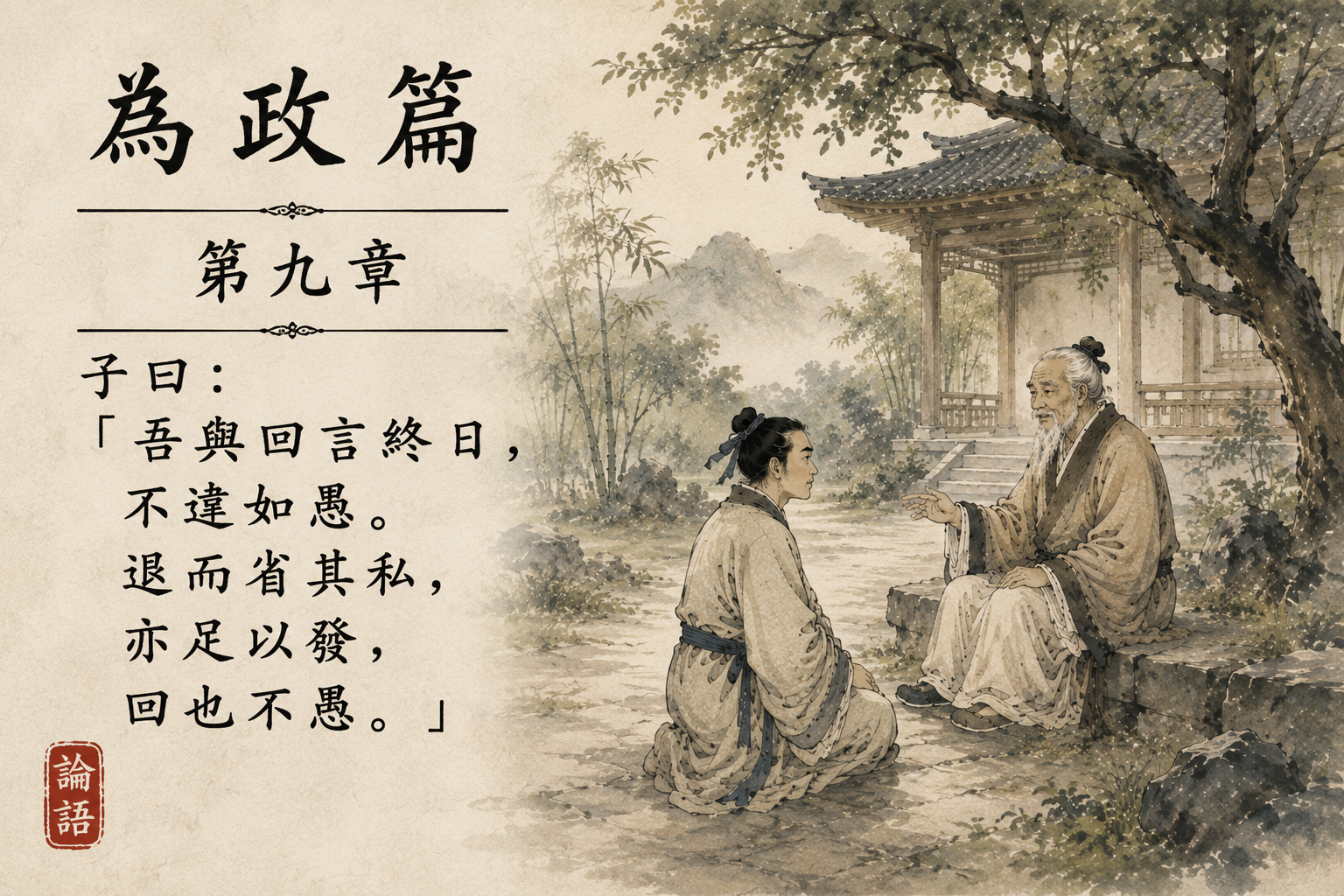
子曰:「吾與回言終日,不違如愚。退而省其私,亦足以發,回也不愚。」
Simplified Chinese
子曰:“吾与回言终日,不违如愚。退而省其私,亦足以发,回也不愚。”
Pinyin
Zǐ yuē: “Wú yǔ Huí yán zhōngrì, bù wéi rú yú. Tuì ér xǐng qí sī, yì zú yǐ fā, Huí yě bù yú.”
Reading the Passage Literally
Confucius said:
“I would speak with Hui all day, and he never went against what I said, as though he were foolish. But after he withdrew, I observed how he conducted himself in private, and he was fully able to bring out what I had taught. Hui was not foolish.”
Reading the Grammar
This passage is built around a contrast between appearance and reality. During his conversations with Confucius, Yan Hui appears almost too quiet: he does not argue, object, or visibly display his understanding, and for that reason he can seem 如愚, “as though foolish.” Yet Confucius does not stop with what Hui looks like during instruction. He observes what happens afterward and discovers that the teaching has taken form in Hui’s actual conduct. The final 不愚 therefore overturns the earlier 如愚 and gives the passage its clear structure.
1. 吾與回言終日
Wú yǔ Huí yán zhōngrì
吾 (wú) means “I.” 與 (yǔ) here means “with,” 回 (Huí) refers to Yan Hui (顔回), one of Confucius’s most highly regarded disciples, 言 (yán) means “to speak” or “to talk,” and 終日 (zhōngrì) means “all day.”
The structure is:
吾 / 與回 / 言 / 終日
I / with Hui / speak / all day
Thus:
“I would speak with Hui all day.”
The phrase establishes the setting for Confucius’s judgment. The point is not merely that the conversation lasted a long time, but that even after extended teaching and discussion, Hui gave very little outward sign of disagreement, questioning, or intellectual display.
Key Characters and Meanings
吾 (wú, I) · 與 (yǔ, with) · 回 (Huí, Hui) · 言 (yán, to speak; words) · 終 (zhōng, to end; whole) · 日 (rì, day)
2. 不違如愚
Bù wéi rú yú
違 (wéi) means “to go against,” “to differ from,” or “to oppose,” so 不違 means “not to go against.” 如 (rú) means “like” or “as if,” and 愚 (yú) means “foolish” or “dull.”
The structure is:
不違 / 如 / 愚
did not go against / like / a fool
Thus:
“He never went against what I said, as though he were foolish.”
This does not necessarily mean that Yan Hui obeyed Confucius mechanically or lacked independent thought. Traditional commentary understands the phrase as describing his outward manner while listening: he did not interrupt, argue, or display his understanding through constant questions and responses. Because he seemed simply to receive what was said, he could momentarily give the impression that he had little to contribute.
The phrase 如愚 is therefore about appearance rather than final judgment. Confucius immediately proceeds to examine evidence beyond Hui’s behavior during instruction.
Key Characters and Meanings
不 (bù, not) · 違 (wéi, to oppose; to go against) · 如 (rú, like; as though) · 愚 (yú, foolish; dull)
3. 退而省其私
Tuì ér xǐng qí sī
退 (tuì) means “to withdraw” or “to leave,” and 而 (ér) connects the sequence of actions. 省 (xǐng) here means “to examine,” “to observe carefully,” or “to reflect upon.” 其 (qí) refers to Yan Hui, while 私 (sī) is traditionally understood as his conduct away from the formal setting of instruction—his private life, personal behavior, and the way he acted after leaving Confucius.
The structure is:
退 / 而 / 省 / 其私
after he withdrew / then / I examined / his private conduct
Thus:
“But after he withdrew, I observed how he conducted himself in private.”
This clause changes the direction of the passage. Confucius does not evaluate his disciple only by how actively he speaks in front of the teacher. He looks beyond the learning situation and asks what happens after the lesson is over. The important question becomes not how Hui appears while listening, but how the teaching is embodied when he returns to ordinary life.
Key Characters and Meanings
退 (tuì, to withdraw; to leave) · 而 (ér, and; then) · 省 (xǐng, to examine; to observe) · 其 (qí, his) · 私 (sī, private; personal conduct)
4. 亦足以發
Yì zú yǐ fā
亦 (yì) means “also” or “indeed,” while 足以 (zú yǐ) means “sufficient to” or “fully capable of.” 發 (fā) can mean “to bring forth,” “to reveal,” or “to develop.”
The structure is:
亦 / 足以 / 發
indeed / sufficiently able to / bring forth
Thus:
“He was fully able to bring out what I had taught.”
Traditional commentators understand 發 here as the ability to bring Confucius’s teaching to light through one’s own conduct. Hui does not demonstrate understanding by immediately explaining the lesson back to the teacher. Instead, what he has learned becomes visible in the way he lives and acts after leaving.
The contrast is important. During the conversation, Hui appears passive; afterward, his life shows that the teaching has been actively understood and absorbed. His silence is therefore not emptiness but a different mode of learning.
Key Characters and Meanings
亦 (yì, also; indeed) · 足 (zú, sufficient) · 以 (yǐ, to; enough to) · 發 (fā, to bring forth; to reveal)
5. 回也不愚
Huí yě bù yú
回 (Huí) refers again to Yan Hui. 也 (yě) gives the statement a firm concluding tone, while 不愚 (bù yú) means “not foolish.”
The structure is:
回 / 也 / 不愚
Hui / indeed / is not foolish
Thus:
“Hui was not foolish.”
The final words deliberately answer the earlier 如愚. Hui had appeared foolish, but observation of his conduct revealed something different. Confucius’s conclusion is therefore not based on verbal performance or quick responsiveness, but on whether learning has actually taken root.
The chapter’s movement can be summarized as:
如愚 → 省其私 → 足以發 → 不愚
seemed foolish → his private conduct was observed → the teaching was revealed in practice → he was not foolish
Key Characters and Meanings
回 (Huí, Hui) · 也 (yě, final particle) · 不 (bù, not) · 愚 (yú, foolish)
Understanding the Meaning
This passage begins with a familiar problem in learning: outward responsiveness can easily be mistaken for understanding. A student who asks many questions, answers quickly, and expresses opinions confidently often appears engaged and intelligent, while someone who listens quietly and rarely interrupts may seem passive or uncertain. Confucius himself admits that Yan Hui’s silence could make him appear 如愚, “as though foolish.”
What makes the passage interesting is that Confucius does not allow that first impression to become his final judgment. He looks at what happens after the conversation ends. When Hui leaves, his behavior shows that the teaching has not merely passed through his ears. He has understood it deeply enough for it to influence the way he lives.
The contrast therefore lies not simply between speaking and silence, but between displaying understanding and embodying understanding. Verbal explanation can be valuable, and questioning can certainly be part of serious learning. Yet neither is the only evidence that learning has occurred. A person may speak little and still understand deeply, while another may speak fluently without allowing what has been learned to change anything important.
This is why 亦足以發 is so important. Hui is able to “bring forth” or “reveal” the teaching, not mainly through repetition but through practice. What Confucius has said becomes visible in Hui’s life.
The chapter therefore presents learning as more than the acquisition of words or ideas. Its deeper test lies in whether what has been heard is absorbed, interpreted, and eventually expressed through conduct.
It also presents a lesson about judgment. Confucius initially sees something that looks like foolishness, but he continues observing and allows further evidence to revise his impression. The passage therefore asks us not only how we learn, but also how carefully we look at other people before deciding what they understand or who they are.
A quiet person may not be empty, and a person who does not display understanding immediately may still be learning very deeply.
Sometimes the clearest evidence of understanding appears not in what a person says, but in how that person lives afterward.
Background and Context
Yan Hui (顔回), also known by his courtesy name Ziyuan (子淵) and frequently referred to as Yan Yuan (顔淵), was one of Confucius’s most highly praised disciples. Throughout the Analects, Confucius repeatedly presents him as an exceptional learner and as a person of unusual moral seriousness. His early death is also treated elsewhere in the text as a profound personal loss for Confucius.
Traditional commentary reads 不違 in this chapter not as mindless obedience but as Hui’s failure to show outward contradiction or resistance while receiving instruction. Because he did not continually question or debate, his manner could appear dull. Yet when Confucius examined 其私, Hui’s behavior outside the immediate teaching situation, he found that what had been taught was clearly being realized in practice.
The word 發 is especially important in this interpretation. Rather than merely “starting” something, it points to the way the meaning of Confucius’s teaching becomes disclosed through Hui’s actions. Hui listens quietly, internalizes what he hears, and then gives it expression through his life.
This style of learning is sometimes associated in later interpretation with the idea of 默識, silently apprehending and retaining what has been learned. The emphasis is not on silence for its own sake, but on a form of understanding that does not depend on immediate verbal display.
The placement of this chapter within Wei Zheng is also suggestive. Chapters 5 through 8 formed a sequence of discussions about filial devotion. Chapter 9 now shifts the focus toward learning and the evaluation of persons.
The following chapter continues this movement by explaining how to understand a person through careful observation: 視其所以,觀其所由,察其所安—look at what a person does, observe the path he follows, and examine where he finds ease.
For that reason, Chapters 9 and 10 can be read together in an interesting way. In Chapter 9, Confucius refuses to judge Yan Hui simply by his quiet behavior during conversation and instead observes what he does afterward. In Chapter 10, he develops a broader principle of looking carefully at several dimensions of a person’s conduct.
Both passages suggest that a human being cannot be understood adequately from one visible trait or one immediate impression.
Dr. Ryu’s Reflection
This passage makes me think about how easily we judge understanding by the amount of visible reaction a person gives us. Someone who asks many questions, speaks confidently, and responds quickly often seems interested and capable, while a person who listens quietly without saying very much can leave us wondering whether anything has really been understood. In classrooms, meetings, and organizations, the people who express themselves clearly are naturally easier to notice.
What interests me is that even Confucius admits that Yan Hui could appear 如愚, as though foolish. Hui listened for a long time without contradicting him, asking a stream of questions, or making a visible display of his own understanding. From the outside, there was very little evidence to work with.
But Confucius did something important: he did not stop at the first impression. He watched what happened after Hui left.
That part of the passage reminds me of people I have met over the years. When teaching students, the students who spoke often and asked many questions were naturally memorable. In meetings or organizations, people who could articulate their ideas quickly also tended to make a strong impression. Yet after working with people for a longer period, the first impression did not always turn out to be the most reliable one. Some people spoke very little, but once they understood something, they absorbed it carefully, did the work accurately, and eventually showed through their results that they had understood far more than their silence had suggested.
Such people are sometimes difficult to recognize at first.
We often treat understanding well and expressing oneself well as though they were the same ability. They are not. Some people understand deeply but need time before speaking. Others are naturally skilled at explaining themselves but do not always carry their words into action. Of course, speaking clearly and asking good questions are valuable abilities. The danger comes only when we use them as the sole measure of thought, seriousness, or understanding.
That issue may be even more relevant today, when people are often expected to respond quickly and make themselves visible. We live in environments where opinions are posted immediately, ideas are presented rapidly, and confidence itself can sometimes be mistaken for depth. In such a setting, Yan Hui’s way of learning can seem almost unfamiliar. He does not rush to display what he knows. He listens, absorbs, and then allows the result to appear later in his conduct.
What I also find important in this chapter is Confucius’s own willingness to revise his judgment. Experience can certainly help us recognize patterns in people, but as we grow older, there may also be a danger in believing that experience allows us to understand someone too quickly. After a few sentences, a facial expression, or a short meeting, we may feel that we already know what kind of person someone is. Sometimes we may be right, but experience can become a shortcut that closes observation too early.
Confucius did not allow his first impression of Hui to become permanent. He looked again.
That may be one of the quiet lessons of this chapter. We can give a quieter person more time, remain open to the possibility that someone may be different from our first impression, and pay attention not only to what people say but also to what they repeatedly do.
The most important evidence often emerges gradually.
A person’s depth may sometimes be revealed less by how much he says than by what becomes visible in the way he lives after he has listened.
References
- The Analects (論語), Wei Zheng (為政), Chapter 9.
- Zhu Xi (朱熹), Sishu Zhangju Jizhu (四書章句集注), Lunyu Jizhu (論語集注), Wei Zheng.
- He Yan (何晏), commentary, and Xing Bing (邢昺), subcommentary, Lunyu Zhushu (論語注疏), Wei Zheng.
- Yang Bojun (楊伯峻), Lunyu Yizhu (論語譯注), Zhonghua Book Company.
- Chinese Text Project, The Analects: Wei Zheng.