Wei Zheng (為政), Chapter 12 | The Junzi (君子) Is Not Confined to a Single Use
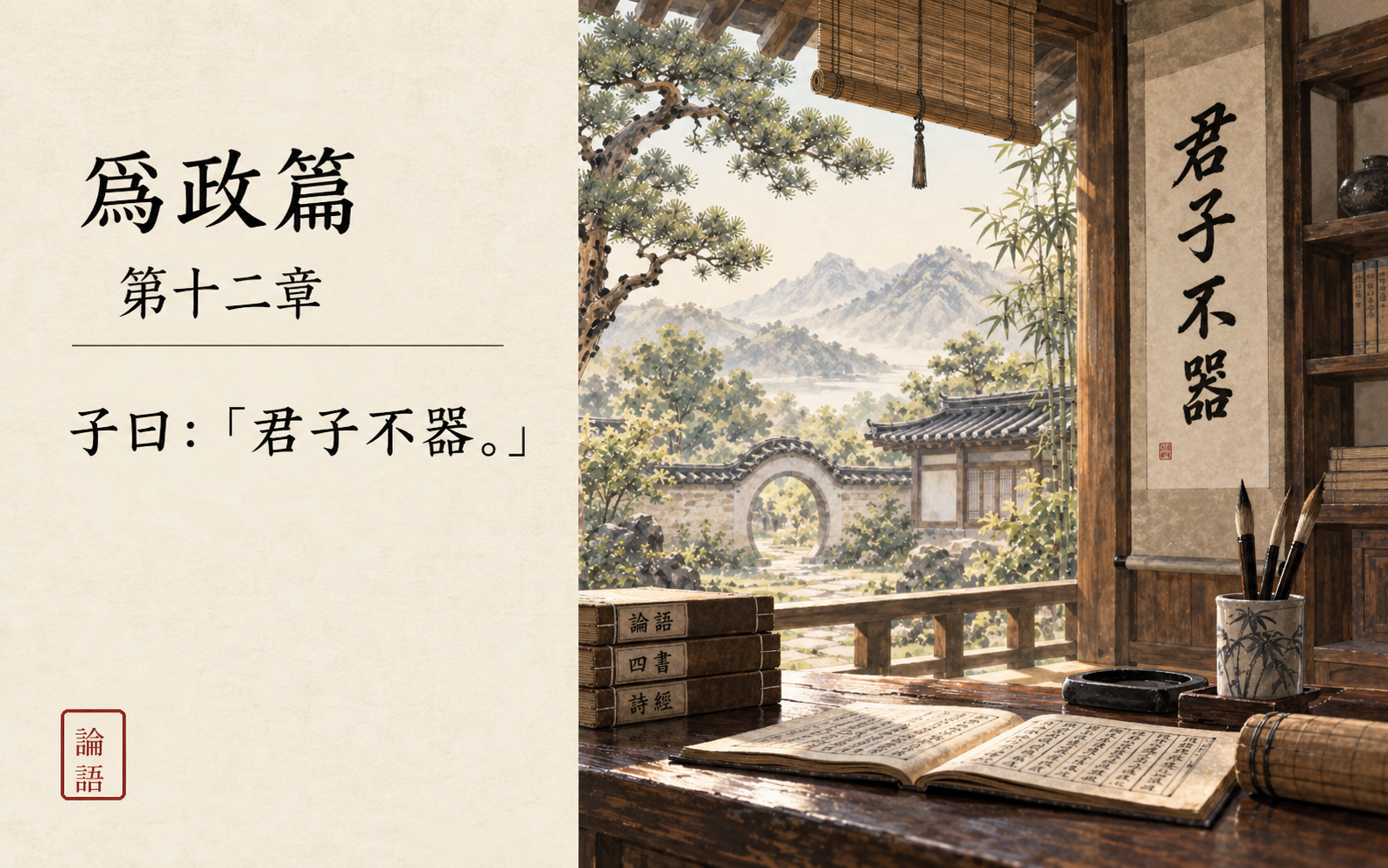
Traditional Chinese
子曰:「君子不器。」
Simplified Chinese
子曰:“君子不器。”
Pinyin
Zǐ yuē: “Jūnzǐ bù qì.”
Reading the Passage Literally
Confucius said:
“The Junzi (君子) is not a vessel.”
Reading the Grammar
Few passages in the Analects are as short as 君子不器, yet each of its four characters carries considerable weight. The key lies in understanding the metaphor of 器 (qì). Confucius is not criticizing physical vessels or practical skills. A vessel is useful precisely because it has a particular function, but that same specialization also limits it: one vessel is suited to one purpose and another to something else. By saying that the Junzi is “not a vessel,” Confucius presents the cultivated person as someone who should not be confined to one fixed use or function.
1. 君子不器
Jūnzǐ bù qì
君子 (Junzi) is one of the central ethical terms of the Analects. Although the word originally had associations with social status, in Confucius’s teaching it increasingly refers to a person who develops moral character through learning, reflection, and self-cultivation. It is often translated as “gentleman,” “noble person,” or “exemplary person,” but none of these expressions captures the concept completely. 不 (bù) means “not,” while 器 (qì) literally means a vessel, implement, utensil, or tool designed for a particular use.
The structure is:
君子 / 不 / 器
the Junzi / is not / a vessel
Thus:
“The Junzi is not a vessel.”
The metaphor depends on the nature of a vessel. A cup is made to hold liquid, a cooking pot has another function, and a particular tool is designed to perform a particular task. Each may perform its function extremely well, yet its usefulness remains defined by that function.
Traditional commentary emphasizes precisely this limitation. The Lunyu Zhushu illustrates the idea by noting that different implements are each suited to their particular uses: a boat serves on water and a carriage on land, but one cannot simply perform the function of the other. Zhu Xi similarly explains that vessels are each suited to their own use but cannot extend freely across different uses.
The Junzi, by contrast, should not be confined to one narrow function. This does not mean that a cultivated person must possess every skill or reject specialization. The point is that a human being should not be reduced to one technical ability, office, profession, or practical use. Moral judgment and cultivated understanding allow a person to respond appropriately to different circumstances rather than merely performing one predetermined function.
Key Characters and Meanings
君 (jūn, ruler; noble) · 子 (zǐ, person; master; son) · 不 (bù, not) · 器 (qì, vessel; implement; tool)
Understanding the Meaning
君子不器.
The sentence contains only four characters, but it offers a compact image of what Confucius expects from a cultivated human being. A vessel has a defined purpose. Its value lies in performing that purpose well, but the same feature also gives it a limit. A vessel designed for one use cannot automatically serve every other use.
Confucius says that the Junzi should not be confined in this way. The point is not that specialization is undesirable or that a person should try to become equally capable of everything. Technical skill, professional expertise, and disciplined mastery all have value. What Confucius challenges is the idea that a human being can be completely defined by one function.
Someone may possess outstanding technical ability, yet still need judgment about when and why that ability should be used. A person may perform one professional role extremely well, yet encounter circumstances in which that role alone cannot provide an adequate response. Human situations involve changing conditions, relationships, competing responsibilities, and moral choices that cannot always be handled by one fixed technique.
In this sense, the Junzi is not merely a highly efficient instrument. The cultivated person must be capable of seeing beyond a single assigned role, understanding the larger situation, and asking what is appropriate. A tool performs the task for which it was designed; a person must sometimes ask whether the task itself should be performed, whether the usual method still fits the circumstances, and whether a different response is required.
This is why 君子不器 should not simply be translated into the modern advice “be versatile.” Versatility may be useful, but Confucius’s concern goes deeper. The Junzi possesses skills and roles but is not imprisoned by any one of them. What gives the cultivated person breadth is not the number of abilities possessed, but the judgment and character that allow those abilities to be used appropriately.
The Junzi has particular abilities, but is not confined to a single use.
Background and Context
This saying appears in Wei Zheng, Chapter 12, in the extremely compact form 子曰:「君子不器。」 Traditional commentators generally explain the passage through the contrast between the fixed usefulness of an implement and the broader capacity of the Junzi.
The Lunyu Zhushu describes the chapter as clarifying the character or virtue of the Junzi. Ordinary implements each possess a particular use. A boat is suited to crossing water, while a carriage is suited to traveling on land. Each can be excellent within its proper function, but its usefulness remains limited by that function. The Junzi should not be restricted in the same way.
Zhu Xi develops a similar interpretation, describing a vessel as something that “is each suited to its own use but cannot extend across other uses”—各適其用而不能相通. A person whose virtue has been cultivated more fully should possess a broader capacity and should not remain confined to a single talent or practical function.
This traditional background is important because the modern contrast between a “specialist” and a “generalist” can easily distort the passage. Confucius is not simply arguing that generalists are better than specialists. Nor does 君子不器 mean that expertise should be avoided. The metaphor concerns the difference between an object whose function is predetermined and a cultivated human being who can exercise judgment when circumstances change.
The preceding chapter, 溫故而知新,可以為師矣, also offers an interesting point of comparison. There, the person worthy of becoming a teacher is someone who can revisit what has already been learned and derive fresh understanding from it. Here, the Junzi is someone who cannot be confined to one fixed use. It would be too strong to claim that the two sayings were deliberately arranged as a single argument, but together they can be read as presenting learning as something that enlarges rather than narrows a person’s capacity for understanding and action.
The next chapter continues the theme of the Junzi from another direction. When Zigong asks about the Junzi, Confucius emphasizes acting first and allowing words to follow what has already been done. Chapters 12 and 13 therefore gradually give the concept greater substance. The Junzi is not merely a person with one useful ability or a particular social role, but someone whose character, judgment, and conduct allow a wider range of appropriate responses.
Dr. Ryu’s Reflection
君子不器.
When I first encounter this sentence, there is something slightly puzzling about it. Why should Confucius say that the Junzi is not a vessel? A vessel performs its function faithfully. A cup that holds water well is a good cup, and a tool that performs the job for which it was made is a good tool. Being well suited to a particular purpose does not seem like a weakness. But human life becomes different when we begin to define ourselves in the same way.
Throughout much of our lives, we explain who we are through particular roles. We say what we studied, what profession we entered, what position we hold, what qualifications we possess, and what kind of work we have done for many years. These descriptions are useful, and developing real expertise in one field requires time, discipline, and commitment. There is nothing wrong with becoming good at something.
Yet after many years, there can be a subtle danger: what we have done can begin to feel identical with who we are. “I am this kind of professional.” “This is what I have always done.” “This is my field, so other things are not for me.” Such sentences can provide confidence while a familiar role continues, but life does not always preserve that role. A career changes, an organization disappears, retirement comes, technology transforms a profession, or circumstances require us to do something we had never imagined doing before.
That is one reason 君子不器 sounds different to me in the later part of life.
When we are young, becoming good at one particular function may seem almost necessary. We need to learn a field, build expertise, establish a career, and find a place where our abilities can be useful. Specialization allows us to enter society and contribute something concrete. But a long life eventually asks questions that specialization alone cannot answer.
The skills that once defined us may become less relevant. We may need to learn unfamiliar technologies, work with people from different generations, enter new fields, or take on roles for which our earlier education did not directly prepare us. At such moments, a fixed definition of ourselves can become more limiting than helpful.
I do not take Confucius’s words to mean that we should abandon expertise or try to become capable of everything. What matters to me is something different: expertise should remain something I possess, not something that confines the whole of who I am.
Years of experience in one field can help us understand another problem. A professional habit can be reconsidered when circumstances change. What we learned in the past can become a foundation for learning something very different. Most importantly, we need enough judgment to ask not only, “Can I do this?” but also, “Should this be done, and what is the right way to use what I know here?”
That distinction becomes increasingly meaningful when thinking about the second half of life. Earlier in life, we may devote much of our energy to becoming something identifiable: an engineer, professor, administrator, businessperson, specialist, or professional of one kind or another. Later, we may discover that life is asking us to become more than the title we spent decades building.
A role can end without the person ending. A profession can change without making the experience accumulated within it worthless. The question is whether we can carry what we have learned into a new situation without insisting that the new situation fit the old role exactly.
Perhaps that is one modern way I can understand 不器. The cultivated person is not without skills or functions. Rather, no single skill or function completely determines the limits of what that person can become.
When I was younger, the important question may have been:
“What particular role should I become capable of fulfilling?”
Now another question may be equally important:
“What role have I lived within until now, and what might become possible if I no longer allow that one role to define the whole of me?”
References
- The Analects (論語), Wei Zheng (為政), Chapter 12.
- Zhu Xi (朱熹), Sishu Zhangju Jizhu (四書章句集注), Lunyu Jizhu (論語集注), Wei Zheng.
- He Yan (何晏), commentary, and Xing Bing (邢昺), subcommentary, Lunyu Zhushu (論語注疏), Wei Zheng.
- Chinese Text Project, The Analects: Wei Zheng.