Xue Er (學而), Chapter 2| Are Filial Devotion and Respect the Root of Ren (仁) ?
Traditional Chinese
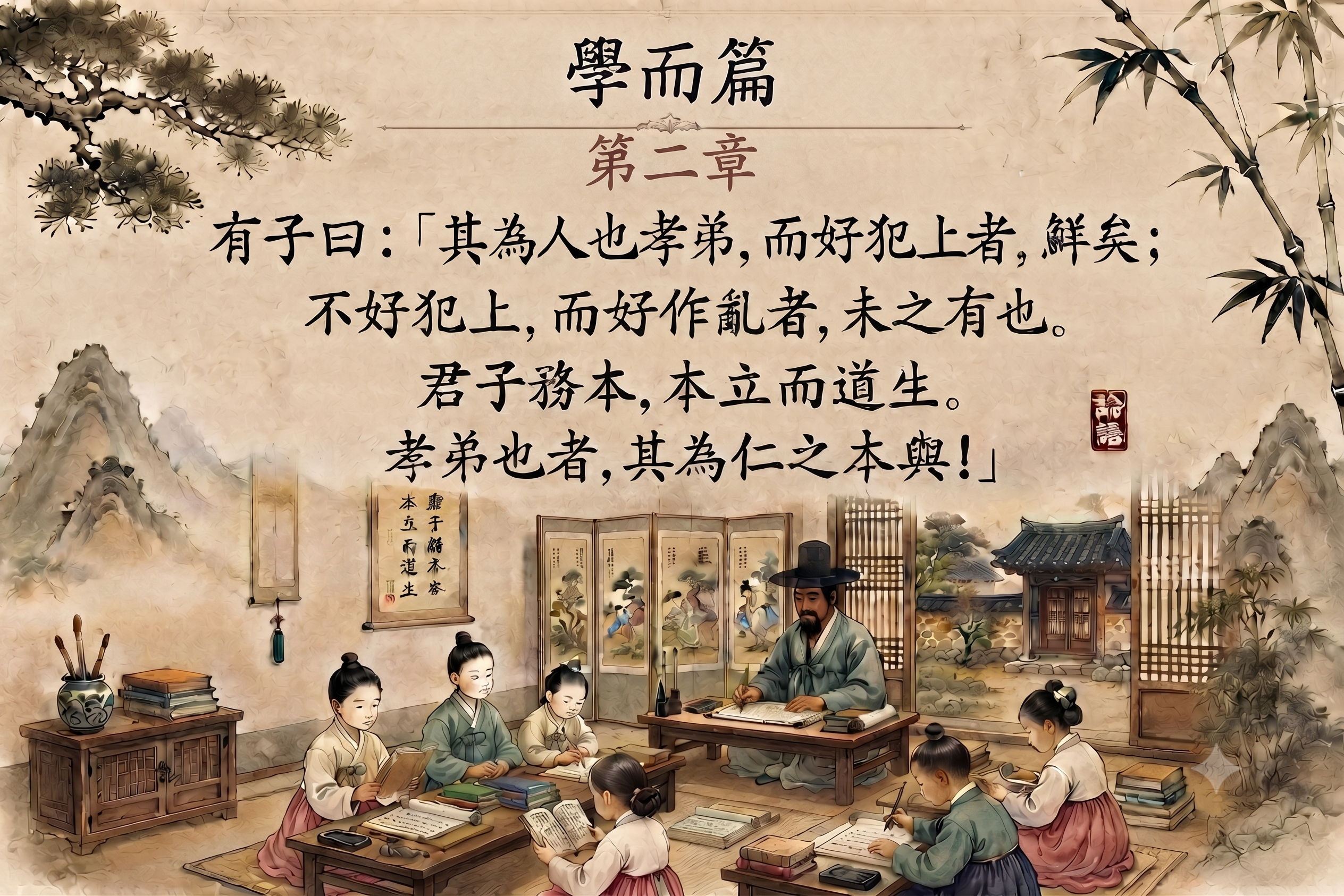
有子曰:「其為人也孝弟,而好犯上者,鮮矣;不好犯上,而好作亂者,未之有也。君子務本,本立而道生。孝弟也者,其為仁之本與!」
Simplified Chinese
有子曰:“其为人也孝弟,而好犯上者,鲜矣;不好犯上,而好作乱者,未之有也。君子务本,本立而道生。孝弟也者,其为仁之本与!”
Pinyin
Yǒuzǐ yuē: “Qí wéi rén yě xiào tì, ér hào fàn shàng zhě, xiǎn yǐ; bù hào fàn shàng, ér hào zuò luàn zhě, wèi zhī yǒu yě. Jūnzǐ wù běn, běn lì ér dào shēng. Xiào tì yě zhě, qí wéi rén zhī běn yú!”
A Literal Reading of the Passage
Youzi said:
“A person who is filial toward his parents and respectful toward his elders, yet likes to oppose those above him, is rare. One who does not like to oppose those above him, yet likes to create disorder, has never existed. The Junzi (君子) devotes himself to the root. When the root is established, the Way arises. Filial devotion and respect—are these not the root of practicing Ren (仁)?”
Reading the Grammar
This passage develops its argument step by step. It begins with conduct within the family, moves outward toward conduct in society, and then arrives at one of its central propositions: 君子務本,本立而道生—the Junzi (君子) attends to the root; when the root is established, the Dao (道), or the Way, emerges.
1. 其為人也孝弟,而好犯上者,鮮矣。
Qí wéi rén yě xiào tì, ér hào fàn shàng zhě, xiǎn yǐ.
其為人也 may be understood as “as for his character” or “in the way he conducts himself as a person.” 其 means “his” or “that person’s,” while 為人 refers to a person’s character or way of conducting himself. 也 helps mark the phrase as the topic of what follows.
孝弟 combines two important ideas. 孝 (xiào) refers to filial devotion toward one’s parents. 弟 (tì) here does not simply mean “younger brother”; in this context it refers to respect toward elder brothers and, more broadly, toward one’s elders.
而 connects the two parts of the sentence and here carries a contrastive sense, something like “yet.” 好犯上者 refers to “one who likes to oppose those above him.” 者 turns the preceding expression into a description of a person: “one who….” 鮮矣 means “such people are rare.”
The structure can be seen as:
其為人也 / 孝弟 / 而 / 好犯上者 / 鮮矣
as for his character / filial and respectful / yet / one who likes to oppose those above him / is rare
Youzi connects behavior in the family with behavior in the wider social world. His argument is that a person who has learned respect and responsibility in close relationships is unlikely to develop a habitual desire to challenge or disrupt social relationships.
Key Characters and Meanings
其 (qí, his; that) · 為 (wéi, to be; to act) · 人 (rén, person) · 也 (yě, sentence particle) · 孝 (xiào, filial devotion) · 弟 (tì, respect toward elder brothers or elders) · 而 (ér, and; yet) · 好 (hào, to like) · 犯 (fàn, to offend; to violate) · 上 (shàng, those above) · 者 (zhě, one who) · 鮮 (xiǎn, rare) · 矣 (yǐ, sentence-final particle)
2. 不好犯上,而好作亂者,未之有也。
Bù hào fàn shàng, ér hào zuò luàn zhě, wèi zhī yǒu yě.
不好犯上 means “does not like to oppose those above him.” 作亂 means to cause disorder, create rebellion, or disturb the established order.
The particularly interesting grammatical construction is 未之有也. In Classical Chinese, when a pronoun serves as the object of a verb in certain negative constructions, it may appear before the verb. Thus 之 precedes 有. The expression can therefore be understood as “there has never been such a case” or “such a person has never existed.”
The structure is:
不好犯上 / 而 / 好作亂者 / 未之有也
does not like to oppose those above / yet / one who likes to create disorder / there has never been such a person
The second sentence strengthens the argument of the first. If a person is not inclined to challenge those above him, Youzi argues, it would be still more unlikely for that person to become someone who actively creates disorder.
Key Characters and Meanings
不 (bù, not) · 好 (hào, to like) · 犯 (fàn, to offend; to oppose) · 上 (shàng, those above) · 而 (ér, and; yet) · 作 (zuò, to make; to cause) · 亂 (luàn, disorder) · 者 (zhě, one who) · 未 (wèi, not yet; never yet) · 之 (zhī, it; such a thing) · 有 (yǒu, to exist; to have) · 也 (yě, sentence-final particle)
3. 君子務本,本立而道生。
Jūnzǐ wù běn, běn lì ér dào shēng.
This short sentence contains the central idea of the chapter.
君子 (Junzi) originally had associations with social status, but in the Analects it increasingly carries an ethical meaning: a cultivated or exemplary person who seeks to develop good character.
務本 means “to devote oneself to the root” or “to attend to what is fundamental.” 務 means to devote effort to something, while 本 means the root, foundation, or fundamental basis.
In 本立而道生, 立 means “to stand” or “to become established.” 道 (Dao) literally means “way,” but in this context it points toward the proper way of living and acting. 生 means “to arise” or “to grow.”
The structure is:
君子 / 務本 / 本立 / 而 / 道生
the Junzi / attends to the root / when the root is established / then / the Way arises
The image is almost organic: if the root is sound, what grows from it can develop properly. Rather than concentrating only on correcting outward behavior, the passage directs attention to the foundation from which behavior grows.
Key Characters and Meanings
君 (jūn, ruler; noble) · 子 (zǐ, person; master) · 務 (wù, to devote oneself to) · 本 (běn, root; foundation) · 立 (lì, to stand; to establish) · 而 (ér, and; then) · 道 (dào, the Way) · 生 (shēng, to arise; to grow)
4. 孝弟也者,其為仁之本與!
Xiào tì yě zhě, qí wéi rén zhī běn yú!
孝弟也者 brings filial devotion and respect back into focus as the topic: “As for filial devotion and respect….”
The final expression deserves particular attention. 為仁之本 may be understood as “the root of practicing Ren (仁).” 仁 (Ren) is one of the most important concepts in Confucian thought and can be translated in different contexts as humaneness, benevolence, or humane goodness. No single English word fully captures its range of meaning.
與 at the end of the sentence functions as a particle giving the statement a questioning or rhetorical force. The sentence therefore asks, in effect: “Are filial devotion and respect not the root of practicing Ren (仁)?”
The structure is:
孝弟也者 / 其 / 為仁 / 之本 / 與
as for filial devotion and respect / perhaps indeed / practicing Ren / its root / is it not?
This line is often rendered simply as “filial piety and brotherly respect are the root of Ren.” There is, however, an important nuance in 為仁之本. The phrase can be read not as saying that filial devotion and respect constitute the entirety of Ren (仁), but that they provide a fundamental starting point for practicing and cultivating Ren (仁).
Key Characters and Meanings
孝 (xiào, filial devotion) · 弟 (tì, respect toward elder brothers or elders) · 也 (yě, particle) · 者 (zhě, topic marker; one who) · 其 (qí, perhaps; indeed) · 為 (wéi, to practice; to do) · 仁 (rén, humaneness) · 之 (zhī, possessive or linking particle) · 本 (běn, root; foundation) · 與 (yú, interrogative particle)
Understanding the Meaning
Chapter 2 of Xue Er (學而) looks for the foundations of moral life in a surprisingly close and ordinary place: our earliest human relationships. Youzi does not begin with an abstract theory of society or a grand philosophical system. He begins with how a person treats parents, elder siblings, and those with whom one shares the closest bonds.
For a modern reader, Xiao (孝) and Ti (弟) should not automatically be reduced to unquestioning obedience to parents or authority. The broader point of the passage is that close relationships are where people first learn respect, responsibility, restraint, and concern for others. The habits formed there may then influence how they behave in the larger social world.
This leads to the central sentence:
君子務本,本立而道生。
The Junzi (君子) attends to the root; when the root is established, the Dao (道) arises.
The metaphor of the root is important. A tree does not become healthy because its leaves are arranged correctly. Its visible growth depends upon what lies beneath the surface. In the same way, Youzi suggests that good conduct cannot be sustained merely by imposing rules on outward behavior. Something more fundamental must first be cultivated.
The final sentence then connects this idea with Ren (仁). Ren is one of the central ethical concepts of the Analects, but here its cultivation does not begin with a grand declaration about humanity. It begins with the difficult, ordinary practice of treating the people closest to us with respect and responsibility.
Read this way, 本立而道生 offers an idea that reaches beyond its ancient setting: when the foundation of a life is sound, the right way of living has somewhere from which to grow.
Background and Context
The speaker in this chapter is Youzi (有子), also known as You Ruo (有若), one of Confucius’s disciples. His words appearing so early in the Analects are significant. Traditional accounts portray him as a respected member of the Confucian community after Confucius’s death.
The passage also reflects a world in which family order and social order were closely connected. In ancient China, the family was not regarded simply as a private sphere separated from public life. It was one of the first places where a person learned ritual behavior, responsibility, hierarchy, reciprocity, and the obligations involved in living with others.
This historical context is important because expressions such as 犯上, “to oppose those above,” can sound very different to modern readers living in societies that value equality, individual rights, and legitimate criticism of authority. Reading the Analects today does not require transferring the social hierarchy of ancient China unchanged into modern life.
A more productive question may be: Where does our capacity to live well with other people begin?
Youzi’s answer is that it begins close to home. Before speaking about transforming society, we should look at the quality of the relationships in which our character is formed. Whatever conclusions a modern reader ultimately draws from that claim, it gives us a useful question with which to examine our own lives.
Dr. Ryu’s Reflection
As I grow older, the word “root” sounds different to me than it once did. When we are young, moving forward often seems more important—learning something new, reaching farther, building a career, or discovering another part of the world. But as the years accumulate, we also begin to look backward and inward. We ask where we began, which relationships shaped us, and what has remained underneath all the changes in our lives.
That is why this sentence stays with me:
君子務本,本立而道生。
The Junzi (君子) attends to the root; when the root is established, the Dao (道) arises.
Today, I read this less as an abstract philosophical statement and more as a practical way of examining life. When something is not working, our first instinct is often to search for a new technique, a new system, or a new solution. Sometimes that is necessary. But there are also moments when adding something new is less important than returning to the foundation and asking whether it is still sound.
And that foundation may be much closer than we imagine. It may be found in the way we speak to our family, how we treat an old friend, whether we listen respectfully to someone who disagrees with us, or how we behave toward people from whom we have nothing to gain. These small relationships reveal things about us that our public words sometimes conceal.
There is also something challenging in the idea that Ren (仁) begins here. It is relatively easy to speak about humanity, kindness, respect, or a better society in the abstract. It is much harder to practice those ideals consistently with the people we encounter every day.
Perhaps this is one reason the Analects places the idea of the root so near its beginning. Before asking how far we can go, it asks us to consider what we are standing on.
Sometimes the most important place to begin again is not somewhere new.
It is at the root.
References
- The Analects (論語), Xue Er (學而), Chapter 2.
- Yang Bojun (楊伯峻), Lunyu Yizhu (論語譯注), Zhonghua Book Company.
- Zhu Xi (朱熹), Lunyu Jizhu (論語集注).
- James Legge, The Chinese Classics, Vol. I: Confucian Analects.
- Edward Slingerland, Confucius: Analects: With Selections from Traditional Commentaries, Hackett Publishing, 2003.