Wei Zheng (為政), Chapter 16 | Stay Focused on the Path of Learning
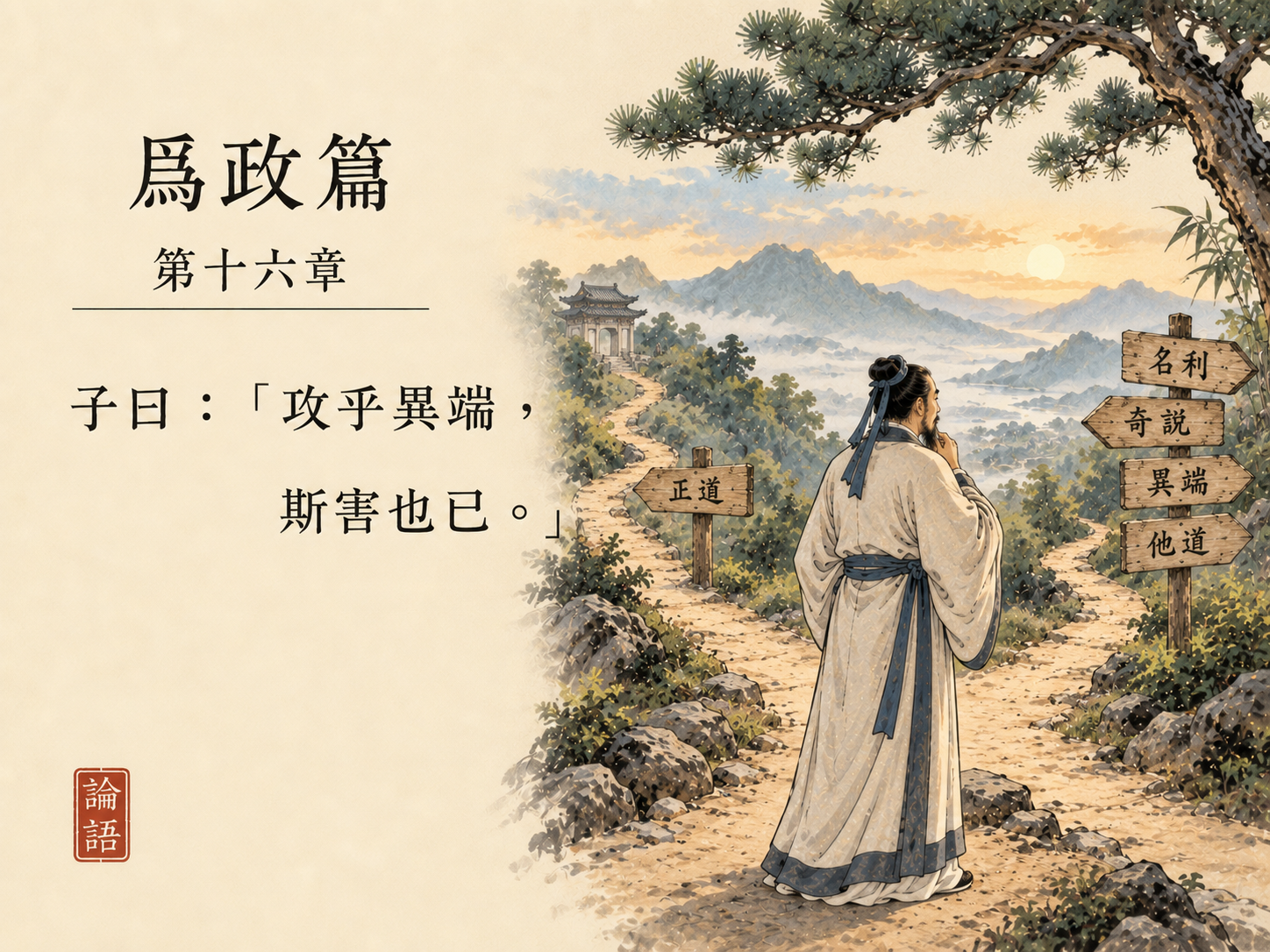
Traditional Chinese
子曰:「攻乎異端,斯害也已。」
Simplified Chinese
子曰:“攻乎异端,斯害也已。”
Pinyin
Zǐ yuē: “Gōng hū yìduān, sī hài yě yǐ.”
Reading the Passage Literally
Confucius said:
“To devote oneself to divergent branches of learning—this can only be harmful.”
Reading the Grammar
This brief passage requires unusual care because two of its key terms, 攻 (gōng) and 異端 (yìduān), can easily be misunderstood through their modern meanings. 攻 today often suggests “to attack,” while 異端 may evoke the strong idea of “heresy.”
In the traditional commentary on the Analects, however, the passage was usually read differently. 攻 was understood as studying, cultivating, or devoting oneself intensively to something, while 異端 referred to divergent or alternative branches of teaching outside what commentators regarded as the proper path. The traditional reading therefore warns not against encountering difference itself, but against becoming absorbed in another path to the point of losing one’s central course of learning.
1. 攻乎異端
Gōng hū yìduān
The first character requiring attention is 攻 (gōng). In modern Chinese it commonly means “to attack,” but traditional Analects commentary does not normally understand it that way here. He Yan glosses 攻 as 治, meaning to work on, study, or cultivate. Zhu Xi, citing Fan Zuyu, similarly explains it as 專治, to devote oneself intensively to the study of something. Discussions preserved in the Zhuzi Yulei also distinguish this usage clearly from the ordinary meaning of “attack,” explaining it instead in the sense of studying and practicing.
乎 (hū) here functions in a relational sense, similar to “in,” “with regard to,” or “upon.”
The second difficult expression is 異端 (yìduān). 異 (yì) means “different,” while 端 (duān) can mean an end, point, beginning, or branch. Taken literally, the expression suggests a different branch or alternative direction.
The structure is:
攻 / 乎 / 異端
devote oneself to studying / in / divergent branches
Thus, on the traditional reading:
“To devote oneself intensively to divergent branches of learning.”
The phrase should not automatically be translated as “to attack heresy.” The later word “heresy” carries religious and ideological associations that are stronger and more specific than the ancient expression itself. Traditional commentators did identify 異端 with teachings they believed departed from the proper Dao, but many of the particular schools they named belonged to later historical interpretation rather than to Confucius’s own wording.
For that reason, the safest reading is to distinguish between encountering different ideas and allowing one’s primary course of learning to be displaced by intensive absorption in a divergent path.
Key Characters and Meanings
攻 (gōng, to work on; to study intensively; to cultivate) · 乎 (hū, in; with regard to) · 異 (yì, different; divergent) · 端 (duān, end; point; branch)
2. 斯害也已
Sī hài yě yǐ
斯 (sī) means “this” or “in this case.” 害 (hài) means harm or something harmful. 也已 (yě yǐ) completes and limits the judgment, giving the sense of “that is all,” “only,” or “nothing but.”
The structure is:
斯 / 害 / 也已
this / is harmful / and that is all
Thus:
“This can only be harmful.”
Traditional commentary understands the harm as arising when a learner leaves aside the central path of study and becomes deeply absorbed in another branch. The danger lies in losing direction and dispersing one’s effort rather than merely becoming acquainted with another perspective.
The entire sentence can therefore be read:
「攻乎異端,斯害也已。」
“To devote oneself to divergent branches of learning can only be harmful.”
It is important, however, to note that this short sentence has also received other interpretations. Some later scholars have taken 攻 in the sense of “attack,” yielding a reading closer to “attacking different views is harmful.” Others have interpreted 異端 as opposing extremes or one-sided positions. The passage has therefore never been entirely free of interpretive debate.
For the present article, the main explanation follows the dominant traditional line represented by the Lunyu Zhushu and Zhu Xi: 攻 means intensive study rather than attack, and the warning concerns losing oneself in a divergent line of learning.
Key Characters and Meanings
斯 (sī, this) · 害 (hài, harm; harmful) · 也 (yě, final particle) · 已 (yǐ, already; only; that is all)
Understanding the Meaning
This is one of the shortest sayings in the Analects, but also one of the easiest to misread.
「攻乎異端,斯害也已。」
Because 異端 later became a strong term for doctrinal or religious “heresy,” and because 攻 commonly means “to attack” in modern Chinese, the sentence can sound as though Confucius were saying, “Attack heretical ideas.” That is not the standard traditional reading of the passage.
In the mainstream commentary tradition, 攻 means to devote oneself to studying something, not to attack it. Once that point is clear, the passage changes considerably.
The warning is not simply against the existence of different ideas.
The problem is becoming absorbed in another branch of learning until one loses the central direction of one’s own study.
Learning requires breadth. We need to hear different voices, encounter unfamiliar arguments, and understand perspectives outside our own experience. Without that openness, learning can become narrow and self-confirming. Yet breadth without direction has its own danger. If every new idea pulls us toward a different path, it becomes difficult to develop anything deeply.
The issue is therefore not difference itself, but loss of center.
A learner may begin with one serious question, discover another topic while researching it, move from that topic to yet another, and gradually forget what the original inquiry was. Curiosity is valuable, but curiosity without direction can become endless movement.
In that sense, this passage can be read as a warning about focus.
The preceding chapter emphasized the balance between learning and reflection. Here another dimension appears: even when one is actively learning and thinking, it still matters what one is allowing to become central.
This does not require shutting out different perspectives. On the contrary, a secure center may make genuine openness easier. A person who knows what question he is pursuing can explore other approaches without being carried away by every new one.
So the passage need not be reduced to:
“Do not study different ideas.”
A more careful modern rendering would be:
Explore widely, but do not lose the center of your learning.
Background and Context
This passage appears in Wei Zheng, Chapter 16: 攻乎異端,斯害也已. It is especially important to separate the wording of the Analects itself from examples supplied by later commentators.
In the Lunyu Zhushu, 攻 is glossed as 治, to study or cultivate, and 異端 is interpreted as a line of learning different from what the commentators regarded as the proper classical path. Later explanatory traditions connected the expression with various schools that stood outside the Confucian tradition.
Zhu Xi follows the same basic direction. Citing Fan Zuyu, he explains 攻 as 專治, intensive or exclusive study, and interprets 異端 as teachings distinct from the Way of the sages. His commentary gives Yang Zhu and Mohism as examples, while discussions connected with Cheng-Zhu thought also extend the category to Buddhism.
These examples must be handled carefully. Yang Zhu, Mohism, and Buddhism are not named in Confucius’s sentence. They are examples introduced by later interpreters to explain what they understood 異端 to mean. It would therefore be historically inaccurate to claim that Confucius himself directly condemned those later traditions in this particular saying.
The passage has also remained open to alternative interpretation. Some scholars have read 攻 as “to attack,” producing the quite different meaning that attacking opposing views is itself harmful. Others have understood 異端 as extremes or one-sided positions. The brevity of the original makes such debate possible.
For that reason, it is best to distinguish two levels clearly. First, the dominant traditional commentary understands the sentence as a warning against devoting oneself to a divergent branch of learning. Second, the wording itself is compact enough that later readers have proposed other interpretations.
The location of the chapter within Wei Zheng is also interesting. Chapter 15 discusses the balance between 學 and 思, learning and reflection. Chapter 16 can then be read as raising the question of direction: what happens when study loses its center? Chapter 17 turns to another issue of intellectual discipline, when Confucius tells Zilu that knowing what one knows and acknowledging what one does not know is true knowledge. It would be too strong to claim that these three chapters were intentionally arranged as a systematic theory of learning.
Even so, they can be read together as raising three enduring questions:
How should we learn?
What should guide our learning?
How honestly should we recognize the limits of what we know?
Dr. Ryu’s Reflection
This passage can feel uncomfortable when first read.
攻乎異端,斯害也已.
It can sound as though Confucius were saying that studying ideas different from one’s own is harmful. In a world where encountering different cultures, perspectives, and values is increasingly important, that kind of statement would be difficult to accept without qualification.
My own experience has made me value difference rather than fear it. Living and studying in different countries taught me that things considered obvious in one society may be understood quite differently in another. A practice that seems completely natural at home may turn out to be only one possible way of organizing life. Encounters with unfamiliar people and ideas can expose assumptions we did not even know we were carrying.
For that reason, I do not want to read this passage simply as “stay away from different ideas.”
What interests me more is not the word “different,” but the idea of becoming deeply absorbed.
There is a difference between exploring something unfamiliar and losing one’s direction inside it.
This distinction feels especially relevant today. We live in an environment of almost unlimited information. I may begin searching for one specific question, click on another article, move to a related video, discover a new tool, and then follow another link from there. After an hour, I may have encountered many interesting things but no longer remember clearly what I originally wanted to learn.
New things are attractive.
They give us the feeling of movement. Sometimes discovering another tool, topic, or method is more exciting than remaining with one subject long enough to understand it deeply. We can begin to confuse constant novelty with genuine learning.
I notice the same danger when beginning new projects. New technologies and new methods appear constantly, and almost every one of them promises to make the work faster or better. Before fully learning one tool, another may already seem more attractive. Before one approach has had time to produce results, a new approach may tempt us to start again.
Eventually, it is possible for searching for better ways to replace actually doing the work.
In that sense, this chapter sounds less to me like “do not look at other paths” and more like “do not forget which path you are actually trying to walk.”
A person with a clear center can look widely. Different perspectives may even deepen that person’s understanding. But without a center, every interesting idea can become a new direction.
This seems especially important when learning something new later in life. Starting a new path is not wrong. Sometimes changing direction is exactly what is needed. The second half of life may require us to leave familiar roles, learn unfamiliar skills, or begin projects we could not have imagined earlier.
But choosing a new path is different from moving endlessly from one path to another.
From time to time, I need to ask why I am learning something, what I am trying to accomplish, and how this new knowledge connects with the larger direction of my life. Without those questions, even useful learning can become scattered.
So although Confucius’s 異端 cannot simply be equated with every modern “different idea,” this passage leaves me with a question that feels very contemporary:
Am I learning something new, or am I chasing novelty until I forget what I originally wanted to learn?
There is value in seeing many roads.
But if we intend to travel anywhere, we still need to know which road we are actually walking.
References
- The Analects (論語), Wei Zheng (為政), Chapter 16.
- He Yan (何晏), commentary, and Xing Bing (邢昺), subcommentary, Lunyu Zhushu (論語注疏), Wei Zheng.
- Zhu Xi (朱熹), Sishu Zhangju Jizhu (四書章句集注), Lunyu Jizhu (論語集注), Wei Zheng.
- Zhu Xi (朱熹), Zhuzi Yulei (朱子語類), discussions on “Gong Hu Yi Duan” in the Wei Zheng section.
- Chinese Text Project, The Analects: Wei Zheng.