Xue Er (學而), Chapter 5 | How Should a State of a Thousand Chariots Be Governed?
Traditional Chinese
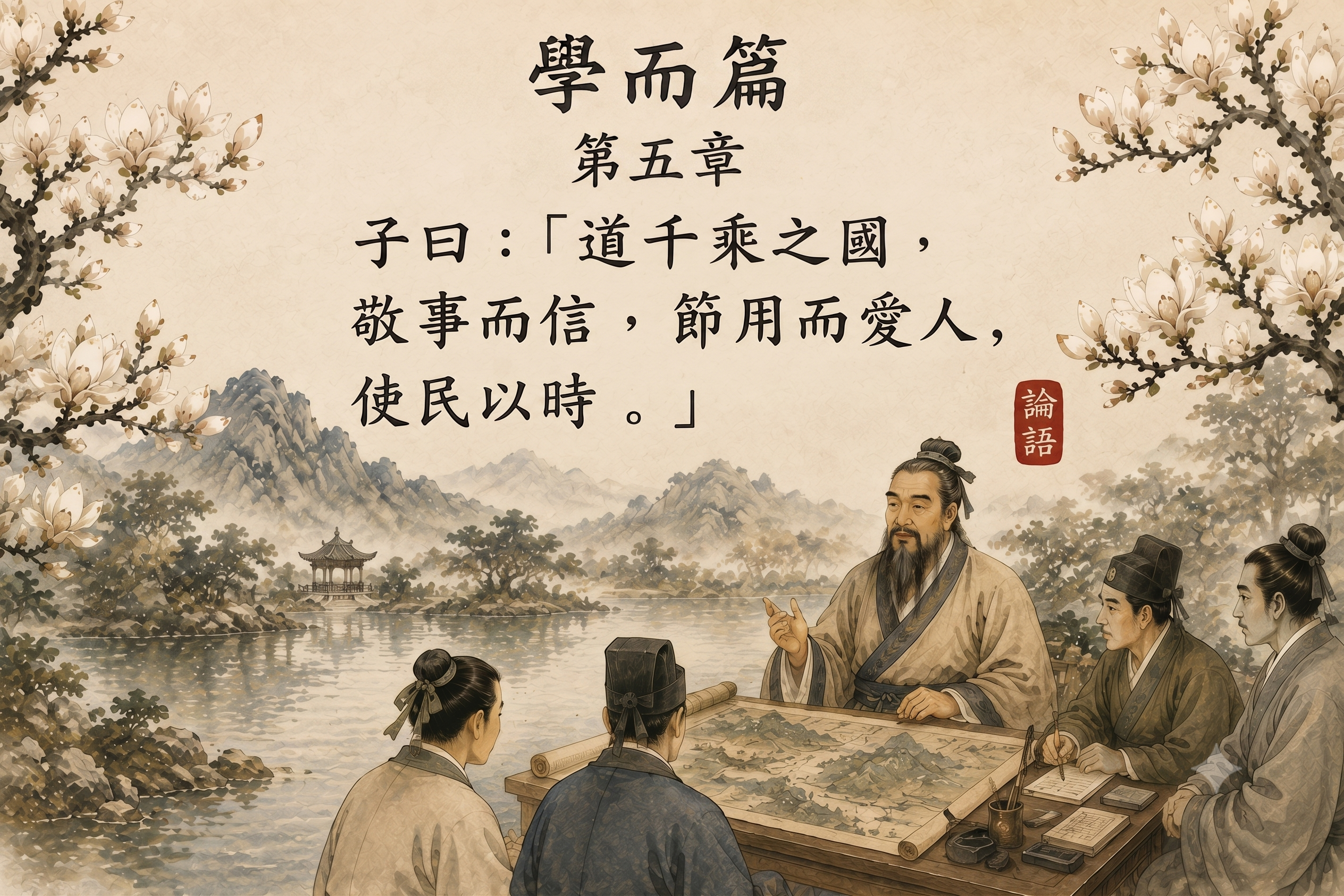
子曰:「道千乘之國,敬事而信,節用而愛人,使民以時。」
Simplified Chinese
子曰:“道千乘之国,敬事而信,节用而爱人,使民以时。”
Pinyin
Zǐ yuē: “Dǎo qiān shèng zhī guó, jìng shì ér xìn, jié yòng ér ài rén, shǐ mín yǐ shí.”
Reading the Whole Passage
Confucius said:
“In governing a state of a thousand chariots, attend to affairs with care and be trustworthy, use resources with restraint and care for the people, and call upon the people for service at the proper times.”
The passage offers a compact set of principles for governing. Confucius begins with seriousness and trust, then turns to the use of resources and concern for people, and finally reminds those in authority that even necessary demands on the people should take account of the conditions of their lives.
Reading through Grammar
1. 道千乘之國
Dǎo qiān shèng zhī guó
Although 道 is commonly encountered as a noun meaning “way” or “path,” here it functions as a verb meaning to govern, guide, or lead.
千乘之國 literally means “a state of a thousand chariots.” 乘 is pronounced shèng here and serves as a counting unit for chariots. In the ancient political setting reflected in the passage, the number of chariots a state could mobilize was one indication of its military capacity and scale. A “state of a thousand chariots” therefore refers to a substantial feudal state.
之 links 千乘 and 國, creating the relationship “a state of a thousand chariots.”
The phrase can be divided as:
道 / 千乘之國
to govern / a state of a thousand chariots
The rest of the passage explains what principles should guide the person responsible for governing such a state.
Character Meanings
道 (dǎo, to govern; to guide; also “the Way”) · 千 (qiān, thousand) · 乘 (shèng, a counting unit for chariots) · 之 (zhī, linking or possessive particle; of) · 國 (guó, state; country)
2. 敬事而信
Jìng shì ér xìn
敬 usually carries the sense of respect or reverence, but here it describes the attitude with which one approaches responsibilities. 事 means affairs, duties, or matters requiring attention. 敬事 therefore suggests taking one's responsibilities seriously and handling them carefully and conscientiously.
而 connects the two ideas, while 信 refers to trustworthiness, reliability, or keeping faith with others.
The phrase can be divided as:
敬事 / 而 / 信
handle affairs with seriousness and care / and / be trustworthy
What is notable is that Confucius begins his advice about governing not with power, punishment, or elaborate political techniques, but with the way the person in authority approaches the work itself and whether others can trust him.
Character Meanings
敬 (jìng, to respect; to treat seriously and carefully) · 事 (shì, affairs; duties; matters) · 而 (ér, and; and then) · 信 (xìn, trust; trustworthiness; to be trustworthy)
3. 節用而愛人
Jié yòng ér ài rén
節用 means to exercise restraint in spending or in the use of resources. 節 carries the sense of moderation or restraint, while 用 means to use, employ, or spend.
愛人 means to care for or cherish people. 愛 means to love, care for, or value, and 人 means people.
The phrase can therefore be divided as:
節用 / 而 / 愛人
use resources with restraint / and / care for people
The two ideas appear side by side. Confucius does not speak only about economy. Careful use of resources is accompanied by concern for the people whose lives are affected by the decisions of those who govern.
Character Meanings
節 (jié, to regulate; to restrain; moderation) · 用 (yòng, to use; expenditure) · 而 (ér, and) · 愛 (ài, to love; to care for; to cherish) · 人 (rén, person; people)
4. 使民以時
Shǐ mín yǐ shí
使 means to cause someone to act, employ, or call upon someone for service. 民 refers to the people. 以時 means “at the proper time” or “in accordance with the appropriate season.”
The phrase can be divided as:
使民 / 以時
call upon the people for service / at the proper time
This expression becomes especially clear in the setting of an agricultural society. Farming seasons were directly connected to people's livelihood. If the state demanded labor during a critical period for planting or harvesting, it could damage the very basis of ordinary people's lives.
Thus 使民以時 is more than advice about scheduling. It means that even when the state requires labor or service, those in authority should consider the livelihood and circumstances of the people upon whom the demand falls.
Character Meanings
使 (shǐ, to cause; to employ; to call upon for service) · 民 (mín, the people) · 以 (yǐ, by means of; according to) · 時 (shí, time; season; proper occasion)
Understanding the Meaning
This chapter is about governing a state, but the principles Confucius presents are remarkably straightforward: take responsibilities seriously, be trustworthy, use resources carefully, care for people, and consider their circumstances when asking for their labor.
What stands out is that Confucius does not begin with authority or the techniques of command. The first requirement falls upon the person who governs. Responsibilities must be handled conscientiously, and trust must be built through reliable words and actions.
The phrases 敬事而信 and 節用而愛人 each bring two qualities together. Serious attention to work is not enough without trust. Careful use of resources is not enough without concern for people. Efficiency and trust, restraint and care, are not treated as separate matters.
The final phrase, 使民以時, extends the same principle to the use of people's labor. The needs of the state do not erase the needs of the people. Authority may require service, but it should not disregard the rhythm of people's livelihoods.
Taken together, the passage suggests that good government begins with something fundamental: how those in responsibility treat their work, shared resources, and the people affected by their decisions.
Background and Context
In the Spring and Autumn period, governing a state required military and administrative organization, but agriculture and various forms of public labor were also essential. Governments needed people for construction, roads, military preparations, and other collective tasks, while for most ordinary people farming remained the foundation of daily livelihood.
This makes 使民以時 especially important. If the state mobilized people without regard for the agricultural season, it might satisfy an immediate public need while damaging the people's ability to sustain their lives. The phrase therefore means more than simply arranging an efficient work schedule. It reminds the ruler to consider the lives of those upon whom government demands fall.
The placement of this passage within the opening chapters of Xue Er (學而) is also revealing. Chapter 1 begins with learning and practice. Chapter 2 turns to foundations of character and relationships. Chapter 3 warns against outward display without inner substance, while Chapter 4 introduces regular self-examination. Chapter 5 widens the perspective from the cultivation of the individual toward the responsibilities of a person entrusted with a community.
The scale changes, but the underlying concerns remain connected. Seriousness, trustworthiness, restraint, and consideration for others matter not only in private life but also when responsibility extends to the wider community.
Dr. Ryu’s Reflection
When I read this passage, I do not think it needs to remain confined to the government of an ancient state. Similar questions arise whenever someone becomes responsible for people and resources. They arise for public officials, but also for business owners, organizational leaders, and even someone responsible for a small team.
The phrase that stays with me most is 節用而愛人. Every organization has limits. Budgets are limited, time is limited, and there are moments when expenses must be reduced or resources used more efficiently. Yet when we look only at numbers, what can easily be overlooked is the time, energy, and breathing space of the people doing the work. Confucius places restraint in the use of resources beside care for people. I find myself reading it this way: resources should be used carefully, but people should be treated with care.
使民以時 also feels surprisingly relevant when translated into the language of ordinary work. Assigning work is not in itself a problem. Organizations exist because there are things that need to be done. The question is whether the person assigning the work considers only his own schedule or also recognizes that the other person has a life, responsibilities, and a rhythm of his or her own. The task may remain the same, but the manner in which it is asked, scheduled, and shared can become very different.
Living and working in different countries and organizations has also made me aware of how important trust in those who operate a system can be. Even well-designed rules lose much of their strength when people in responsibility frequently change their word, treat others as useful only when they are needed, or handle shared resources as though they were their own. On the other hand, even an imperfect organization can feel different when those responsible take their work seriously, keep their promises, and pay attention to the circumstances of the people around them.
If I were to put this passage into today's language, I would read it this way: Take the work seriously, keep your word, use resources carefully, care for people, and when you ask for someone's time, remember that the person has a life beyond the task.
Confucius was speaking about governing a state more than two thousand years ago, but for anyone who must accomplish something together with other people, these remain practical questions.
References
- The Analects (論語), Xue Er (學而), Chapter 5 (Analects 1.5).
- Zhu Xi (朱熹), Lunyu Jizhu (論語集注), in Sishu Zhangju Jizhu (四書章句集注).
- Chinese Text Project, The Analects: Xue Er.
- Institute for the Translation of Korean Classics, Classical Chinese and Chinese-character reference materials.