Xue Er (學而), Chapter 6 | Live with Character First, Then Learn from Books
Traditional Chinese
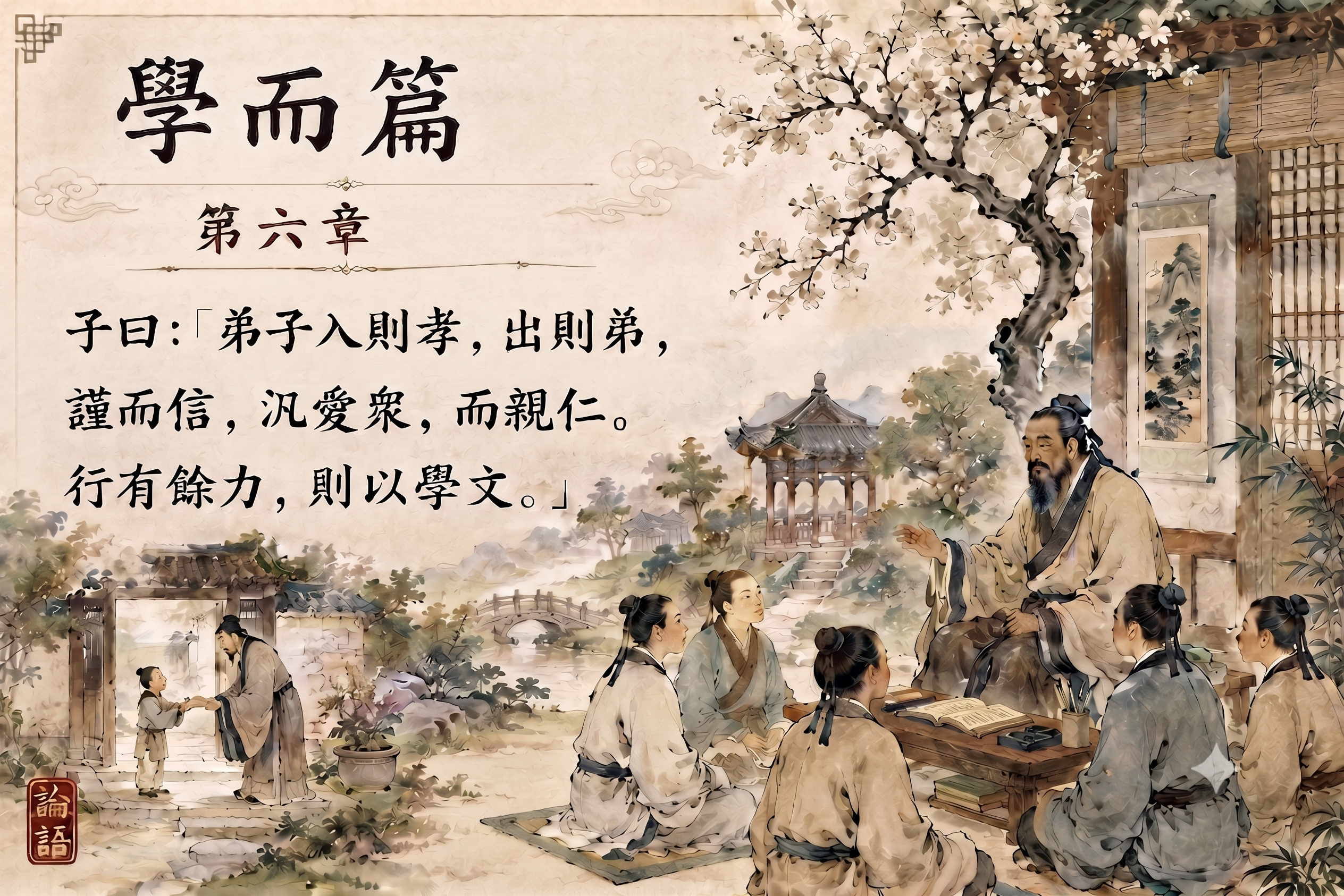
子曰:「弟子入則孝,出則弟,謹而信,汎愛衆,而親仁。行有餘力,則以學文。」
Simplified Chinese
子曰:“弟子入则孝,出则弟,谨而信,泛爱众,而亲仁。行有余力,则以学文。”
Pinyin
Zǐ yuē: “Dìzǐ rù zé xiào, chū zé tì, jǐn ér xìn, fàn ài zhòng, ér qīn rén. Xíng yǒu yúlì, zé yǐ xué wén.”
Reading the Whole Passage
Confucius said:
“A young person should be filial at home and respectful to elders when away from home, careful in conduct and trustworthy, caring broadly for others while drawing close to people of Ren (仁). After putting these things into practice, if there is strength remaining, one should devote it to the study of culture and learning.”
At first glance, the final sentence may sound as though Confucius places study in a secondary position. But the passage is better read as a statement about the order of education. Before learning becomes an accumulation of knowledge, it should be grounded in the way a person actually lives and relates to others.
Reading through Grammar
1. 弟子入則孝,出則弟
Dìzǐ rù zé xiào, chū zé tì
弟子 is familiar today as a word meaning “disciple,” but in this passage it is more naturally understood as referring to a young person or the younger generation.
入 literally means “to enter,” but here it refers to being within the home and family. 出, “to go out,” refers to life outside the household and one's relationships with others.
則 marks what should follow in each situation: when at home, 孝; when outside, 弟. 孝 (xiào) refers to filial devotion and respectful care toward one's parents. 弟, pronounced tì in this context, refers to respectful conduct toward elder brothers and, more broadly, elders.
The structure is:
弟子 / 入 / 則 / 孝
a young person / at home / then / should be filial
出 / 則 / 弟
outside the home / then / should be respectful to elders
The sentence therefore presents ethical conduct through two ordinary spheres of life: within the family and beyond it.
It also recalls Chapter 2, where 孝弟 (xiào tì) was presented as a foundation for the practice of Ren (仁). Here that principle takes a more concrete form in everyday conduct.
Character Meanings
弟 (dì, younger brother; in 弟子, younger person; tì when referring to respect for elders) · 子 (zǐ, child; person) · 入 (rù, to enter; here, at home) · 則 (zé, then; in that case) · 孝 (xiào, filial devotion) · 出 (chū, to go out; outside the home) · 弟 (tì, respect toward elder brothers or elders)
2. 謹而信
Jǐn ér xìn
謹 means to be careful, cautious, or restrained. Here it refers to conducting oneself thoughtfully rather than speaking and acting carelessly.
而 connects this quality with 信, which means trustworthiness, reliability, or keeping faith with others.
The phrase can be divided as:
謹 / 而 / 信
be careful in conduct / and / be trustworthy
The point is not simply to behave cautiously. A person should conduct himself in such a way that others can rely upon his words and actions.
The recurrence of 信 (xìn) in the opening chapters of Xue Er (學而) is noteworthy. In Chapter 4, Zengzi (曾子) asks whether he has been trustworthy in his friendships: 與朋友交而不信乎? In Chapter 5, trustworthiness appears as a principle of government in 敬事而信. Here it appears again as part of the everyday formation of a young person's character.
Character Meanings
謹 (jǐn, careful; cautious; conscientious) · 而 (ér, and) · 信 (xìn, trust; trustworthiness; reliability)
3. 汎愛衆,而親仁
Fàn ài zhòng, ér qīn rén
汎 means broadly or widely, while 愛衆 means to care for or love the many. 汎愛衆 therefore calls for a broad concern for people rather than kindness restricted only to one's immediate circle.
The phrase 親仁 requires particular attention. 親 means to draw close to, associate closely with, or become near to. Here 仁 is traditionally understood as referring to people of Ren (仁)—people characterized by humaneness or moral goodness. Thus 親仁 can naturally be read as “draw close to people of Ren (仁)” or “associate closely with the humane and virtuous.”
The structure is:
汎 / 愛 / 衆
broadly / care for / the many
而 / 親 / 仁
and / draw close to / people of Ren (仁)
The two ideas create an interesting balance. One should extend respect and concern broadly, while also exercising judgment about whose character one chooses to stay close to and learn from.
Caring for everyone and choosing one's closest moral influences carefully are not contradictory.
Character Meanings
汎 (fàn, broadly; widely) · 愛 (ài, to love; to care for) · 衆 (zhòng, the many; people) · 而 (ér, and) · 親 (qīn, to be close to; to associate with) · 仁 (rén, humaneness; here, a person characterized by Ren)
4. 行有餘力,則以學文
Xíng yǒu yúlì, zé yǐ xué wén
行 refers to putting into practice the conduct described in the preceding lines. 有餘力 literally means “to have remaining strength”: 餘 means remaining or left over, and 力 means strength or capacity.
則 introduces what should follow: 以學文.
The meaning of 文 (wén) is broader here than modern “literature” or simply learning to write. In the classical context, it can encompass cultural and textual learning, including the inherited traditions, texts, rites, and other forms of cultivated learning.
The structure is:
行 / 有餘力 / 則 / 以學文
having practiced these things / if there is strength remaining / then / devote it to learning wen
This sentence can easily be misunderstood as saying that study is unimportant or should be undertaken only when nothing else remains to be done. Such a reading would sit uneasily with the very opening of the Analects: 學而時習之, “to learn and repeatedly practice what one has learned.”
The emphasis is better understood as one of priority and foundation. Knowledge should not be separated from the formation of the person who possesses it.
Character Meanings
行 (xíng, to practice; to put into action) · 有 (yǒu, to have) · 餘 (yú, remaining; left over) · 力 (lì, strength; capacity) · 則 (zé, then) · 以 (yǐ, with; by means of; here introducing what follows) · 學 (xué, to learn; to study) · 文 (wén, texts; culture; cultivated learning)
Understanding the Meaning
The final sentence, 行有餘力,則以學文, may initially seem surprising to a modern reader. Education today is often imagined first in terms of schooling, knowledge, qualifications, and academic achievement. Confucius, however, begins this passage somewhere else.
Before mentioning books or textual learning, he speaks of filial devotion, respect for elders, careful conduct, trustworthiness, broad concern for others, and closeness to people of good character. Only after describing these forms of conduct does he introduce 學文, the study of texts and culture.
This does not mean that Confucius dismisses intellectual learning. The Analects itself begins with 學, learning. Rather, Chapter 6 asks what kind of person should receive and use knowledge. Knowledge does not automatically produce good character. A person may know a great deal and still treat others badly, break promises, or refuse responsibility for his own conduct.
The passage therefore places the formation of character alongside the acquisition of knowledge. Learning needs a human foundation upon which to stand.
汎愛衆,而親仁 adds another dimension. Broad concern for people does not require treating every relationship as identical. One can respect and care for people generally while being thoughtful about those one chooses as close companions, teachers, and influences.
The chapter is therefore more than a simple instruction to “put character before study.” Its deeper question is about the proper relationship between the person we become and the things we learn.
Background and Context
Chapter 6 becomes especially clear when read alongside Chapter 2. There, Youzi (有子) says that 孝弟 (xiào tì)—filial devotion and respect—is a foundation for practicing Ren (仁). Chapter 6 turns that principle into a series of practical expectations for a young person's daily life.
The movement of the passage is also significant. It begins inside the home with 孝, moves outside the home through 弟, continues through careful and trustworthy conduct, and then widens further toward 汎愛衆, concern for people broadly. At the same time, 親仁 introduces the importance of choosing good moral influences.
Only after this widening circle of relationships does 學文 appear.
This ordering helps explain why learning in the Analects should not be reduced to the accumulation of information. Chapter 1 opens with learning and practice, yet Chapter 6 reminds the reader that learning cannot be detached from the conduct of the learner. What one studies and how one lives are meant to develop together.
The meaning of 文 (wén) also needs to be understood within its classical setting. It does not correspond exactly to a modern school subject. It can refer broadly to inherited texts, cultural traditions, ritual learning, and the forms of cultivated knowledge through which an educated person was formed.
Thus 則以學文 should not simply be understood as “read books if you have some spare time.” It points instead toward cultivated learning built upon the practice of basic human responsibilities.
Dr. Ryu’s Reflection
Reading this chapter makes me wonder whether we sometimes think about education in the reverse order. We often assume that if a person attends a good school, acquires enough knowledge, and earns the right qualifications, he or she is more likely to become an admirable person. Education and professional knowledge certainly matter. I have spent much of my own life studying, learning new things, and moving into unfamiliar fields, and I still regard learning as an important part of life. Yet with the passing of time, I have also come to feel more strongly that knowing more and becoming a better person do not necessarily move in the same direction.
A person with excellent academic results does not necessarily keep promises. A highly educated person does not automatically treat others with consideration. Professional expertise does not guarantee responsibility for one's words and actions. Knowledge can give a person ability, but how that ability is used ultimately depends upon the person who possesses it. Having studied and worked in different countries and met people from many backgrounds, I find that the people I remember most are not simply those who knew the most. I remember those who took their responsibilities seriously, kept their word, respected others, and remained willing to learn from people better than themselves.
The phrase 汎愛衆,而親仁 also stays with me. Care broadly for people, yet draw close to people of Ren (仁). We can treat everyone with respect without needing to maintain the same degree of closeness with everyone. The people we spend time with gradually influence the way we think and act. When I was younger, I may not have realized how much it mattered whom I met and stayed close to. Looking back, however, I can see more clearly how good teachers, good friends, and good colleagues sometimes changed the direction of my life.
Nor do I think 行有餘力,則以學文 should be applied literally to modern life as though study were something to do only with leftover time. Education and specialized knowledge are essential in today's world. But the question behind the sentence remains relevant: Am I living in a way that is worthy of what I have learned?
Gaining one more piece of knowledge matters, but putting into practice even one thing we already know can be more difficult. Speaking warmly to one's parents, treating others respectfully, keeping a promise, refusing to judge people carelessly, and remaining willing to learn from someone better than oneself—Confucius speaks of such things before turning to textual learning.
More than two thousand years later, I would not reduce this passage to the slogan, “Become a good person first, and study later.” That would make Confucius' lifelong emphasis on learning far too simple. I would rather read it this way:
Do not separate learning from character. Live what you learn, and continue learning through the way you live.
Perhaps this is one way in which 學而時習之—learning and repeatedly practicing what one has learned—begins to take concrete form in a person's life.
References
- The Analects (論語), Xue Er (學而), Chapter 6 (Analects 1.6).
- Zhu Xi (朱熹), Lunyu Jizhu (論語集注), in Sishu Zhangju Jizhu (四書章句集注).
- Chinese Text Project, The Analects: Xue Er.
- Institute for the Translation of Korean Classics, Classical Chinese and Chinese-character reference materials.