Xue Er (學而), Chapter 7 | Learning Reveals Itself in Life
Traditional Chinese
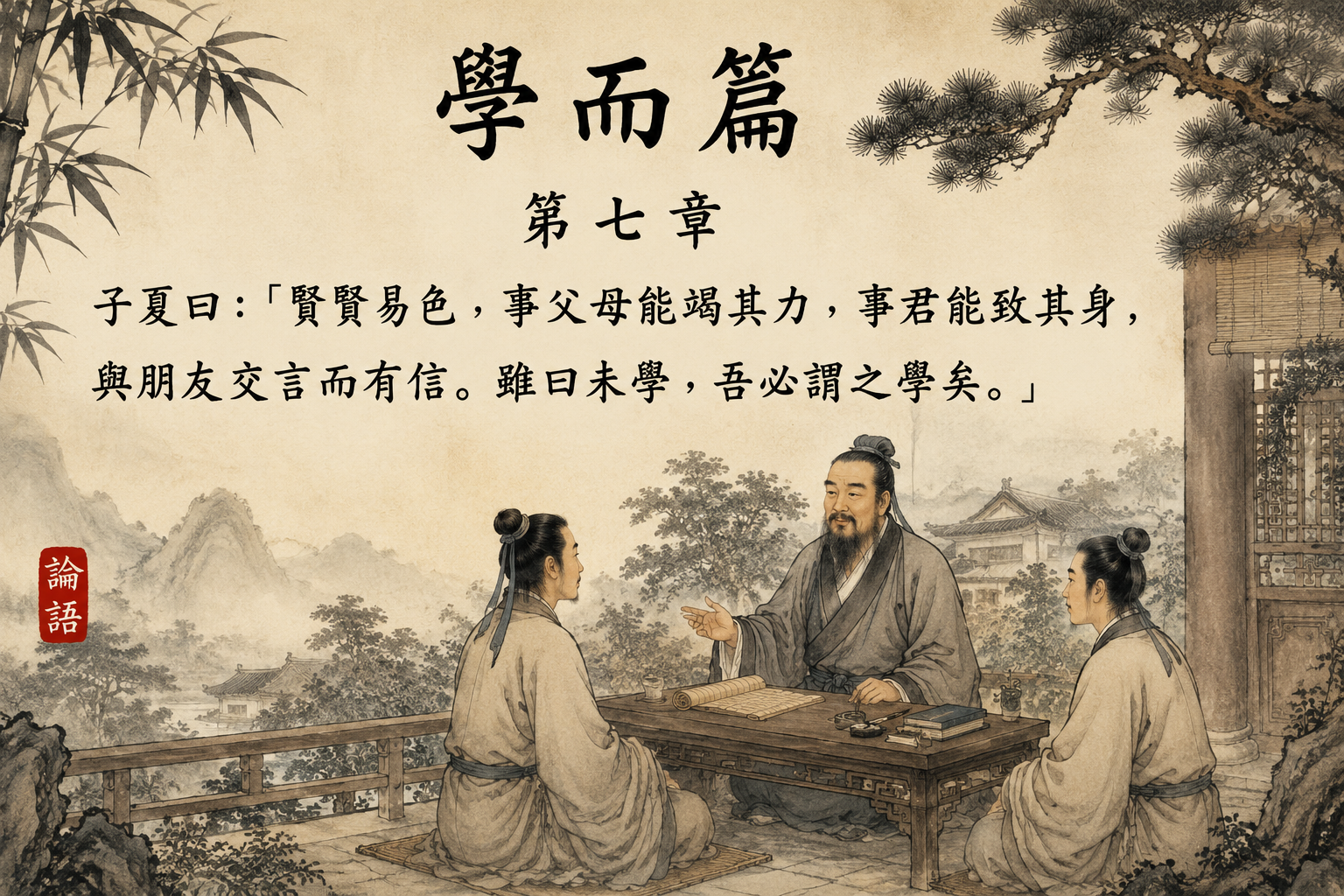
子夏曰:「賢賢易色,事父母能竭其力,事君能致其身,與朋友交言而有信。雖曰未學,吾必謂之學矣。」
Simplified Chinese
子夏曰:“贤贤易色,事父母能竭其力,事君能致其身,与朋友交言而有信。虽曰未学,吾必谓之学矣。”
Pinyin
Zǐ Xià yuē: “Xián xián yì sè, shì fùmǔ néng jié qí lì, shì jūn néng zhì qí shēn, yǔ péngyǒu jiāo yán ér yǒu xìn. Suī yuē wèi xué, wú bì wèi zhī xué yǐ.”
Reading the Passage Literally
Zixia said:
“Value the worthy above outward beauty; in serving your parents, be able to exert all your strength; in serving your ruler, be able to devote yourself fully; and in your dealings with friends, let your words be trustworthy. Even if someone says that such a person has never studied, I would certainly say that he has learned.”
Reading the Grammar
This passage develops its idea through a sequence of relationships. It begins with what a person values in others, then moves to parents, the ruler, and friends, before arriving at its striking conclusion: a person who lives in this way may be called learned even if others say that he has never studied. The grammatical movement of the passage therefore leads from particular forms of conduct toward a broader understanding of 學 (xué), learning.
1. 賢賢易色
Xián xián yì sè
These four characters form the most difficult and debated expression in this chapter. The two occurrences of 賢 (xián) can be understood as performing different functions. The first may be read verbally, meaning “to regard as worthy” or “to value as worthy,” while the second refers to a worthy or virtuous person. 賢賢 can therefore be understood as “to value the worthy.”
The principal difficulty lies in 易色. 易 (yì) means “to change,” “to exchange,” or “to replace,” while 色 (sè) can refer to appearance, facial expression, physical beauty, or sexual attraction depending on context. A longstanding traditional interpretation understands the phrase as replacing one’s attraction to physical beauty with admiration for virtue. On this reading, the expression means that moral worth should be valued more highly than outward attractiveness.
The traditional commentarial line represented by the Lunyu Zhushu (論語注疏) and Zhu Xi reads the phrase in this direction. Zhu Xi connects it with genuinely valuing the goodness of the worthy rather than being governed primarily by physical attraction.
The wording, however, has long admitted more than one interpretation. Some readings understand 色 as facial expression or outward demeanor and take the phrase to refer to the respectful attitude one shows toward a worthy person. Other interpretations connect it with marriage, suggesting that one should value a spouse’s virtue above physical appearance.
For this series, the traditional and widely used interpretation—valuing virtue above outward beauty or attraction—will serve as the main reading, while the existence of other plausible interpretations should not be forgotten.
The structure can be seen as:
賢 / 賢 / 易 / 色
to value as worthy / the worthy / to exchange or change / outward beauty or attraction
The deeper point is not simply that desire must be suppressed. The phrase asks what we value most when we look at another person. Do visible qualities command our attention, or are we able to recognize and value character and virtue?
Key Characters and Meanings
賢 (xián, worthy; virtuous) · 易 (yì, to change; to exchange) · 色 (sè, appearance; beauty; physical attraction)
2. 事父母能竭其力
Shì fùmǔ néng jié qí lì
Here 事 (shì) is used as a verb meaning “to serve.” 父母 (fùmǔ) means “parents,” 能 (néng) means “to be able to,” and 竭 (jié) means “to exhaust,” “to use completely,” or “to exert fully.” 其力 (qí lì) literally means “his strength,” referring in context to one’s own strength and ability.
The phrase therefore means that in serving one’s parents, one gives the full measure of one’s effort. The emphasis is not primarily on the quantity of material support a person can provide, but on whether that person sincerely gives what he or she is capable of giving.
The structure is:
事 / 父母 / 能 / 竭 / 其力
to serve / parents / to be able to / exert fully / one’s strength
This expression connects closely with earlier chapters of Xue Er. In Chapter 2, Youzi links filial devotion and respect with the root of practicing Ren (仁). Chapter 6 again says 弟子入則孝, instructing the young to be filial at home. Chapter 7 returns once more to conduct toward parents.
Across these early chapters, Xiao (孝), filial devotion, is repeatedly presented not merely as an abstract principle but as something made visible through conduct.
Key Characters and Meanings
事 (shì, to serve) · 父 (fù, father) · 母 (mǔ, mother) · 能 (néng, to be able to) · 竭 (jié, to exhaust; to exert fully) · 其 (qí, his; one’s) · 力 (lì, strength)
3. 事君能致其身
Shì jūn néng zhì qí shēn
This phrase follows a structure parallel to the preceding one. 事君 (shì jūn) means “to serve the ruler.” 致 (zhì) here carries the sense of giving fully, committing, or devoting something completely, while 其身 (qí shēn) means “one’s person” or “oneself.”
The structure is:
事 / 君 / 能 / 致 / 其身
to serve / the ruler / to be able to / devote fully / oneself
If 竭其力 in the previous phrase means exerting all one’s strength, 致其身 is even stronger. It suggests committing one’s very self to the responsibility one has undertaken.
The phrase belongs to the social and political world of ancient China. The relationship between ruler and minister or subject cannot simply be equated with a modern employer-employee relationship or transferred unchanged into contemporary institutions. Within its historical context, however, the expression conveys the seriousness with which a person was expected to fulfill an entrusted responsibility.
Key Characters and Meanings
事 (shì, to serve) · 君 (jūn, ruler) · 能 (néng, to be able to) · 致 (zhì, to devote; to give fully) · 其 (qí, his; one’s) · 身 (shēn, body; oneself)
4. 與朋友交言而有信
Yǔ péngyǒu jiāo yán ér yǒu xìn
與朋友交 (yǔ péngyǒu jiāo) means “to associate with friends” or “to have dealings with friends.” 與 (yǔ) means “with,” 朋友 (péngyǒu) means “friends,” and 交 (jiāo) means “to associate” or “to interact.”
In 言而有信 (yán ér yǒu xìn), 言 (yán) refers to one’s words, 而 (ér) connects the elements of the phrase, and 有信 (yǒu xìn) means to possess trustworthiness or credibility.
Here 信 (Xin) means more than simply avoiding lies. It includes keeping one’s word and becoming the kind of person whose words other people can rely upon.
The structure is:
與 / 朋友 / 交
with / friends / to associate
言 / 而 / 有信
in one’s words / and / to have trustworthiness
Xin (信), trustworthiness, appears repeatedly in Xue Er. In Chapter 4, Zengzi asks himself whether he has failed to be trustworthy in his dealings with friends: 與朋友交而不信乎. Chapter 5 includes 敬事而信, connecting careful conduct with trustworthiness in governing. Chapter 6 again says 謹而信, calling for careful conduct and trustworthiness. Chapter 7 now returns to Xin as a defining quality of friendship.
This repetition suggests that trustworthiness is not treated as a minor personal virtue in the opening book of the Analects. It is one of the basic conditions that allow relationships to endure.
Key Characters and Meanings
與 (yǔ, with; together with) · 朋 (péng, friend; companion) · 友 (yǒu, friend) · 交 (jiāo, to associate; to interact) · 言 (yán, words; speech) · 而 (ér, and; then) · 有 (yǒu, to have) · 信 (xìn, trustworthiness; reliability)
5. 雖曰未學,吾必謂之學矣
Suī yuē wèi xué, wú bì wèi zhī xué yǐ
雖 (suī) introduces a concessive expression, meaning “although” or “even if.” 曰未學 (yuē wèi xué) means “to say that one has not studied” or “to be said not to have learned.” Here 學 (xué) refers to learning or study.
吾 (wú) means “I,” 必 (bì) means “certainly” or “surely,” and 謂 (wèi) means “to call,” “to say of,” or “to regard as.” 之 (zhī) refers back to the kind of person described in the preceding clauses.
Thus 謂之學 can be understood as “to regard him as one who has learned.” The final particle 矣 (yǐ) reinforces the speaker’s conclusion or judgment.
The structure is:
雖 / 曰 / 未學
even if / it is said / that he has not studied
吾 / 必 / 謂之 / 學 / 矣
I / certainly / would call him / learned / indeed
This final sentence brings the entire chapter into focus. If a person values the worthy, gives full effort in serving parents, commits himself seriously to his responsibilities, and remains trustworthy in friendship, Zixia says that even if someone claims that such a person has never studied, he would still call that person learned.
This does not mean that Zixia dismisses books, study, or intellectual learning. Rather, the sentence suggests something more demanding: learning cannot finally be separated from the way a person lives.
Key Characters and Meanings
雖 (suī, although; even if) · 曰 (yuē, to say) · 未 (wèi, not yet; not) · 學 (xué, to learn; learning) · 吾 (wú, I) · 必 (bì, certainly; surely) · 謂 (wèi, to call; to regard as) · 之 (zhī, him; such a person) · 矣 (yǐ, sentence-final particle)
Understanding the Meaning
Chapter 7 of Xue Er (學而) naturally raises a question: Why does Zixia speak first about the way a person treats others rather than asking how much that person has studied?
The chapter begins with 賢賢易色. Although the precise interpretation of the phrase has long been debated, the traditional reading places at its center the idea that virtue and worthy character should be valued more highly than outward beauty or attraction. Zixia then turns to serving one’s parents with all one’s strength, devoting oneself fully to responsibilities toward the ruler, and being trustworthy in one’s words when dealing with friends.
What is striking is that all of these qualities become visible in relationships between people. Zixia does not begin with the ability to read texts, accumulate information, or display knowledge. Instead, the signs of learning appear in what a person values, how one treats parents, how seriously one accepts responsibility, and whether friends can trust one’s words.
This gives the final sentence its force:
雖曰未學,吾必謂之學矣。
Even if someone says that such a person has not studied, I would certainly say that he has learned.
Zixia does not first ask about formal education or the number of books someone has read. If the qualities described in the passage have already taken shape in a person’s conduct, he is prepared to call that person learned.
This should not be read as a claim that study is unnecessary. The preceding chapter says 行有餘力,則以學文—after carrying out the basic responsibilities of life, if one still has strength to spare, one should devote it to learning Wen (文), the cultural and literary tradition. The Analects itself begins with 學而時習之, “to learn and from time to time practice what one has learned.” Learning is never treated lightly.
Chapter 7 instead asks where the result of learning should become visible. Knowledge stored in the mind is not enough by itself. Learning begins to reveal itself when it changes what we value in others, the way we treat those closest to us, the seriousness with which we fulfill our responsibilities, and the reliability of our words.
Read together, Chapters 6 and 7 complement each other. Chapter 6 asks what should first be practiced and then studied; Chapter 7 shows what learning should eventually look like in the character and conduct of a person.
Background and Context
The speaker in this chapter is Zixia (子夏), traditionally identified as Bu Shang (卜商), one of Confucius’s disciples. He appears several times in the Analects, especially in discussions related to learning, ritual, and the Book of Odes. His statement in Chapter 7 fits naturally into the developing argument of the opening chapters of Xue Er.
Chapter 1 begins with 學而時習之, introducing the joy of learning and practicing what has been learned. Chapter 2 connects filial devotion and respect for elders with the root of practicing Ren (仁). In Chapter 4, Zengzi examines himself daily, asking whether he has been faithful in his responsibilities, trustworthy toward friends, and diligent in practicing what has been transmitted to him. Chapter 6 tells the young first to practice filial devotion, respect, careful conduct, trustworthiness, and love for others, and then, with strength remaining, to study Wen (文).
Chapter 7 carries this sequence a step further. Learning is not simply a condition of knowing something; it is something that can be recognized in the pattern of a person’s life and relationships.
The chapter also presents relationships central to the social world of early China: parent and child, ruler and those who served the ruler, and friend and friend. Some interpreters have understood the opening 賢賢易色 in relation to marriage as well, taking it to mean that one should value a spouse’s virtue more highly than physical appearance. The expression is famously difficult, however, and its interpretation has varied across the commentarial tradition. It would therefore be misleading to present any single reading as unquestionably settled.
Zhu Xi interprets the opening phrase as valuing the worthiness of the worthy and replacing attachment to physical beauty with genuine love of what is good. He then reads the succeeding statements—exerting one’s strength for parents, devoting oneself in service to the ruler, and maintaining trustworthiness among friends—as expressions of sincerity within the important relationships of life.
For this reason, reducing the chapter to the modern slogan “character matters more than study” would make its argument too narrow. The Xue (學) of this passage is better understood as a form of learning in which knowledge and conduct are not separated. What a person values, how that person behaves in close relationships, how seriously responsibilities are taken, and whether one’s words can be trusted all belong to the question of what it means to have learned.
Dr. Ryu’s Reflection
As I read this chapter, I find myself returning to a question that has become more important with age: Are “a person who knows a great deal” and “a person who has truly learned” necessarily the same person?
From childhood onward, most of us become accustomed to measuring learning by the amount of knowledge a person possesses. We look at where someone studied, what degrees they earned, and what kind of professional expertise they have acquired. I, too, have spent many years studying, researching, and teaching, so I know very well how important knowledge and formal education can be. Even now, I do not want to stop learning new skills or entering unfamiliar fields.
Yet the longer I live, the more I also realize that knowing a great deal does not tell us everything about a person. A highly educated person does not necessarily respect others, and someone with great professional knowledge does not necessarily keep promises. On the other hand, when I meet someone without an impressive academic background who cares sincerely for parents, takes responsibility seriously, and values a promise made to a friend, I often find myself looking at that person with a different kind of respect.
Over the years, I have studied and worked in different countries and met people from many cultural and professional backgrounds. Looking back, the people who remain most clearly in my memory are not necessarily those who seemed the most intelligent. I remember people whose words could be trusted, people who did their work properly even when no one was watching, and people who knew how to treat others with respect regardless of status. Even after many years, these are the people one would gladly meet again. Perhaps this is how trust is built—not through one impressive act, but gradually through the consistency of a person’s words and actions.
That is why my attention is especially drawn to 與朋友交言而有信: in dealing with friends, let your words be trustworthy. Words cost us little, and perhaps for that reason we sometimes make promises too easily, offer reassuring words too quickly, and later forget what we have said. The other person, however, may remember. Keeping a small promise, arriving when we said we would, and not promising lightly what we cannot do—such ordinary acts accumulate over time until they become what we call trust.
賢賢易色 also invites reflection in contemporary life. We cannot simply transfer an ancient expression into the present without considering its historical setting, but one question remains surprisingly current: By what standards do I judge another person? Am I too easily impressed by titles, education, wealth, appearance, or social position—things that are immediately visible? Or do I pay attention to how someone has lived over time and how that person treats others? Perhaps as we grow older, the way we see people should mature as well.
The final sentence, 雖曰未學,吾必謂之學矣, also makes me reconsider what learning means in my own life. Continuing to learn is important in the second half of life. I myself am learning how to build and manage a website, operate blogs, work with AI, and enter digital worlds that were once entirely unfamiliar to me. But learning one more function or mastering one more tool is not the same thing as becoming a better person. Perhaps learning truly becomes ours only when what we have learned changes, even slightly, the way we live.
In Chapter 6, Confucius says that after doing what one should do as a person, one should devote one’s remaining energy to learning Wen (文). In the very next chapter, Zixia says that someone who lives according to these fundamental qualities may be called learned even if others say that he has never studied. Reading the two chapters together makes the meaning of learning in the Analects a little clearer.
Learning is not only the act of putting more knowledge into the mind. It is also the gradual process of changing the way we see people and the way we treat them.
So today I would like to read Zixia’s words this way:
Learning much matters, but let what you have learned become visible in the way you live.
Perhaps this becomes an even more important standard when we begin learning again later in life. The question is not only what new things I have come to know. It is also whether learning has helped me understand another person a little more deeply, value a promise a little more seriously, and carry my responsibilities a little more faithfully than I did yesterday.
When learning and living gradually draw closer together, Zixia’s idea of “a person who has learned” may finally become a question about our own lives.
References
- The Analects (論語), Xue Er (學而), Chapter 7.
- Yang Bojun (楊伯峻), Lunyu Yizhu (論語譯注), Zhonghua Book Company.
- Zhu Xi (朱熹), Lunyu Jizhu (論語集注).
- He Yan (何晏), collected commentary; Xing Bing (邢昺), subcommentary, Lunyu Zhushu (論語注疏).
- James Legge, The Chinese Classics, Vol. I: Confucian Analects.
- Edward Slingerland, Confucius: Analects: With Selections from Traditional Commentaries, Hackett Publishing, 2003.