Xue Er (學而), Chapter 8 | Stand Firm, and Do Not Fear Correcting Your Mistakes
Traditional Chinese
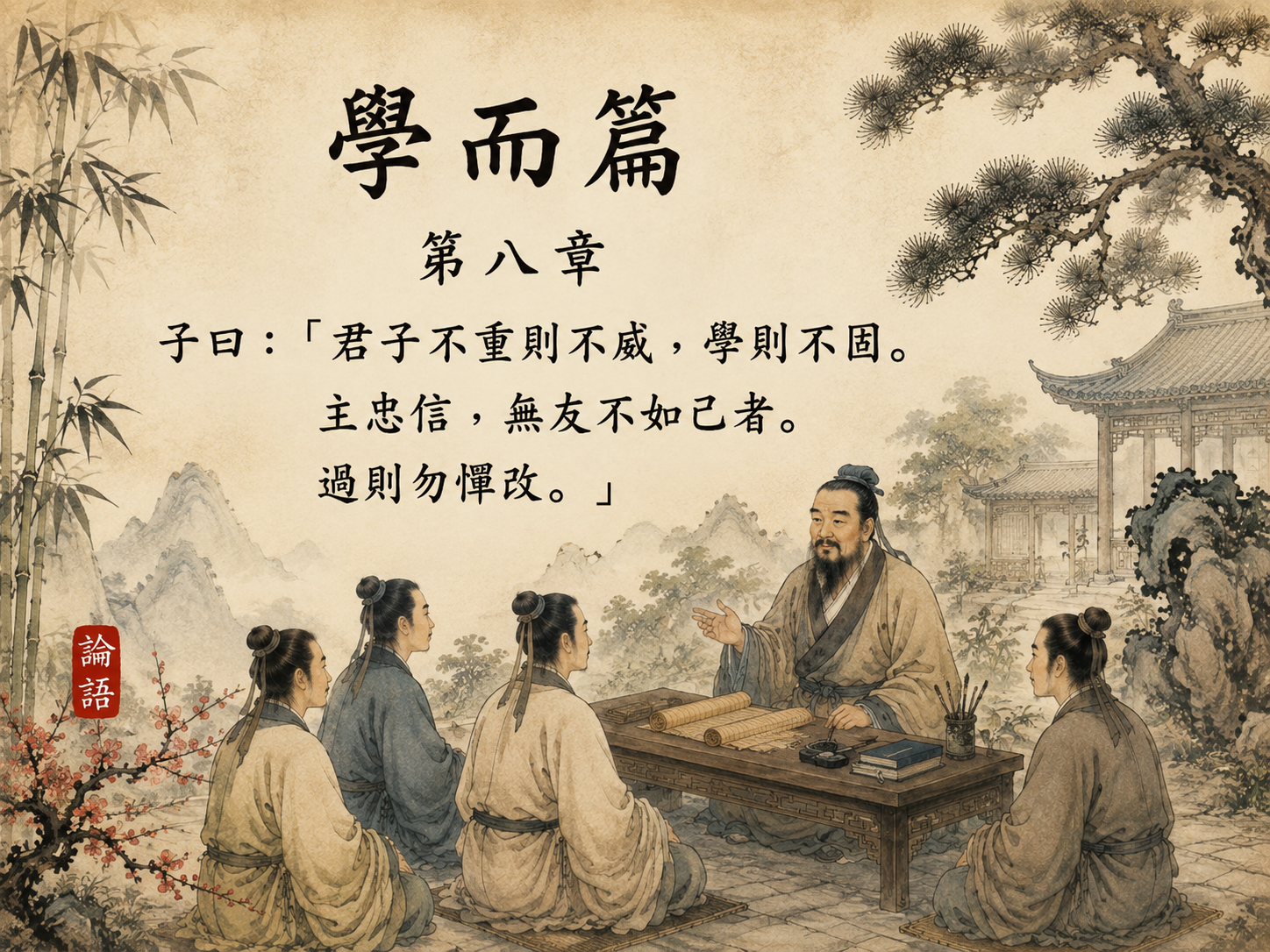
子曰:「君子不重則不威,學則不固。主忠信,無友不如己者。過則勿憚改。」
Simplified Chinese
子曰:“君子不重则不威,学则不固。主忠信,无友不如己者。过则勿惮改。”
Pinyin
Zǐ yuē: “Jūnzǐ bù zhòng zé bù wēi, xué zé bù gù. Zhǔ zhōng xìn, wú yǒu bù rú jǐ zhě. Guò zé wù dàn gǎi.”
Reading the Passage Literally
Confucius said:
“If the Junzi (君子) is not serious and steady, he will have no dignity, and what he learns will not be firmly established. Take loyalty and trustworthiness as your guiding principles. Do not take as a friend one who is not your equal. When you make a mistake, do not be afraid to correct it.”
Reading the Grammar
At first glance, this passage may seem to bring together several separate pieces of advice: seriousness of character, learning, loyalty and trustworthiness, friendship, and correcting one’s mistakes. Read as a whole, however, the sentences can be understood as describing how a person engaged in learning establishes and continually cultivates the self.
1. 君子不重則不威,學則不固
Jūnzǐ bù zhòng zé bù wēi, xué zé bù gù.
君子 (Junzi) originally carried associations with social status, but in the Analects it increasingly takes on an ethical meaning: a cultivated or exemplary person who seeks to develop good character.
Here 重 (zhòng) literally means “heavy,” but in this context it is better understood as seriousness, steadiness, or gravity of character. 則 (zé) connects a condition with its consequence and may be translated as “then” or “if … then.” Thus 不重則不威 literally means that if the Junzi lacks gravity, he will lack 威 (wēi).
威 need not suggest an authority that intimidates or dominates others. In this context, it can be understood as the dignity or presence that naturally arises from a serious and steady manner.
The following phrase, 學則不固, requires some care. 固 (gù) means “firm,” “solid,” or “securely established.” Traditional readings commonly understand the earlier condition 不重, “not being serious or steady,” as carrying over into this phrase: if a person lacks gravity, what he learns will not become firmly rooted.
The structure can be seen as:
君子 / 不重 / 則 / 不威
the Junzi / is not serious and steady / then / has no dignity
學 / 則 / 不固
what he learns / then / is not firmly established
The passage therefore suggests that learning cannot be explained only by the quantity of knowledge acquired. The disposition of the learner also affects how deeply learning takes root.
Key Characters and Meanings
君 (jūn, ruler; noble) · 子 (zǐ, person; master) · 不 (bù, not) · 重 (zhòng, heavy; serious; steady) · 則 (zé, then; if … then) · 威 (wēi, dignity; authority) · 學 (xué, to learn; learning) · 固 (gù, firm; firmly established)
2. 主忠信
Zhǔ zhōng xìn
主 (zhǔ) literally means “master” or “host,” but as a verb it can mean to make something primary, to take something as one’s guiding principle, or to place it at the center.
忠 (zhōng) is often translated as “loyalty,” but that English word can be too narrow if it is understood only in a political sense. In the Analects, Zhong (忠) can refer more broadly to doing one’s part wholeheartedly, faithfully, and with a sincere sense of responsibility.
信 (Xin) means trustworthiness—the quality of being reliable in one’s words and actions.
Thus 主忠信 may be read as:
主 / 忠信
take as primary / loyalty and trustworthiness
or more naturally:
“Take loyalty and trustworthiness as your guiding principles.”
Xin (信) has already appeared repeatedly in the opening chapters of Xue Er. In Chapter 4, Zengzi asks himself 與朋友交而不信乎, whether he has failed to be trustworthy in dealing with friends. Chapter 5 speaks of 敬事而信, conducting affairs carefully and maintaining trustworthiness. Chapter 6 calls for being 謹而信, careful and trustworthy, and Chapter 7 again places Xin at the center of friendship.
Chapter 8 now goes further by telling the learner to make Zhong (忠) and Xin (信) central principles of life. Their recurrence throughout Xue Er suggests that trustworthiness is not incidental but one of the foundations of cultivated character.
Key Characters and Meanings
主 (zhǔ, to make primary; to take as a guiding principle) · 忠 (zhōng, wholeheartedness; faithfulness; loyalty) · 信 (xìn, trustworthiness; reliability)
3. 無友不如己者
Wú yǒu bù rú jǐ zhě
This is one of the expressions in Chapter 8 that requires particular care.
友 (yǒu) normally means “friend” as a noun, but here it may be read verbally as “to befriend” or “to take as a friend.” 如 (rú) means “to be like,” “to equal,” or “to be comparable to.” 己 (jǐ) means oneself, and 者 (zhě) turns the preceding expression into a reference to a person.
Read literally, the sentence says:
“Do not take as a friend one who is not your equal.”
The structure is:
無 / 友 / 不如己 / 者
do not / befriend / one who is not equal to oneself / the person
Yet this sentence should not be too quickly turned into the modern claim that one should avoid friendship with people of lower ability, status, education, or achievement. Such a reading would reduce friendship to a hierarchy that the larger concerns of the passage do not require.
Traditional commentary has often understood the line in relation to moral cultivation: one should seek companions from whom one can learn and who can assist one’s development in virtue. This also connects with the surrounding chapters. Chapter 6 says 而親仁, to draw near to those who are humane, while Chapter 7 begins with 賢賢易色, traditionally read as valuing the worthy.
Within this sequence, the emphasis can therefore be placed on choosing relationships that help one learn, examine oneself, and grow in character, rather than on ranking people according to social standing or worldly achievement.
Key Characters and Meanings
無 (wú, do not; there is no) · 友 (yǒu, friend; to befriend) · 不 (bù, not) · 如 (rú, to be like; to equal) · 己 (jǐ, oneself) · 者 (zhě, one who; person)
4. 過則勿憚改
Guò zé wù dàn gǎi
過 (guò) can mean “to pass” or “to go beyond,” but here it refers to a fault, error, or mistake. 則 (zé) again marks the connection between a condition and what should follow.
勿 (wù) is a negative imperative meaning “do not.” 憚 (dàn) means “to fear,” “to shrink from,” or “to be reluctant to do something,” while 改 (gǎi) means “to change” or “to correct.”
The structure is:
過 / 則 / 勿 / 憚 / 改
when there is a mistake / then / do not / fear or hesitate / to correct it
What is striking is that Confucius does not simply say, “Do not make mistakes.” The possibility of human error is left open. The emphasis falls instead on what happens after an error is recognized: do not be afraid or reluctant to correct it.
Key Characters and Meanings
過 (guò, fault; mistake) · 則 (zé, then; if … then) · 勿 (wù, do not) · 憚 (dàn, to fear; to hesitate; to shrink from) · 改 (gǎi, to change; to correct)
Understanding the Meaning
Chapter 8 of Xue Er (學而) may initially seem to consist of several brief pieces of advice placed side by side. Confucius speaks first about gravity and dignity, then about learning, loyalty and trustworthiness, friendship, and finally the correction of mistakes. Yet when these statements are read together, they form a coherent picture of how a person engaged in learning establishes and cultivates the self.
The first element is steadiness of character. To be “weighty” or “serious” here does not mean that one must always appear solemn or speak as little as possible. It points instead toward taking one’s words, actions, and responsibilities seriously. Without such an inner steadiness, it is difficult to inspire trust in others, and what one learns may also fail to become firmly rooted in one’s life.
The second question is what should stand at the center of one’s conduct. Confucius answers with Zhong (忠) and Xin (信): wholehearted faithfulness in what one undertakes and trustworthiness in one’s words and actions. Considering how often Xin appears in the preceding chapters, the Analects seems to regard becoming a trustworthy person as an important part of what learning should accomplish.
The third question concerns the people with whom we grow. The literal wording of 無友不如己者 can sound uncomfortable to a modern reader because it appears to divide people into those who are above or below oneself. But its place within the chapter suggests a more productive emphasis: relationships influence moral cultivation. We should remain close to people who cause us to examine ourselves, offer good examples, and help us grow rather than treating friendship merely as a matter of convenience or social advantage.
The final element is how we respond to our own mistakes. However serious, trustworthy, or careful a person may be, mistakes remain possible. Confucius does not demand an impossible state of never being wrong. Instead, he says that once a fault is recognized, we should not hesitate to correct it. Admitting an error need not diminish a person; the willingness to change may itself be evidence of genuine learning.
Taken together, the chapter presents a person who stands with seriousness, makes faithfulness and trustworthiness central, learns through good relationships, and willingly corrects mistakes when they appear. Learning is therefore not merely the accumulation of knowledge. It is also the continuing work of reshaping one’s character and conduct.
Background and Context
Chapter 8 gathers several themes that have already appeared in the opening chapters of Xue Er and connects them more explicitly with self-cultivation. The learning introduced in Chapter 1 through 學而時習之 develops through the self-examination of Chapter 4, the practices of everyday conduct in Chapter 6, and the close relationship between learning and character in Chapter 7. Chapter 8 now turns more directly toward the disposition and practices of the learner.
Two important terms in this chapter are Zhong (忠) and Xin (信). Translating Zhong simply as political “loyalty” can narrow its meaning too much. In early Confucian usage, the term can refer more broadly to wholeheartedness and faithfulness in carrying out one’s responsibilities and dealing with others. Xin likewise means more than simply not telling lies. It describes a reliability of word and action that enables others to place trust in a person.
The expression 無友不如己者 has also generated considerable discussion. Traditional interpretations have commonly understood it as an instruction not to take as a friend someone inferior to oneself in virtue. For modern readers, however, care is needed not to reduce the sentence to a claim about social rank, educational attainment, wealth, or ability.
Elsewhere in the Analects, learning from others is repeatedly valued. Within the present chapter, the important point is that friendship and companionship form part of the environment in which self-cultivation takes place.
The closing words, 過則勿憚改, connect with a recurring concern of the Analects: the significance of recognizing and correcting one’s faults. Confucius does not construct the cultivated person as someone who never errs. What matters is whether a person can see a fault and respond by changing rather than defending it.
Seen in this way, the sentences of Chapter 8 are not isolated moral instructions. Steadiness of character, wholeheartedness and trustworthiness, relationships that support growth, and the willingness to correct oneself all belong to the continuing work of self-cultivation.
Dr. Ryu’s Reflection
As I read this chapter, the words that first draw my attention are the last ones: 過則勿憚改—when you make a mistake, do not be afraid to correct it. As the years pass, we accumulate experience and knowledge. Yet having more experience does not necessarily make it easier to admit that we are wrong. In fact, as we grow older and acquire positions, responsibilities, and a history of decisions behind us, saying “I was wrong” can sometimes become more difficult.
When we are young, admitting a mistake may feel like exposing our lack of ability. Later in life, another difficulty can arise. We have already made many judgments and decisions, and changing one of them may seem to threaten our authority or consistency. Yet after working with people in different organizations and countries over many years, I have often found the opposite to be true. A person who can change a judgment when new facts emerge may ultimately earn more trust than someone who insists on defending an earlier position at all costs.
My own years of study and research have also taught me that learning always begins, in some sense, by admitting that there is something I do not know. Living in different countries taught me a similar lesson. Ways of doing things that seemed completely natural to me did not always work in another culture, and assumptions I had taken for granted were sometimes not shared at all by the people around me. Experiences like these gradually taught me that one of the most important abilities in adapting to a new environment is not the ability never to be wrong, but the ability to make a correction when one discovers that one is wrong.
I also find myself reading 無友不如己者 differently as I grow older. When I was younger, I do not think I consciously approached relationships by asking, “What can I learn from this person?” Looking back, however, many of the people who influenced my life positively possessed something that I did not. Some were intellectually impressive; others quietly fulfilled their responsibilities with remarkable consistency; still others knew how to listen carefully to another person. I have also learned many things from people younger than I am or with less experience in fields familiar to me.
For that reason, I would rather hear 無友不如己者 not simply as “do not associate with someone inferior to yourself,” but as a reminder not to surround myself with relationships from which I am unwilling to learn. Different people have different things to teach us, and sometimes the person we think we are teaching turns out to teach us something more important in return. What matters is not the other person’s status or age, but whether the relationship encourages us to move in a better direction.
The opening words 君子不重則不威 can be considered in the same way. As we grow older, it is easy to confuse being a “person of weight” with speaking less, appearing stern, or behaving with authority. Yet among the people I have known, those who seemed to possess genuine gravity often did not emphasize their position at all. They did not speak carelessly, tried to take responsibility for what they said, and were able to admit when they did not know something. Trust arose naturally from that kind of steadiness.
Now, as I prepare for and live through a new stage of life, I find myself learning many things again. I am acquiring new skills, navigating unfamiliar digital environments, and sometimes revising today what I thought I had understood yesterday. In such a process, mistakes and trial and error cannot be avoided. That is why the short phrase 過則勿憚改 feels particularly practical to me now.
Rather than trying to become a person who never makes mistakes, become a person who can correct them when they are recognized.
These few words from more than two thousand years ago make me reconsider the meaning of learning. Perhaps learning is not a continuous attempt to prove that I am right. It may instead be the continuing process of correcting my thoughts and actions so that I can become a little better than I was yesterday.
References
- The Analects (論語), Xue Er (學而), Chapter 8.
- Yang Bojun (楊伯峻), Lunyu Yizhu (論語譯注), Zhonghua Book Company.
- Zhu Xi (朱熹), Lunyu Jizhu (論語集注).
- James Legge, The Chinese Classics, Vol. I: Confucian Analects.
- Edward Slingerland, Confucius: Analects: With Selections from Traditional Commentaries, Hackett Publishing, 2003.