Traditional Chinese
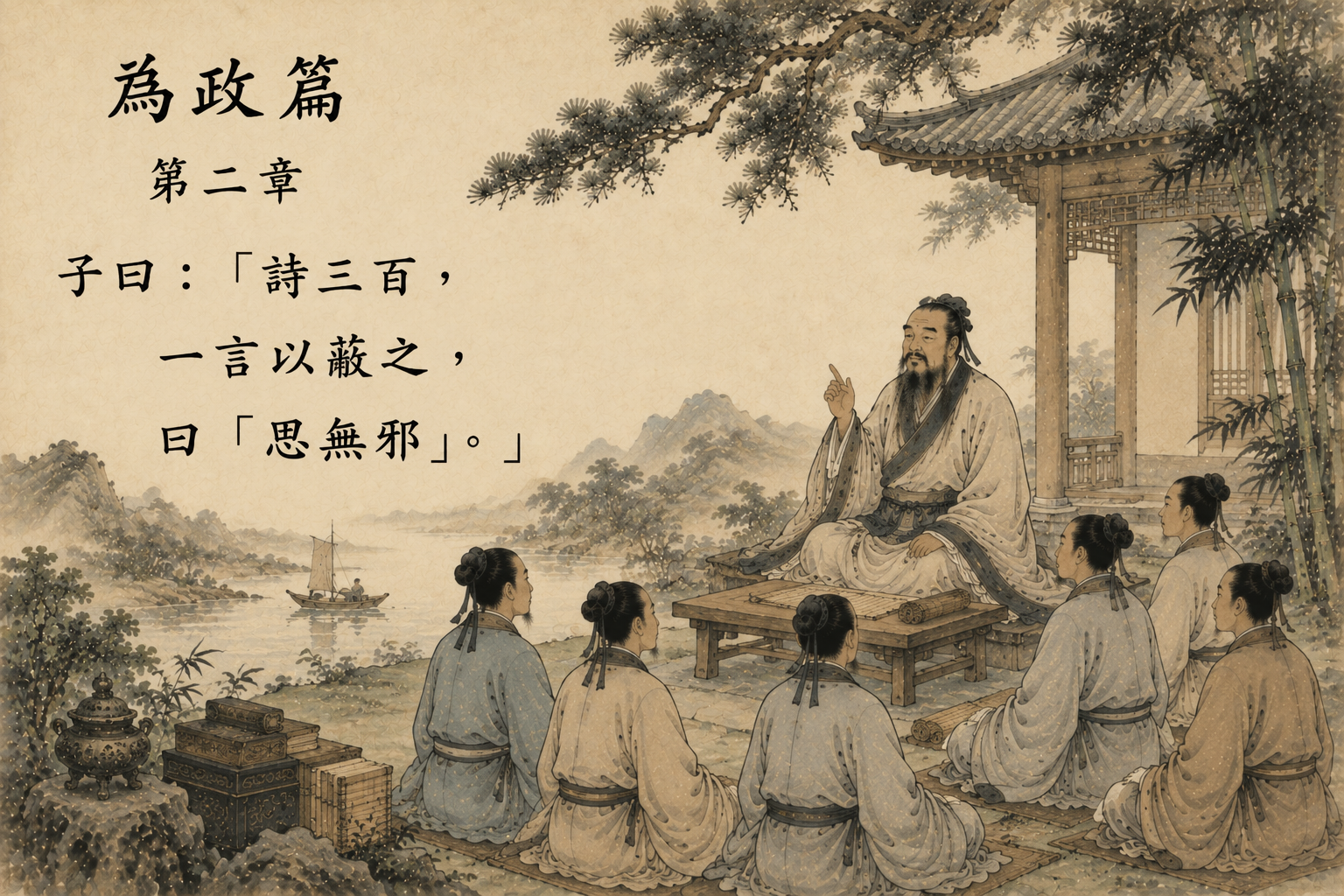
子曰:「詩三百,一言以蔽之,曰『思無邪』。」
Simplified Chinese
子曰:“诗三百,一言以蔽之,曰‘思无邪’。”
Pinyin
Zǐ yuē: “Shī sānbǎi, yī yán yǐ bì zhī, yuē ‘sī wú xié’.”
Reading the Passage Literally
Confucius said:
“The three hundred poems can be summed up in a single phrase: ‘The thoughts are without crookedness.’”
Put a little more naturally:
“If the many poems of the Book of Poetry were summed up in one phrase, it would be this: there is nothing wayward in the heart and mind.”
Reading the Grammar
This short sentence contains one of the most famous statements about the Book of Poetry in the Analects. Confucius takes a collection containing hundreds of poems with very different subjects, voices, emotions, and social settings, and gathers them under one brief expression: 思無邪. To understand the force of the passage, however, it is important not to read these four characters too narrowly as a command to “have no bad thoughts.” The statement is better understood as pointing toward a way in which poetry can reveal, shape, and refine the human heart.
1. 詩三百
Shī sānbǎi
詩 (Shī) here does not simply mean “poetry” in a general sense. It refers to the collection of poems later known as the Book of Poetry or Book of Songs (詩經).
三百 (sānbǎi) literally means “three hundred.” The received Book of Poetry contains 305 poems, and yet the expression 詩三百, “the three hundred poems,” became a traditional way of referring to the collection as a whole. Zhu Xi explains that 三百 should be understood as a rounded number, a way of referring broadly to the entire body of poems rather than as an exact count.
The structure is:
詩 / 三百
the Poetry / three hundred
In context, this can therefore be understood as:
“the three hundred poems,” or more naturally, “the whole Book of Poetry.”
The phrase directs attention not to the precise number of poems but to the breadth and variety of the collection that Confucius is about to summarize.
Key Characters and Meanings
詩 (shī, poem; the Book of Poetry) · 三 (sān, three) · 百 (bǎi, hundred)
2. 一言以蔽之
Yī yán yǐ bì zhī
一言 (yī yán) means “one word” or “one statement,” and here it carries the sense of “a single phrase.”
以 (yǐ) indicates means or method and may be translated as “with,” “by means of,” or “in.” 蔽 (bì) originally means to cover or conceal something, but in this context it means to cover comprehensively, embrace, or sum up a large body of material under one expression.
Zhu Xi glosses 蔽 through the sense of 蓋, “to cover.” The image is that a single phrase can extend over the many poems and gather their essential meaning beneath it. The final 之 (zhī) refers back to 詩三百, the whole collection.
The structure is:
一言 / 以 / 蔽 / 之
one phrase / by means of / encompass / it
Thus the sentence means:
“to sum it all up in a single phrase.”
The expression is important because it does not suggest that every poem says exactly the same thing. Rather, Confucius is claiming that beneath their diversity there is a principle that can bring them together.
Key Characters and Meanings
一 (yī, one) · 言 (yán, word; saying) · 以 (yǐ, by means of; with) · 蔽 (bì, to cover; to encompass; to sum up) · 之 (zhī, it)
3. 曰「思無邪」
Yuē “sī wú xié”
曰 (yuē) means “to say,” but here it introduces the expression that summarizes the poems: “namely,” or “it is said.”
The key phrase is 思無邪.
思 (sī) means thought, thinking, or the movement of the mind and heart. 無 (wú) means “without” or “there is no,” while 邪 (xié) refers to what is crooked, deviant, improper, or morally wayward.
Taken literally, the phrase can be rendered:
“The thoughts are without crookedness.” or: “There is no waywardness in the heart and mind.”
These four characters were not invented by Confucius. The phrase comes from the poem “Jiong” (駉) in the Hymns of Lu (魯頌) section of the Book of Poetry. Confucius takes a brief expression from one particular poem and uses it as a statement about the collection as a whole.
Zhu Xi interprets the phrase broadly. In his reading, poems describing what is good can awaken and strengthen good impulses, while poems portraying what is improper can warn against excess and disorder. In either case, poetry can help guide a person toward 情性之正, a proper or balanced condition of feeling and human nature.
For that reason, 思無邪 should not be reduced to the command “never have a bad thought.” Such a reading would make the phrase far narrower than the role poetry actually plays in the Analects.
The structure is:
曰 / 思 / 無 / 邪
it says / thought and mind / have no / crookedness
The phrase is therefore better understood as pointing toward a heart whose emotions and thoughts are not allowed to become distorted or misdirected.
Key Characters and Meanings
曰 (yuē, to say) · 思 (sī, thought; mind; reflection) · 無 (wú, without; there is no) · 邪 (xié, crooked; improper; wayward)
Understanding the Meaning
The Book of Poetry contains love and separation, marriage and family life, agriculture and labor, warfare and politics. Some poems celebrate joy, while others express grief, longing, disappointment, resentment, or criticism of social injustice. Its voices are varied, and so are the human emotions that appear within it.
Yet Confucius summarizes all of this in four characters:
思無邪.
The point cannot be that the Book of Poetry contains only pleasant or morally uplifting experiences. Human life does not consist only of joy and harmony, and neither does the collection. Desire, sorrow, anger, frustration, disappointment, and complaint all appear there.
The question, then, is how such a wide range of emotions can be gathered under the statement 無邪—“without crookedness.”
One way to understand the phrase is that the problem is not the existence of emotion itself, but the direction in which emotion is allowed to move. Feeling sorrow is not a moral failure. Feeling anger does not automatically make someone a bad person. Desire, jealousy, disappointment, and frustration are also part of human life. What matters is whether we can see those feelings clearly, express them appropriately, and keep them from becoming forces that distort our judgment or harm ourselves and others.
From this perspective, poetry is not merely a decorative literary art. Poetry reveals the heart. It allows us to encounter the joy and suffering of other people, and in doing so it may also help us recognize feelings within ourselves that we had not yet been able to name.
A poem may move us toward admiration for what is good. Another may expose the consequences of excess, selfishness, or disorder. Through both kinds of experience, the reader is invited to examine the heart.
This helps explain why Confucius considered the Book of Poetry so important to learning. The point was not simply to memorize many poems or acquire literary knowledge. The deeper purpose was to understand human feeling and gradually refine one’s own responses to life.
Background and Context
The Book of Poetry is the oldest surviving anthology of Chinese verse, and the received text contains 305 poems. Nevertheless, the Analects refers to the collection here as 詩三百, “the three hundred poems.” Zhu Xi explains the number as a rounded expression rather than a precise count, a traditional way of referring to the collection as a whole.
The phrase 思無邪 itself comes from “Jiong” (駉) in the Hymns of Lu (魯頌) section of the Book of Poetry. Confucius therefore does something particularly interesting: he takes a short phrase from one poem and uses it to characterize the meaning of the entire collection.
The placement of this chapter immediately after the first chapter of Wei Zheng is also worth noticing.
Chapter 1 begins with 為政以德, governing through virtue. Chapter 2 suddenly turns to poetry. At first glance, the transition may seem abrupt, as though the text has moved from politics to literature without explanation. Yet within Confucian thought, the two are not as distant as they appear.
If people are to be led through virtue, then those who lead must first cultivate their own character. The education of emotion was therefore closely connected with moral and political formation. Poetry, music, and Li (禮) were understood not merely as cultural accomplishments but as ways through which human feeling could be expressed, disciplined, and refined.
Reading the Book of Poetry was therefore not simply a literary exercise. It formed part of an education in understanding human emotion and learning how to govern one’s own heart.
Zhu Xi’s interpretation reflects this broader educational role. Poems depicting what is good can awaken good impulses, while poems portraying disorder or excess can cause the reader to recognize and guard against those tendencies. In both cases, poetry may help direct feeling toward a more balanced and proper condition.
Seen in this way, the first two chapters of Wei Zheng are not unrelated. Chapter 1 asks:
How should people be led?
Chapter 2 can be read as pointing toward a question that comes even earlier:
How is the human heart itself to be formed?
Dr. Ryu’s Reflection
When I read this chapter, the first words that catch my attention are 一言以蔽之—“to sum it all up in one phrase.” The Book of Poetry contains hundreds of poems filled with different lives, situations, and emotions, yet Confucius does not offer a long explanation. He gathers the collection into four characters: 思無邪.
That makes me think about the difference between knowing a great deal and understanding what is essential. The longer we study, the more material we accumulate. We read books, gather information, build experience, and gradually become capable of explaining more and more. Yet when someone asks, “What, then, is the most important point?” it is often surprisingly difficult to answer in a single clear sentence. Perhaps deep understanding does not end when we can say many things about a subject. It may reach another stage when we can see what lies at the center of all that complexity and express it simply without making it shallow.
Still, the phrase that stays with me longest is 思無邪.
At first glance, it may sound like “Do not have bad thoughts.” But human beings are not that simple. We cannot go through life thinking only good thoughts or maintaining a peaceful heart at every moment. We become angry. We envy someone. We feel hurt, disappointed, unfairly treated, or resentful.
If the mere appearance of such feelings were treated as wrongdoing, it might actually become harder to look honestly at our own hearts.
For that reason, I prefer to read 無邪 not as a state in which no negative emotion ever arises, but as an attitude of not deceiving oneself about what is happening within and of not allowing those feelings to carry the heart in a crooked direction.
This seems increasingly important to me with age. When we are young, much of our attention is directed toward what we still need to learn and what we still hope to achieve. As time passes, another question becomes important as well: What am I allowing to remain in my heart?
Two people may experience the same disappointment, but one may carry it for years as resentment while the other eventually turns it into an opportunity for reflection. Two people may experience success, but one may use it as a reason to look down on others while another may find in it a reason for gratitude.
The event itself is important, of course, but often what shapes the years that follow is how the heart receives and carries that event.
That is also one reason poetry still matters.
Reading one good poem does not immediately change a life. But for a moment it can stop us and allow us to look into another person’s heart. Sometimes, while doing so, we unexpectedly discover our own. A single line may give language to a feeling we have carried for a long time without knowing how to express it.
Perhaps this is part of why Confucius could summarize the three hundred poems with the four characters 思無邪. The important question is not only how much we have read, but where our reading is gradually taking the heart.
If someone reads all three hundred poems and nothing within changes, then perhaps only the fact of having read them remains. But if even one poem enables us to see our own heart more honestly and clearly, that reading has already become part of life.
So if I were to turn this chapter into a question for myself today, I would ask:
Not how much have I read, but have the things I have read led my heart even a little closer to what is right?
Confucius’s 詩三百,一言以蔽之 therefore sounds to me not like a question about how much knowledge we have accumulated, but about something more difficult:
After all our learning, what is it that finally remains within us?
References
- The Analects (論語), Wei Zheng (為政), Chapter 2.
- Zhu Xi (朱熹), Sishu Zhangju Jizhu (四書章句集注), commentary on Lunyu, Wei Zheng, including discussion of 詩三百, 蔽, and 思無邪.
- Zhu Xi (朱熹), Lunyu Jizhu (論語集注), Volume 1, on the educational significance of 思無邪 and the Book of Poetry.
- Yang Bojun (楊伯峻), Lunyu Yizhu (論語譯注), Zhonghua Book Company.
- Book of Poetry (詩經), “Jiong” (駉), Hymns of Lu (魯頌).


