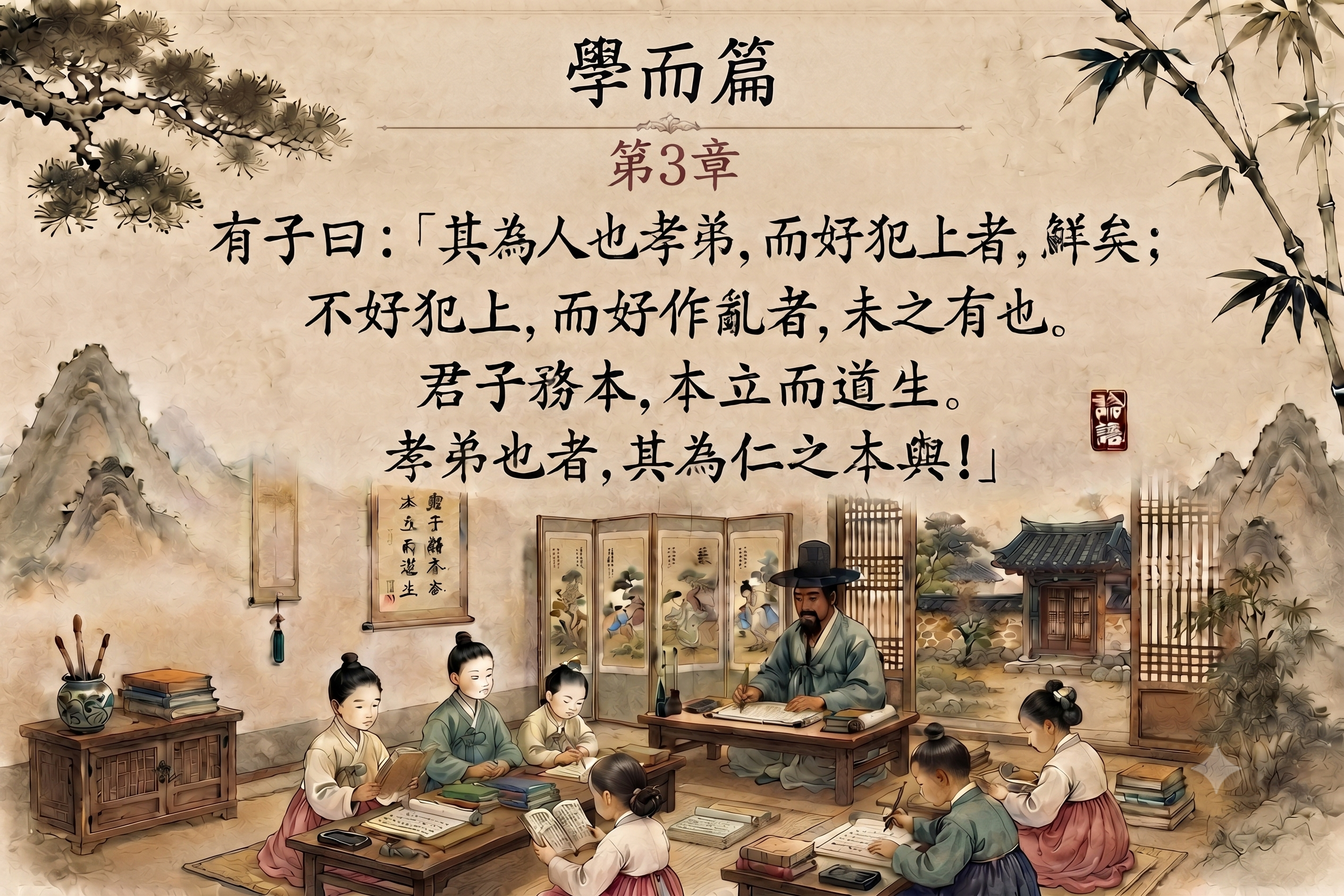
Traditional Chinese
子曰:「巧言令色,鮮矣仁。」
Simplified Chinese
子曰:“巧言令色,鲜矣仁。”
Pinyin
Zǐ yuē: “Qiǎo yán lìng sè, xiǎn yǐ rén.”
Reading the Whole Passage
Confucius said:
“Clever words and pleasing expressions—Ren (仁) is rarely found in them.”
This is one of the shortest passages in the Analects, yet its point is remarkably direct. Confucius contrasts an outward manner carefully fashioned to please others with Ren (仁), the inner quality of humaneness that lies at the heart of Confucian ethics.
The passage does not condemn eloquence, courtesy, or a pleasant expression. Rather, it raises a more difficult question: When words and appearances are carefully shaped to win approval, how much sincerity remains behind them?
Reading through Grammar
1. 子曰:「巧言令色,鮮矣仁。」
Zǐ yuē: “Qiǎo yán lìng sè, xiǎn yǐ rén.”
子曰 (zǐ yuē) is one of the most familiar expressions in the Analects. 子 refers here to Confucius, while 曰 means “to say” or “to speak.” Together, the phrase introduces a statement by Confucius: “Confucius said.”
巧言 (qiǎo yán) combines 巧, meaning skillful, clever, or artfully fashioned, with 言, meaning words or speech. Here it does not simply describe someone who speaks eloquently. It suggests speech deliberately polished or fashioned to win another person's favor. The problem, therefore, is not verbal ability itself, but speech in which pleasing the listener becomes more important than sincerity.
令色 (lìng sè) works in much the same way. 令 here has the sense of pleasing or agreeable, while 色 refers to a person's facial expression or outward appearance. In this context, 令色 suggests presenting a carefully pleasing expression in order to make a favorable impression.
The final phrase, 鮮矣仁 (xiǎn yǐ rén), is especially compact. 鮮 here means “few,” “rare,” or “scarce,” rather than “fresh,” its more familiar meaning in modern Chinese. 矣 is a particle that adds emphasis or a sense of judgment. 仁 is Ren (仁), one of the central concepts of Confucian thought, commonly rendered in English as “humaneness” or “benevolence.”
The sentence can therefore be broken down as:
子曰 / 巧言 / 令色 / 鮮矣仁
Confucius said / artfully fashioned words / pleasing expressions / Ren (仁) is rare
The structure creates a sharp contrast. 巧言令色 describes what is presented outwardly through speech and expression; 仁 points toward the moral quality within.
It is also worth noticing that Confucius says 鮮矣仁—Ren (仁) is rare—rather than declaring that it is entirely absent. The wording is brief but carefully measured. His concern is not that every eloquent or pleasant person lacks Ren (仁), but that excessive concern with outward impression can easily become separated from genuine character.
Understanding the Meaning
It would be misleading to read this passage as saying that people who speak well are lacking in Ren (仁). Confucius is not criticizing eloquence itself, nor is he suggesting that friendliness or a warm expression is somehow morally suspect. Speaking gently out of consideration for another person can be a virtue, and a welcoming expression can be a genuine sign of respect.
The real question is whether our words and expressions arise from what we sincerely feel, or whether they are manufactured primarily to win approval.
Both 巧言 and 令色 concern outward presentation. Ren (仁), by contrast, concerns the quality of our humanity as it is expressed in our relationships with others. Confucius warns about the distance that can emerge between these two dimensions: the person we present and the person we actually are.
That distinction makes this very short passage surprisingly contemporary. Human beings have always cared about how they appear to others, but modern life gives us more opportunities than ever to manage that appearance. We choose our words, photographs, profiles, and public expressions with great care. There is nothing inherently wrong with doing so. The question raised by the Analects is whether the presentation still corresponds to something genuine within.
The passage therefore asks something deeper than whether we are good speakers:
How closely do our words, our expressions, and our actual character correspond to one another?
Background and Context
The placement of this passage near the beginning of Xue Er (學而) is worth noticing. In Chapter 2, Youzi (有子) says that “the exemplary person attends to the root” (君子務本) and connects filial devotion and respect with the cultivation of Ren (仁). Chapter 3 immediately turns to 巧言令色.
Read together, the two passages create a useful contrast. Chapter 2 directs attention toward the root of moral cultivation; Chapter 3 warns against placing too much weight on outward presentation. One asks where genuine character begins, while the other identifies an attitude that may conceal its absence.
Words and conduct are recurring concerns throughout the Analects. Confucius does not treat language as unimportant. How people speak matters because words are part of human relationships. Yet words become morally questionable when they are separated from conduct or used primarily to create an appearance that character cannot support.
Seen in this context, 巧言令色 means more than simple flattery. It points to a possible gap between outward presentation and inward reality, continuing one of the fundamental questions raised at the beginning of the Analects: What should a person cultivate at the root of one's life?
Dr. Ryu’s Reflection
Over the years, I have often seen how different a first impression can be from the impression that remains after knowing someone for a long time. A person who speaks well and immediately makes others feel comfortable may seem impressive at first, yet with time we may discover a considerable distance between that person's words and actions. The opposite can also happen. Someone who initially seems quiet, reserved, or even somewhat awkward may, after many years, prove to be the person we trust most. Perhaps this is one reason why truly understanding another person takes much longer than we expect.
Yet I do not read this passage as a warning against people who communicate well. In today's world, the ability to express one's thoughts clearly and considerately is more important than ever. Having lived and worked among people from different countries and cultural backgrounds, I have repeatedly seen how differently a relationship can develop depending on how the same thought is expressed. Kind words and a warm expression can genuinely shorten the distance between people.
So the question that remains with me is a different one:
How close are my words to what is actually in my heart?
Do I sometimes say things I do not truly mean because I want others to think well of me? Do I present a slightly more polished version of myself because I am conscious of how others may judge me? These questions seem particularly relevant today, when social media and online spaces continually invite us to present carefully selected versions of ourselves.
巧言令色,鮮矣仁。
Perhaps what Confucius warned against was not beautiful speech, but beautiful speech that has lost its sincerity. As I grow older, it seems increasingly important not to make my words more impressive, but to reduce, little by little, the distance between what I say and how I actually live.
References
- The Analects (論語), Xue Er (學而), Chapter 3 (Analects 1.3).
- Zhu Xi (朱熹), Lunyu Jizhu (論語集注), in Sishu Zhangju Jizhu (四書章句集注).
- James Legge, The Chinese Classics, Vol. I: Confucian Analects.
- Edward Slingerland, Confucius: Analects: With Selections from Traditional Commentaries. Hackett Publishing, 2003.
- Chinese Text Project, The Analects: Xue Er.


