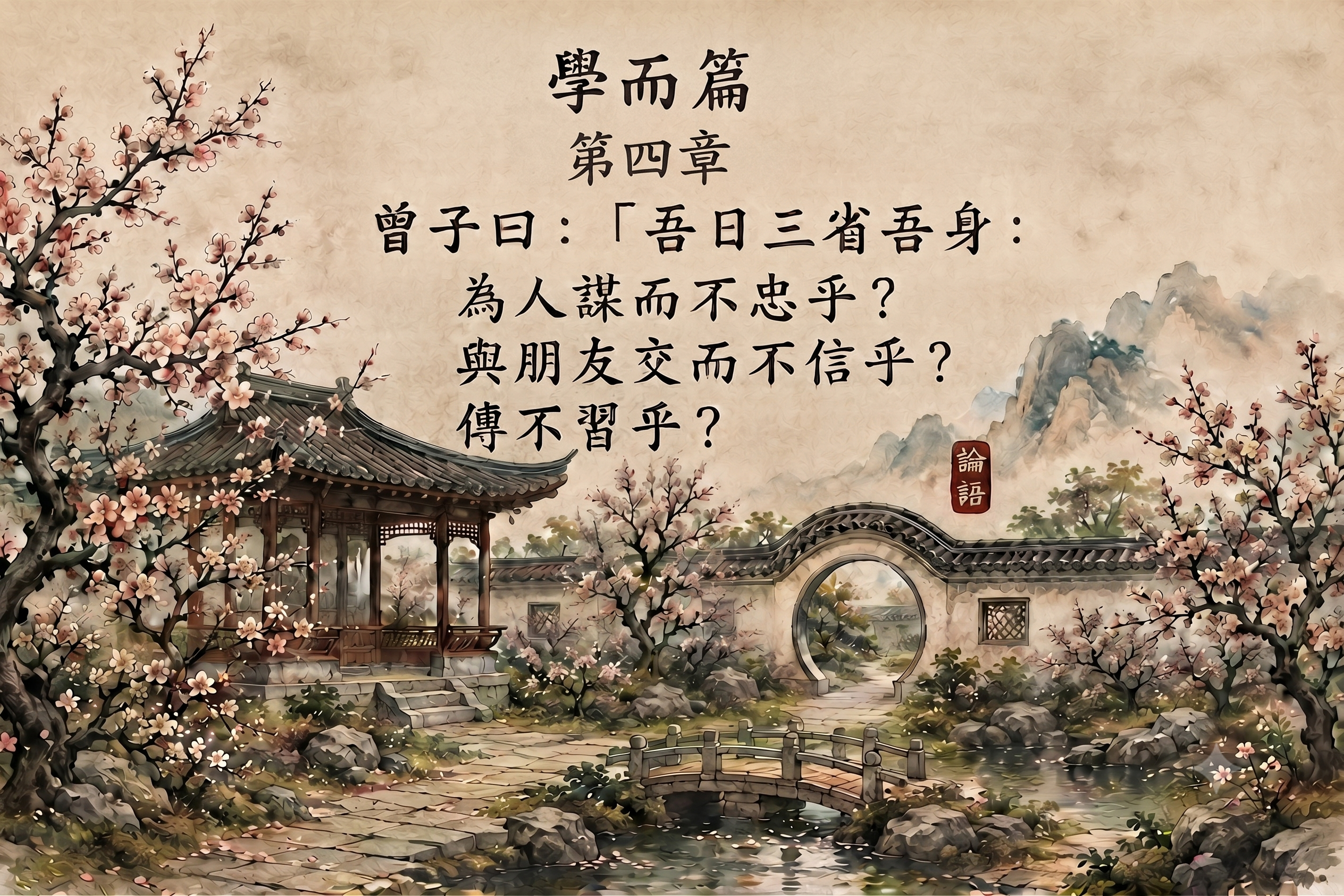
Traditional Chinese
曾子曰:「吾日三省吾身:為人謀而不忠乎?與朋友交而不信乎?傳不習乎?」
Simplified Chinese
曾子曰:“吾日三省吾身:为人谋而不忠乎?与朋友交而不信乎?传不习乎?”
Pinyin
Zēngzǐ yuē: “Wú rì sān xǐng wú shēn: Wèi rén móu ér bù zhōng hū? Yǔ péngyǒu jiāo ér bù xìn hū? Chuán bù xí hū?”
Reading the Whole Passage
Zengzi (曾子) said:
“Every day I examine myself in three ways: In working on behalf of others, have I failed to do my best? In my relationships with friends, have I failed to be trustworthy? Have I failed to practice what has been passed on to me?”
The three questions all turn in the same direction. Zengzi does not begin by asking what others have done wrong. He asks what he himself has done: whether he has been conscientious in his responsibilities, trustworthy in friendship, and diligent in putting what he has learned into practice.
Reading through Grammar
1. 曾子曰:「吾日三省吾身」
Zēngzǐ yuē: “Wú rì sān xǐng wú shēn.”
曾子 (Zengzi) is an honorific name for Zeng Shen (曾參), one of Confucius' disciples. 子 here is a respectful title used for a teacher or learned person, while 曰 means “to say.”
吾 means “I” or “my,” and 日 here functions adverbially, meaning “daily” or “every day.”
The character requiring particular attention is 省. Here it is pronounced xǐng and means “to examine,” “to reflect upon,” or “to inspect oneself.” Thus 省吾身 literally means “examine my own person,” naturally understood as “examine myself” or “reflect on myself.”
三省 can literally be read as “examine three times.” However, because three specific questions immediately follow, it may also be understood as examining oneself in three respects or in three ways, rather than necessarily performing self-examination at exactly three separate times each day.
The structure is:
曾子曰 / 吾 / 日 / 三省 / 吾身
Zengzi said / I / every day / examine in three ways / myself
The sentence therefore introduces a regular practice of self-examination rather than an occasional response to a particular failure.
Character Meanings
曾 (Zēng, surname Zeng) · 子 (zǐ, master; respected teacher) · 曰 (yuē, to say) · 吾 (wú, I; my) · 日 (rì, day; here, every day) · 三 (sān, three) · 省 (xǐng, to examine; to reflect upon) · 身 (shēn, body; oneself)
2. 為人謀而不忠乎?
Wèi rén móu ér bù zhōng hū?
為人 means “for another person” or “on behalf of others,” while 謀 means to plan, deliberate, or manage something on someone's behalf.
The key word here is 忠 (zhōng). In later or more familiar usage, it can easily bring to mind “loyalty” to a ruler or state. In this passage, however, it is better understood as being fully committed, conscientious, and wholehearted in carrying out a responsibility for another person.
而 connects the elements of the question, 不忠 means “not being conscientious or wholehearted,” and 乎 is an interrogative particle.
The structure is:
為人謀 / 而 / 不忠 / 乎
in planning or working for others / have I / not been wholehearted / ?
Zengzi's first question is therefore directed toward the quality of his own conduct when entrusted with something on behalf of another person.
Character Meanings
為 (wèi, for; on behalf of) · 人 (rén, person; others) · 謀 (móu, to plan; to deliberate; to manage) · 而 (ér, and; yet) · 不 (bù, not) · 忠 (zhōng, wholeheartedness; conscientious devotion) · 乎 (hū, interrogative particle)
3. 與朋友交而不信乎?
Yǔ péngyǒu jiāo ér bù xìn hū?
與朋友交 means “to associate with friends” or “to interact with friends.” 與 means “with,” 朋友 means friends, and 交 refers to associating or maintaining relationships with others.
The central character is 信 (xìn). It can mean trust or belief, but here the emphasis is not primarily on whether Zengzi trusted his friends. Rather, it concerns whether he himself was trustworthy in his dealings with them. It therefore carries the sense of reliability, keeping faith, and being true to one's word.
The structure is:
與朋友交 / 而 / 不信 / 乎
in associating with friends / have I / failed to be trustworthy / ?
Again, the direction of the question is inward. Zengzi does not ask whether his friends kept faith with him. He asks whether he kept faith with them.
Character Meanings
與 (yǔ, with; together with) · 朋 (péng, companion; friend) · 友 (yǒu, friend) · 交 (jiāo, to associate; to interact) · 而 (ér, and; yet) · 不 (bù, not) · 信 (xìn, trustworthiness; keeping faith) · 乎 (hū, interrogative particle)
4. 傳不習乎?
Chuán bù xí hū?
This is the shortest of the three questions, but it deserves careful attention.
傳 here can be understood as what has been transmitted or passed on, particularly teachings received from one's teacher. 習 is the same character that appeared in the opening passage of the Analects, 學而時習之. It means more than merely hearing or learning something once. It carries the idea of repeatedly practicing, reviewing, and making what one has learned one's own.
Thus 傳不習乎 may be read as: “Have I failed to practice what has been transmitted to me?” or “Have I failed to review and put into practice what I have been taught?”
The structure is:
傳 / 不習 / 乎
what has been transmitted / have I failed to practice / ?
The reappearance of 習 (xí) is significant. The idea introduced in Chapter 1—that learning requires repeated practice—returns here as a question of personal responsibility.
Character Meanings
傳 (chuán, what is transmitted; teaching passed on) · 不 (bù, not) · 習 (xí, to practice; to review; to become familiar through repetition) · 乎 (hū, interrogative particle)
Understanding the Meaning
The three questions Zengzi asks himself share one striking feature: none of them asks what another person has done wrong.
The first asks whether I have been conscientious when acting on behalf of someone else. The second asks whether I have been trustworthy in friendship. The third asks whether I have truly practiced what I have learned. From beginning to end, the object of examination is oneself.
This is perhaps the most important point in the passage. When something goes wrong, it is natural to look outward for the cause. A task failed because someone else did not do his part. A friendship suffered because the other person failed to keep a promise. Learning was unsuccessful because the teacher did not explain something clearly enough. Zengzi's questions reverse that direction. Before asking what others have done, he asks: What have I done?
The three questions also cover three different but fundamental areas of life: work and responsibility, relationships with others, and learning. Seen this way, 吾日三省吾身 is more than an instruction to search for one's faults. It describes a regular habit of examining how one is living.
Self-examination here is therefore concrete rather than abstract. Zengzi does not simply ask, “Was I a good person today?” He asks more practical questions: Was I conscientious in what I was entrusted to do? Was I trustworthy toward others? Did I practice what I learned?
Background and Context
Zengzi (曾子), whose personal name was Zeng Shen (曾參), was one of Confucius' disciples. He appears several times in the Analects, often in passages concerned with self-cultivation, responsibility, and the ethical demands of human relationships.
The placement of his words in Chapter 4 is meaningful when read alongside the opening chapters of Xue Er (學而). Chapter 1 begins with the joy of learning and repeated practice. Chapter 2 turns to filial devotion, respect, and the roots of moral cultivation. Chapter 3 warns against clever words and pleasing appearances that lack genuine inner substance. Chapter 4 then presents a practical method for turning these concerns inward: regularly examining one's own conduct.
Read in sequence, a pattern begins to emerge: learn and practice, establish the foundations of character, beware of outward appearance without inner substance, and then examine yourself regularly.
The expression 三省吾身 later became widely associated with the idea of self-reflection. Yet it is important not to detach it from the three questions that follow. Zengzi's self-examination was not vague introspection. It concerned very specific aspects of daily life: responsibility, trustworthiness, and learning.
Dr. Ryu’s Reflection
When I encountered 吾日三省吾身 when I was younger, it was easy to hear it simply as an instruction to “reflect on yourself every day.” Reading it again later in life, however, I find myself paying more attention to the three questions that follow. Zengzi did not ask how successful he had been, how much recognition he had received, or what he had gained that day. He asked whether he had been conscientious in what was entrusted to him, whether he had been trustworthy toward others, and whether he had truly practiced what he had learned.
Many days in life do not unfold according to plan. Things sometimes go wrong because of other people, unexpected circumstances arise, and even things we have worked hard to learn can fade with time. It would not be reasonable to assume that every outcome is entirely our responsibility. But there is still an important distinction between what we cannot control and what we can examine. I cannot decide how faithfully another person treats me, but I can ask how faithfully I treated that person. I cannot control how a friend behaves toward me, but I can ask whether I was someone that friend could trust.
The third question, 傳不習乎, feels especially meaningful to me now. I believe there is no age at which we must stop learning, but learning something and making it truly our own are clearly different things. Reading a book, learning a new technology, or encountering a new idea does not complete the process. We have to try it, make mistakes, try again, and sometimes return to it after time has passed before it gradually becomes part of us. That is why I find the connection between 學而時習之 in Chapter 1 and 傳不習乎 here particularly interesting.
I do not think we need literally to examine ourselves three times every day. But perhaps, at the end of a day, it is worth pausing long enough to ask three simple questions: Did I give proper care to the responsibilities entrusted to me? Was I someone others could trust? Did I allow what I learned today simply to pass by, or did I make some effort to practice it?
Perhaps a life is shaped less by grand resolutions than by small questions like these, asked repeatedly over many years.
References
- The Analects (論語), Xue Er (學而), Chapter 4 (Analects 1.4).
- Zhu Xi (朱熹), Lunyu Jizhu (論語集注), in Sishu Zhangju Jizhu (四書章句集注).
- Chinese Text Project, The Analects: Xue Er.
- Institute for the Translation of Korean Classics, Classical Chinese and Chinese-character reference materials.


