Traditional Chinese
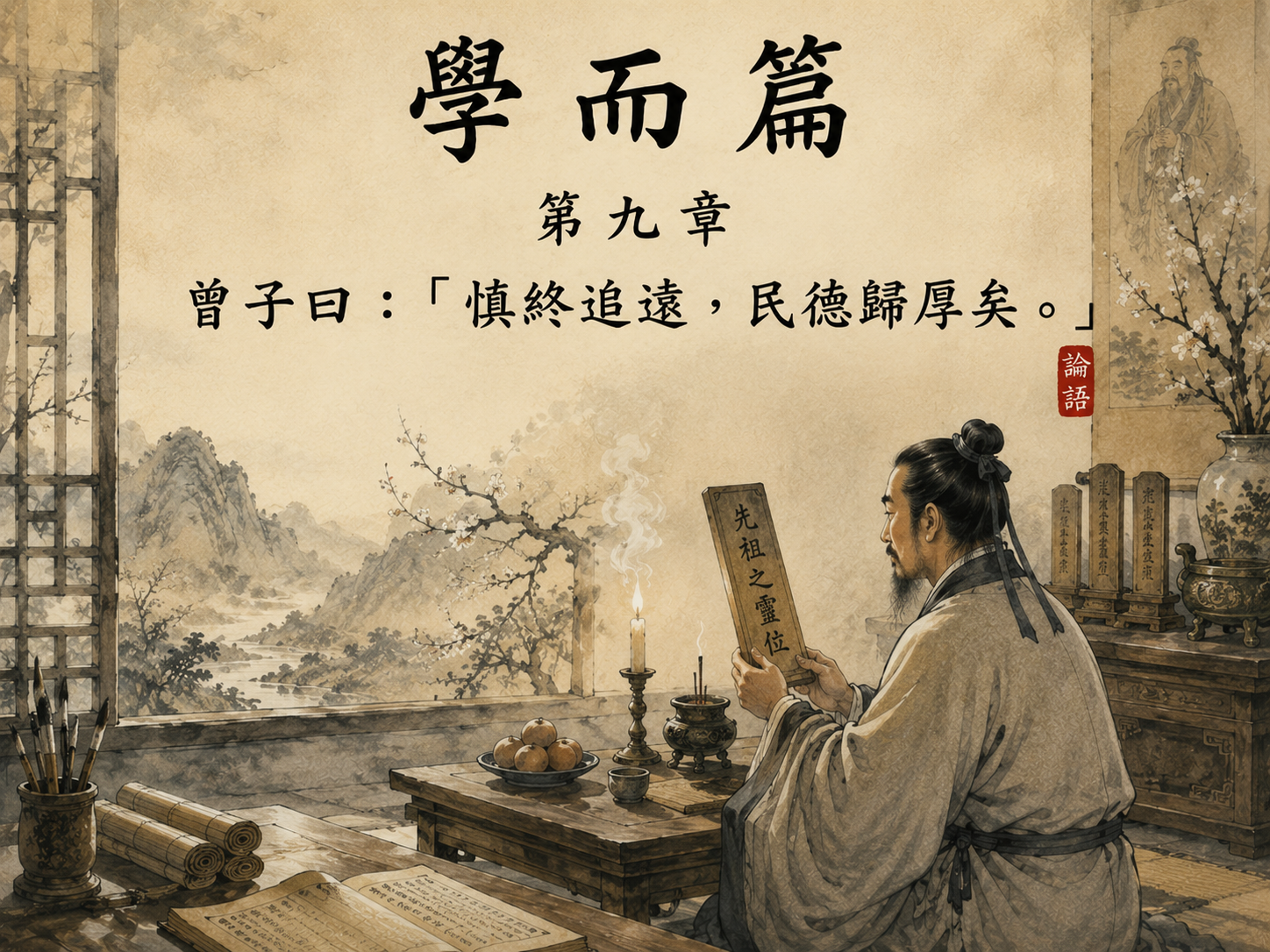
曾子曰:「慎終追遠,民德歸厚矣。」
Simplified Chinese
曾子曰:“慎终追远,民德归厚矣。”
Pinyin
Zēng Zǐ yuē: “Shèn zhōng zhuī yuǎn, mín dé guī hòu yǐ.”
Reading the Passage Literally
Zengzi said:
“Attend carefully to the end and remember those long departed; then the virtue of the people will return to fullness and depth.”
Reading the Grammar
This is one of the shortest passages in Xue Er (學而), yet its movement is surprisingly broad. Zengzi begins with the way people treat death and remember those who came before them, then connects those practices with the moral character of an entire community. The passage moves from 慎終追遠, careful remembrance of the dead and distant ancestors, to 民德歸厚, the deepening of the people’s moral character.
1. 慎終追遠
Shèn zhōng zhuī yuǎn
慎 (shèn) means “to be careful,” “to be cautious,” or “to treat something with seriousness and care.” Here it suggests more than simply avoiding mistakes. It conveys the idea of attending to something with sincerity and not treating it lightly.
終 (zhōng) literally means “end” or “completion.” In the traditional interpretation of this passage, it refers especially to the end of a person’s life and therefore to death, mourning, and funeral rites. 慎終 can thus be understood as treating a person’s death and final rites with care and reverence.
In 追遠, 追 (zhuī) literally means “to pursue” or “to follow after,” but here it carries the sense of looking back toward, remembering, or commemorating those who have passed away. 遠 (yuǎn) means “distant.” In this context, it is traditionally understood as referring to those distant in time—especially remote ancestors.
The structure can be seen as:
慎 / 終
attend carefully to / the end
追 / 遠
remember or commemorate / those distant in time
The two compact expressions stand in parallel. 慎終 begins with the death of someone closer in time, while 追遠 extends remembrance backward toward earlier generations. The movement is therefore from the recent dead toward those who belong to a more distant past.
Taken together, 慎終追遠 means more than simply carrying out funeral and ancestral rites correctly. It expresses an attitude of treating the death of those close to us with care and continuing to remember those who came before us.
Key Characters and Meanings
慎 (shèn, to be careful; to treat with reverence) · 終 (zhōng, end; death) · 追 (zhuī, to pursue; to remember) · 遠 (yuǎn, distant; those long departed)
2. 民德歸厚矣
Mín dé guī hòu yǐ
民 (mín) means “the people,” while 德 (dé) means virtue, moral character, or ethical quality. 民德 can therefore refer to the moral disposition or prevailing character of the people.
歸 (guī) means “to return,” “to come back,” or “to move toward.” 厚 (hòu) literally means “thick,” but when applied to character, relationships, or social customs, it can suggest depth, generosity, sincerity, warmth, or moral substance.
Thus 歸厚 literally means “to return to thickness,” but in natural English it points toward a condition in which people’s character and social relationships become deeper, more sincere, and more humane.
The final particle 矣 (yǐ) marks a conclusion or a resulting state. Here it emphasizes the consequence of 慎終追遠.
The structure is:
民 / 德 / 歸 / 厚 / 矣
the people / their virtue / returns / to depth and fullness / indeed
The sentence therefore suggests that when people treat the dead with care and remember those who came before them, the moral character of society itself becomes deeper and more substantial.
Key Characters and Meanings
民 (mín, the people) · 德 (dé, virtue; moral character) · 歸 (guī, to return; to move toward) · 厚 (hòu, thick; deep; generous; substantial) · 矣 (yǐ, sentence-final particle marking conclusion or change)
Understanding the Meaning
Chapter 9 is extremely brief, but Zengzi begins with the death of an individual and ends with the moral character of a whole society.
At first, 慎終追遠 may appear simply to mean that funerals should be conducted carefully and ancestors should be properly remembered. Traditional interpretations do indeed connect 慎終 with mourning and funeral rites, especially those for one’s parents, and 追遠 with continuing remembrance of ancestors through ritual practices.
Yet the meaning of the passage does not need to stop with ritual procedure. The deeper question concerns how people remember those who lived before them.
No one begins life entirely alone. We receive life from parents, inherit relationships and memories from earlier generations, and live within worlds that others helped to build before we arrived. Remembering the dead is therefore not merely an act of looking backward. It can also be a way of remembering where we came from and what we have received.
This helps explain why Zengzi immediately follows 慎終追遠 with 民德歸厚矣. Why should the way individuals mourn the dead and remember their ancestors influence the moral character of society?
One possible answer lies in the attitudes that remembrance cultivates. A person who does not easily forget those from whom life, care, teaching, and support were received may also become more attentive to gratitude, responsibility, and respect. When such attitudes are repeatedly cultivated within families and communities, relationships themselves may become less superficial.
This is the force of 厚. Literally, it means “thick,” but applied to human relationships and moral life it suggests depth, substance, warmth, and generosity. Zengzi’s point can therefore be read as saying that a society becomes morally deeper when people do not forget those to whom they are indebted.
Modern funeral customs and ways of remembering ancestors vary widely, and they continue to change. The passage therefore need not be reduced to the claim that everyone must preserve one particular ritual form. Its underlying question remains broader:
What have I received from those who lived before me, and how do I remember them?
The passage suggests that the way we remember the dead may ultimately shape the way we treat the living.
Background and Context
The speaker in this chapter is Zengzi (曾子), whose personal name was Shen (參). He was one of Confucius’s disciples and is especially associated in the Analects with self-examination, filial devotion, and moral discipline. Earlier, in Chapter 4 of Xue Er, Zengzi says 吾日三省吾身, “Each day I examine myself on three matters.” In Chapter 9, his attention expands from individual self-examination to family memory and eventually to the moral character of society.
The phrase 慎終追遠 is closely connected with the traditional Chinese contexts of mourning rites (喪禮) and ancestral rites (祭禮). In early Chinese society, funerals and ancestral remembrance were not merely private ceremonies. They helped affirm family bonds, continuity between generations, and the responsibilities that connected the living with those who had died.
Mourning a parent carefully and continuing to remember earlier ancestors were therefore ways in which individuals located themselves within a larger chain of relationships. The practices reminded the living that their own lives had not begun independently of the generations before them.
This theme connects naturally with Xiao (孝), filial devotion, which appears repeatedly in the opening chapters of Xue Er. In Chapter 2, Youzi asks whether filial devotion and respect for elders are not the root of practicing Ren (仁). Chapter 6 again says 入則孝, that the young should be filial at home. Chapter 9 extends this attitude beyond the lifetime of one’s parents. Respect and remembrance do not simply end when a person dies.
Filial devotion in these chapters is therefore broader than obedience to living parents. It also involves remembering one’s origins and recognizing relationships that extend across generations.
What is particularly striking is that Zengzi does not stop with private virtue. He says 民德歸厚矣: the virtue of the people will become deeper. This reflects an important tendency in early Confucian thought, in which individual cultivation, family relationships, and the moral quality of the wider community are closely connected rather than treated as completely separate domains.
In this sense, a disposition cultivated within the family can influence the moral atmosphere of a community. When people remember what they have received and refuse to treat human relationships as disposable, the bonds between people may become more substantial. That connection between remembrance and social depth lies at the heart of 民德歸厚矣.
Dr. Ryu’s Reflection
As I grow older, some expressions that once seemed distant begin to sound very different. 慎終追遠 is one of them. When I was younger, I might have read these four characters mainly as a traditional Confucian teaching about funerals and the remembrance of ancestors. But as the years pass, and as we experience the departure of people who lived before us, the question of what it means to remember someone begins to feel much more personal.
Throughout life, we receive something from many people. We receive life and care from our parents, learning from teachers, encouragement from friends, and help from colleagues and others we meet along the way. At the time, we do not always realize how valuable these gifts are. Some are so close to us that we take them for granted. At other times, we are simply too busy to say thank you properly. Only later, sometimes after a person is no longer beside us, do we begin to understand how much we received.
For that reason, 追遠 now speaks to me in a broader way than simply commemorating distant ancestors. Remembering those who have gone before us does not mean living in the past. To me, it means remembering that the person I am today was not made by my effort alone.
We often like to think that we have reached our present position through our own hard work. Personal effort certainly matters. But when we look back carefully, we discover many hands along the road: someone who made it possible for us to study, someone who remained beside us during a difficult period, someone who opened a door, and even someone whose uncomfortable advice eventually helped us choose a better direction. Each, in some way, became part of the person we later became.
Remembering such people changes the way we look at others. Zengzi says that when people 慎終追遠, then 民德歸厚矣. At first, the connection between these two ideas may not seem obvious. Why should careful mourning and remembrance of ancestors make the moral character of society deeper? Yet the more I think about it, the more I feel that something lies between the two: gratitude.
A person who remembers what he has received finds it more difficult to regard the help of others as something naturally owed to him. Remembering what we received from our parents may change the way we look toward the next generation. Remembering what we received from teachers may encourage us to share what we know with someone else. A person who once passed through a difficult time because someone offered a helping hand may be more willing to extend a hand when another person is struggling.
Seen this way, the expression that **virtue becomes 厚—deep or substantial—**begins to make sense. A society does not necessarily become warmer because people repeat impressive moral slogans. It may become warmer because more people remember what they have received and allow that memory to influence the way they treat others.
Family structures are changing today, as are funeral customs and the ways people remember previous generations. Some traditions will continue, while others will take new forms. I do not think that every such change needs to be judged simply as right or wrong. Forms change with time.
But even when the form changes, the willingness to remember those who should not be forgotten need not disappear.
It may be as simple as looking again at an old photograph, sharing stories about someone who has passed away, or contacting a teacher whom we have not spoken to for many years. What matters is not the scale of the ritual. What matters is remembering the people who helped make it possible for us to stand where we stand today.
Reading this chapter, I also find myself looking backward for a moment. Who are the people who shaped my life, and whom have I remembered well? Did I say thank you when I still had the opportunity? And am I passing on even a small part of what I received to someone who comes after me?
慎終追遠,民德歸厚矣。
It is an extraordinarily short sentence, but within it lies a much longer story: how we face the end of a human life, how we remember those who have passed away, and how that remembrance may transform our relationships with those who are still living.
Perhaps in an age when relationships can sometimes become increasingly brief and light, Zengzi’s single character 厚—depth, substance, human warmth—is especially worth reconsidering.
Remembering people may be one of the ways we make our relationships with people deeper.
References
- The Analects (論語), Xue Er (學而), Chapter 9.
- Zhu Xi (朱熹), Sishu Zhangju Jizhu (四書章句集注), commentary on Lunyu, Xue Er.
- James Legge, The Chinese Classics, Vol. I: Confucian Analects, 1861.
- Chinese Text Project, The Analects: Xue Er.
- Korean Classics Translation Institute, Classical Chinese and Chinese-character reference materials.


