Traditional Chinese
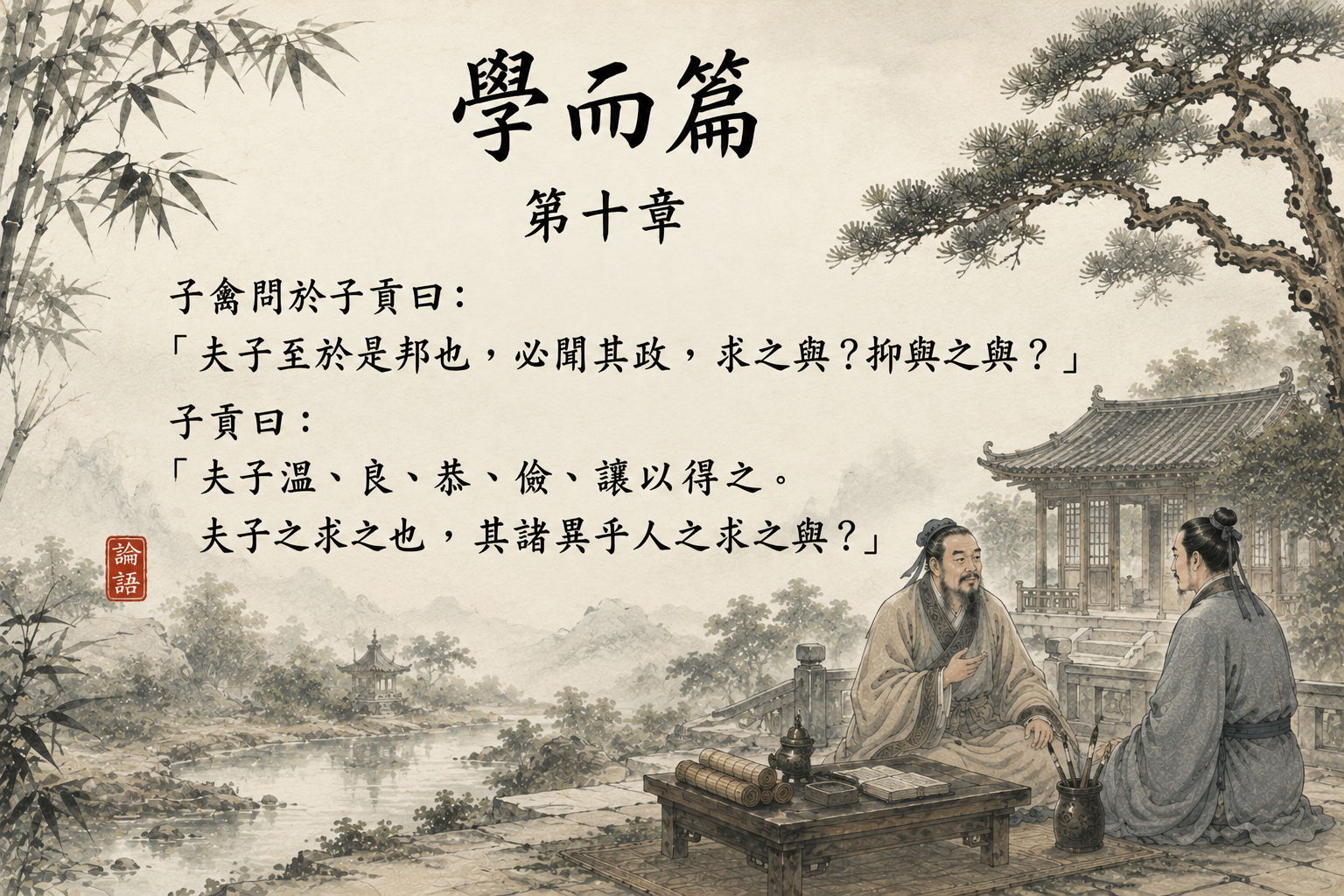
子禽問於子貢曰:「夫子至於是邦也,必聞其政,求之與?抑與之與?」子貢曰:「夫子溫、良、恭、儉、讓以得之。夫子之求之也,其諸異乎人之求之與?」
Simplified Chinese
子禽问于子贡曰:“夫子至于是邦也,必闻其政,求之与?抑与之与?”子贡曰:“夫子温、良、恭、俭、让以得之。夫子之求之也,其诸异乎人之求之与?”
Pinyin
Zǐ Qín wèn yú Zǐ Gòng yuē: “Fūzǐ zhì yú shì bāng yě, bì wén qí zhèng, qiú zhī yú? Yì yǔ zhī yú?” Zǐ Gòng yuē: “Fūzǐ wēn, liáng, gōng, jiǎn, ràng yǐ dé zhī. Fūzǐ zhī qiú zhī yě, qí zhū yì hū rén zhī qiú zhī yú?”
Reading the Passage Literally
Ziqin asked Zigong:
“Whenever the Master arrives in a state, he always hears about its government. Does he seek this information himself, or is it given to him?”
Zigong replied:
“The Master obtains it through being gentle, good, respectful, restrained, and yielding. His way of seeking it is perhaps different from the way other people seek it.”
Reading the Grammar
This passage is built around a simple but revealing question. Ziqin notices that wherever Confucius goes, he somehow comes to hear about the political affairs of the state. He therefore asks Zigong whether Confucius actively seeks such information or whether other people voluntarily offer it to him. Zigong’s answer shifts attention away from technique and toward character: what makes Confucius different is not merely what he asks, but the kind of person he is when he asks—or even before he asks at all.
1. 子禽問於子貢曰
Zǐ Qín wèn yú Zǐ Gòng yuē
子禽 (Ziqin) is traditionally identified as a disciple associated with Confucius, while 子貢 (Zigong) is one of Confucius’s best-known disciples. Zigong’s personal name was Ci (賜), and his surname was Duanmu (端木). He appears frequently in the Analects and is often portrayed as articulate, perceptive, and practically minded.
In 問於子貢, 問 (wèn) means “to ask,” while 於 (yú) marks the person to whom the question is directed. Thus the phrase means “to ask Zigong.” 曰 (yuē) introduces the words that follow.
The structure can be seen as:
子禽 / 問 / 於 / 子貢 / 曰
Ziqin / asked / of / Zigong / saying
The important point is that Ziqin does not ask Confucius directly. He asks Zigong about Confucius’s way of acting, and Zigong interprets what makes the Master distinctive.
Key Characters and Meanings
子 (zǐ, master; person) · 禽 (qín, bird; part of the name Ziqin) · 問 (wèn, to ask) · 於 (yú, at; to; from) · 貢 (gòng, tribute; part of the name Zigong) · 曰 (yuē, to say)
2. 夫子至於是邦也,必聞其政
Fūzǐ zhì yú shì bāng yě, bì wén qí zhèng
夫子 (fūzǐ) is a respectful term for a teacher or master and here refers to Confucius.
In 至於是邦, 至 (zhì) means “to arrive,” 於 (yú) means “at” or “in,” and 是邦 (shì bāng) means “this state.” 邦 (bāng) refers to a state or polity.
必 (bì) means “certainly” or “always,” while 聞 (wén) means “to hear.” 其政 (qí zhèng) means “its government” or “its political affairs,” referring to the state Confucius has entered.
The structure is:
夫子 / 至於 / 是邦 / 也
the Master / arrives in / this state / when
必 / 聞 / 其政
certainly / hears about / its government
Here 聞 should not be restricted to the physical act of hearing. In context, it can include coming to know, receiving information about, or becoming informed about political affairs.
Ziqin’s observation is therefore that wherever Confucius travels, he somehow comes to understand what is happening politically in that place.
Key Characters and Meanings
夫 (fū, man; husband; part of 夫子) · 子 (zǐ, master) · 至 (zhì, to arrive) · 於 (yú, at; in) · 是 (shì, this) · 邦 (bāng, state) · 也 (yě, particle) · 必 (bì, certainly; always) · 聞 (wén, to hear; to learn of) · 其 (qí, its) · 政 (zhèng, government; political affairs)
3. 求之與?抑與之與?
Qiú zhī yú? Yì yǔ zhī yú?
This pair of questions is central to the passage.
In 求之, 求 (qiú) means “to seek” or “to ask for,” while 之 (zhī) refers to the information just mentioned—knowledge of the state’s political affairs. The final 與 (yú) functions as an interrogative particle.
Thus 求之與? asks:
“Does he seek it?”
The following 抑 (yì) introduces an alternative and can be understood as “or rather,” “or,” or “perhaps instead.”
In 與之與, the first 與 (yǔ) is a verb meaning “to give,” while 之 (zhī) refers in context to Confucius as the recipient. The final 與 (yú) is again an interrogative particle.
The contrast can therefore be seen as:
求 / 之 / 與
seek / it / is that so?
抑 / 與 / 之 / 與
or / give / it to him / is that so?
In plain terms, Ziqin is asking:
“Does Confucius ask for political information, or do people tell him voluntarily?”
The contrast is not between knowing and not knowing. It is between actively extracting information and receiving it because others choose to offer it.
Key Characters and Meanings
求 (qiú, to seek; to ask for) · 之 (zhī, it; him) · 與 (yú, interrogative particle; yǔ, to give) · 抑 (yì, or; or rather)
4. 夫子溫、良、恭、儉、讓以得之
Fūzǐ wēn, liáng, gōng, jiǎn, ràng yǐ dé zhī
Zigong does not answer by describing a questioning technique, political strategy, or method of information gathering. Instead, he describes Confucius’s character and manner.
溫 (wēn) means gentle or warm.
良 (liáng) means good, kind, or upright.
恭 (gōng) means respectful or courteous.
儉 (jiǎn) means restrained, modest, or frugal.
讓 (ràng) means yielding, deferential, or modest in putting oneself forward.
The phrase 以得之 shows the relation between these qualities and the result. 以 (yǐ) can mean “by means of” or “through,” while 得之 (dé zhī) means “to obtain it.”
The structure is:
夫子 / 溫 / 良 / 恭 / 儉 / 讓 / 以 / 得之
the Master / gentle / good / respectful / restrained / yielding / through these / obtains it
The point is not that Confucius possesses five virtues in the abstract. Zigong is explaining why people are willing to speak openly with him. His manner lowers defensiveness rather than increasing it.
Instead of forcing information from others, Confucius creates a relationship in which people are willing to share what they know.
Key Characters and Meanings
夫子 (fūzǐ, the Master) · 溫 (wēn, gentle; warm) · 良 (liáng, good; kind) · 恭 (gōng, respectful; courteous) · 儉 (jiǎn, restrained; frugal; modest) · 讓 (ràng, yielding; deferential) · 以 (yǐ, by means of; through) · 得 (dé, to obtain) · 之 (zhī, it)
5. 夫子之求之也,其諸異乎人之求之與
Fūzǐ zhī qiú zhī yě, qí zhū yì hū rén zhī qiú zhī yú
The final sentence summarizes Zigong’s answer by comparing Confucius’s way of seeking information with that of others.
In 夫子之求之也, the first 之 (zhī) forms a possessive or nominalizing relationship, allowing the phrase to mean something like “as for the Master’s seeking of it.”
The expression 其諸 (qí zhū) introduces a tentative or rhetorical judgment. Rather than making a blunt assertion, it carries a sense such as “perhaps,” “surely,” or “is it not perhaps the case that…”
異乎 (yì hū) means “to differ from.” 人之求之 means “the way other people seek it.”
The structure can be seen as:
夫子之 / 求之 / 也
as for the Master’s / seeking it /
其諸 / 異乎 / 人之求之 / 與
perhaps / it differs from / the way other people seek it / does it not?
Zigong therefore does not deny that Confucius also seeks to understand political affairs. His point is subtler: the way Confucius seeks is different.
The distinction lies less in what is obtained than in how it is obtained.
Key Characters and Meanings
夫子 (fūzǐ, the Master) · 之 (zhī, linking particle; it) · 求 (qiú, to seek) · 也 (yě, particle) · 其 (qí, perhaps; surely) · 諸 (zhū, part of the expression 其諸) · 異 (yì, different) · 乎 (hū, from; interrogative particle) · 人 (rén, people; others) · 與 (yú, interrogative particle)
Understanding the Meaning
Chapter 10 begins with an interesting practical question. Confucius travels from one state to another, and wherever he goes he comes to hear about that state’s political affairs. Ziqin wants to know how this happens.
Does Confucius deliberately ask for such information, or do people tell him of their own accord?
Zigong’s answer is unexpected. He does not describe the questions Confucius asks, the people he approaches, or the techniques he uses to gather information. Instead, he gives five words:
溫、良、恭、儉、讓
gentle, good, respectful, restrained, and yielding.
The answer shifts the center of the passage from information-gathering technique to the conditions that make honest conversation possible.
When people feel that they are being examined, pressured, or judged, they naturally become cautious. Even a well-designed question may produce only a short or formal response. But when someone appears trustworthy, respectful, and unthreatening, people often become willing to speak more openly. Sometimes they may even share things that were never directly requested.
That is why the final sentence matters:
夫子之求之也,其諸異乎人之求之與?
Confucius may indeed be seeking understanding, just as other people do. But his way of seeking is different.
He does not begin by demanding access to another person’s knowledge. He begins, in a sense, by becoming the kind of person with whom others are willing to share what they know.
Read this way, Chapter 10 is more than a list of admirable qualities attributed to Confucius. It presents a principle of human relationships: if we want to understand others, we must first create conditions in which they feel safe enough to speak honestly.
The quality of the information we receive often depends on the quality of the relationship through which it is given.
Background and Context
Chapter 10 can be read against the broader picture of Confucius traveling among the states of his time. Confucius was not a thinker who spent his entire life in Lu (魯). At different points, he traveled beyond his home state and encountered rulers, officials, and political communities in other regions.
In such a setting, Ziqin’s question is understandable. A visitor does not automatically gain access to the internal political affairs of another state. Political information, especially information involving rulers and officials, is not something people necessarily discuss freely with an outsider. Yet Confucius repeatedly appears to become informed about the political circumstances of the places he visits.
Zigong explains this not primarily through Confucius’s reputation or status, but through 溫、良、恭、儉、讓.
These five qualities later became famous as a compact description of Confucius’s character. In this passage, however, they should not be treated merely as an abstract list of virtues. They function within a specific relationship: they help explain why other people are willing to open themselves to him.
This connects with several themes already developed in Xue Er. Chapter 4 emphasizes Xin (信), trustworthiness, in relationships with friends. Chapter 6 again calls for being careful and trustworthy, 謹而信. Chapter 7 returns to Xin in friendship, while Chapter 8 says 主忠信, making wholeheartedness and trustworthiness central principles.
Chapter 10 now shows how character can produce a practical effect in human relationships. Virtue does not remain sealed within the individual. The way a person carries himself influences how others respond to him.
This is why it would be too narrow to summarize the passage simply as “Confucius was gentle and virtuous.” Zigong’s deeper point is that the process by which Confucius came to know political affairs was itself different from the way others sought information.
The emphasis is not merely on what Confucius knew, but on the kind of relationship through which knowledge became available to him.
Dr. Ryu’s Reflection
Reading this chapter makes me think first about how we come to hear important things from other people. When we want to understand something, we often assume that the most important skill is knowing how to ask the right question. And good questions certainly matter. In research, interviews, organizations, and unfamiliar societies, what we ask and how we ask it can determine the quality of the information we receive.
But after studying and working in different countries for many years, I have often felt that something must come even before the question.
The other person has to feel that it is safe to speak with us.
No matter how precise a question may be, if the other person is cautious or defensive, the answer will often remain brief and formal. On the other hand, once sufficient trust has developed, people may begin to speak about things we never directly asked. What appears to be “information” from the outside is often, in reality, something made possible by a relationship.
This becomes especially clear when living in another country. A foreigner can usually learn the visible parts of a society fairly quickly. Laws can be read, institutions can be studied, official explanations can be found, and statistics can be collected. But it is far more difficult to understand what people actually think, how an organization really works, or why official explanations sometimes differ from everyday reality.
Those things are often learned through people.
That is why I find it so interesting that Zigong explains Confucius’s ability to learn about political affairs not by praising his intelligence or eloquence, but by describing him as 溫、良、恭、儉、讓—gentle, good, respectful, restrained, and yielding.
A gentle manner that does not pressure the other person, basic goodwill, respect in the way one listens and responds, restraint rather than self-display, and modesty rather than insistence on being right—these qualities may open the door to a deeper conversation more effectively than clever questioning.
Today, our ways of obtaining information are incomparably more powerful than those available in Confucius’s time. We use search engines, databases, social media, and now AI systems capable of producing enormous amounts of information almost instantly.
Yet having more information has not necessarily made understanding people easier.
Numbers and documents can tell us what happened. They can sometimes show patterns with remarkable precision. But when we want to understand why people think the way they do, why they behave as they do, or why reality differs from what appears in an official report, we still often need to hear someone’s story.
That makes this ancient passage surprisingly practical.
Am I someone who is always trying to get something from other people, or am I someone with whom other people feel willing to speak openly?
Zigong suggests that Confucius did not rely on some special technique for extracting political information. Rather, he first became the kind of person to whom others were willing to speak.
Perhaps one of the most important abilities in understanding people is still found there.
Preparing a good question matters. But becoming the kind of person whom others genuinely want to answer may matter even more.
That is how I would like to read 溫良恭儉讓 today.
References
- The Analects (論語), Xue Er (學而), Chapter 10.
- Zhu Xi (朱熹), Sishu Zhangju Jizhu (四書章句集注), commentary on Lunyu, Xue Er.
- He Yan (何晏), collected commentary; Xing Bing (邢昺), subcommentary, Lunyu Zhushu (論語注疏).
- James Legge, The Chinese Classics, Vol. I: Confucian Analects.
- Chinese Text Project, The Analects: Xue Er.
- Korean Classics Translation Institute, Classical Chinese and Chinese-character reference materials.


