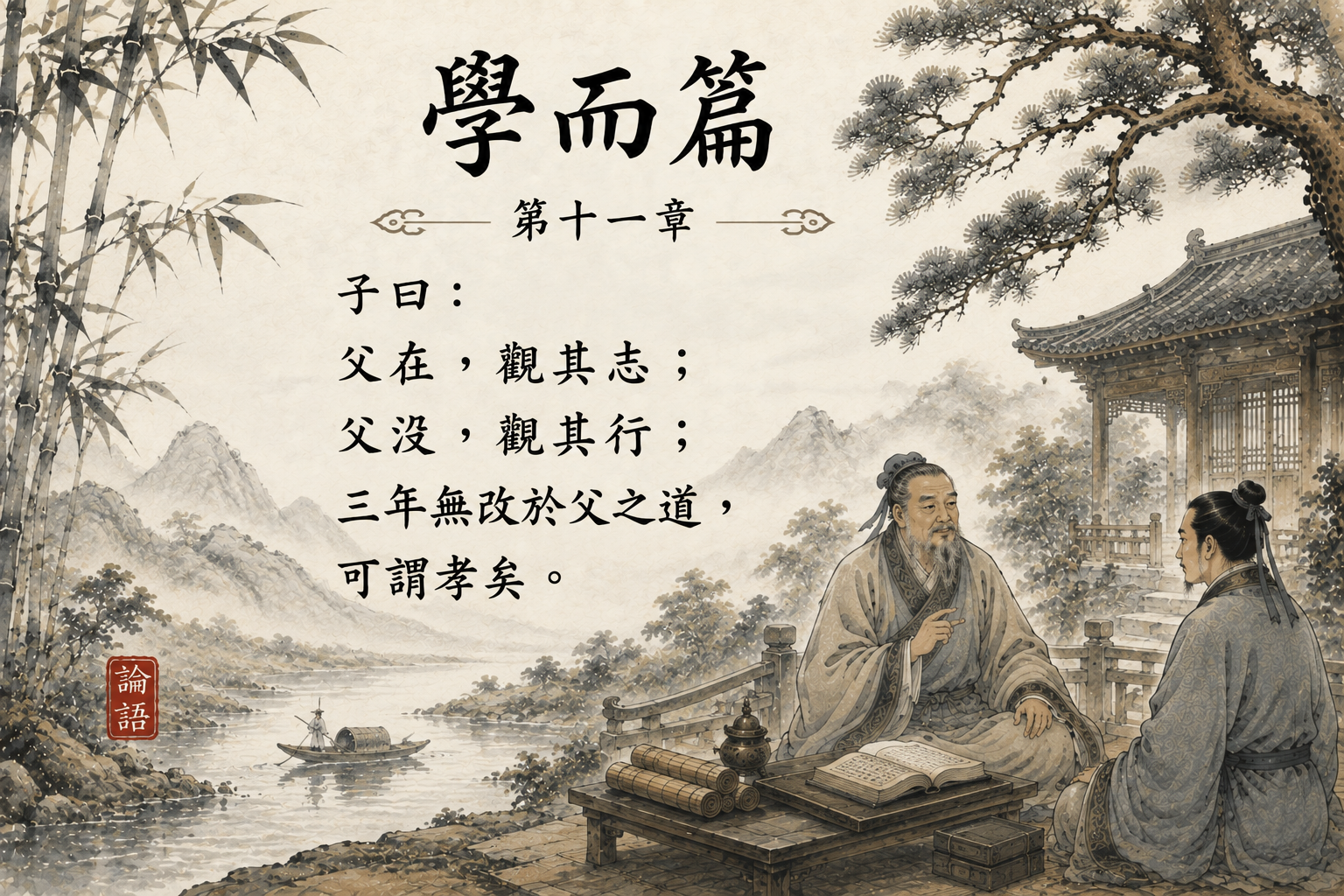
Traditional Chinese
子曰:「父在,觀其志;父沒,觀其行;三年無改於父之道,可謂孝矣。」
Simplified Chinese
子曰:“父在,观其志;父没,观其行;三年无改于父之道,可谓孝矣。”
Pinyin
Zǐ yuē: “Fù zài, guān qí zhì; fù mò, guān qí xíng; sān nián wú gǎi yú fù zhī dào, kě wèi xiào yǐ.”
Reading the Passage Literally
Confucius said:
“When the father is alive, observe the son’s intentions; when the father has died, observe his conduct. If for three years he does not change his father’s way, he may be called filial.”
Reading the Grammar
This passage turns on three closely connected ideas: intention, conduct, and continuity after a parent’s death. The first two clauses contrast what can be observed while the father is alive with what can be observed after his death. The final clause then asks what it means for a son to remain faithful to the way his father lived.
1. 父在,觀其志
Fù zài, guān qí zhì
父在 (fù zài) means “when the father is alive.” 在 (zài) ordinarily means “to be present” or “to exist,” but here it indicates that the father is still living.
In 觀其志, 觀 (guān) means “to observe,” “to examine,” or “to look carefully at,” while 志 (zhì) refers to intention, aspiration, or what a person has set his mind upon.
An important question concerns the referent of 其 (qí). In the traditional interpretation, it refers to the son. While the father is alive, the son may not be entirely free to act according to his own judgment because he remains subject to his father’s authority and wishes. For this reason, one should not judge him only by outward action but should also examine what he intends and what kind of direction he holds within himself.
The structure can be seen as:
父 / 在
the father / is alive
觀 / 其 / 志
observe / his / intention
The sentence therefore suggests that a person should not be evaluated only by visible action. The circumstances in which that action takes place and the intention behind it also matter.
Key Characters and Meanings
父 (fù, father) · 在 (zài, to be present; to be alive) · 觀 (guān, to observe; to examine) · 其 (qí, his) · 志 (zhì, intention; aspiration)
2. 父沒,觀其行
Fù mò, guān qí xíng
父沒 (fù mò) means “when the father has died.” Here 沒 (mò) does not carry its ordinary sense of “to disappear” or “to sink,” but is used in the classical sense of “to die” or “to pass away.”
Once the father is no longer alive, the son has greater freedom to act according to his own judgment. Confucius therefore says 觀其行, “observe his conduct.”
The contrast between 志 (zhì), intention, and 行 (xíng), conduct, is central:
父在 → 觀其志
when the father is alive → observe his intention
父沒 → 觀其行
when the father has died → observe his conduct
The pair suggests a movement from what a person intends under constraint to what that person actually does once he has greater freedom to choose.
The structure is:
父 / 沒
the father / has died
觀 / 其 / 行
observe / his / conduct
These two clauses can therefore be read as a reminder that a person’s real character becomes clearer when intention is eventually tested through action.
Key Characters and Meanings
父 (fù, father) · 沒 (mò, to die; to pass away) · 觀 (guān, to observe) · 其 (qí, his) · 行 (xíng, conduct; action)
3. 三年無改於父之道
Sān nián wú gǎi yú fù zhī dào
This is the part of the chapter that requires the greatest interpretive care.
三年 (sān nián) literally means “three years.” It is commonly understood in relation to the traditional mourning period following the death of a parent. It should therefore be read within the broader cultural context of the three-year mourning period (三年喪) rather than treated simply as a modern calculation of exactly thirty-six months.
無改 (wú gǎi) means “not to change” or “not to alter.” 於父之道 (yú fù zhī dào) means “with regard to the father’s way,” or more naturally, “the way the father had followed.”
Here 道 (Dao) need not be understood only as the grand philosophical “Way.” In context, it can refer more broadly to the father’s manner of living, principles, household practices, or way of conducting affairs.
The structure can be seen as:
三年 / 無改 / 於 / 父之道
for three years / does not change / with regard to / the father’s way
The literal wording may sound difficult to modern readers. It can easily be misunderstood as saying that a son must preserve everything his father did, even if the father’s conduct was clearly wrong.
Traditional interpreters themselves recognized this difficulty. Later commentarial traditions explain that if the father’s way was right, it might be preserved indefinitely, while something gravely wrong or harmful should not be left unchanged simply because three years have not passed. The emphasis therefore need not lie in an absolute prohibition against change.
A more careful reading sees the phrase as expressing reluctance to erase immediately what a parent has left behind. The son should first remember, reflect, and mourn rather than hastily overturning everything simply because authority has now passed to him.
Key Characters and Meanings
三 (sān, three) · 年 (nián, year) · 無 (wú, not; without) · 改 (gǎi, to change; to correct) · 於 (yú, with regard to; in) · 父 (fù, father) · 之 (zhī, linking particle) · 道 (dào, way; path; manner of living)
4. 可謂孝矣
Kě wèi xiào yǐ
可 (kě) means “can” or “may,” while 謂 (wèi) means “to call,” “to describe,” or “to say of.” Together, 可謂 means “may be called” or “can be described as.”
孝 (Xiao) is one of the recurring ideas in Xue Er. It is often translated as “filial devotion” or “filial piety,” but in these early chapters it involves more than simple obedience. It includes respect, care, remembrance, and a serious attitude toward the relationship between parent and child.
The final 矣 (yǐ) marks the conclusion of the statement.
The structure is:
可 / 謂 / 孝 / 矣
may / be called / filial / indeed
Thus the sentence means:
“Such a person may be called filial.”
Key Characters and Meanings
可 (kě, may; can) · 謂 (wèi, to call; to describe as) · 孝 (xiào, filial devotion) · 矣 (yǐ, sentence-final particle)
Understanding the Meaning
Chapter 11 can be uncomfortable for a modern reader, especially because of the phrase 三年無改於父之道—not changing the father’s way for three years after his death. Read quickly, the sentence can sound like an instruction to preserve a parent’s views and practices without question. But the first two clauses suggest a more careful reading.
Confucius first says that while the father is alive, we observe the son’s intentions; after the father has died, we observe his conduct. While the father is alive, the son may not be fully free to decide and act independently. Once the father is gone, the son’s own choices become more visible. At that point, conduct reveals whether earlier intentions were genuine.
This leads naturally to the question of why not changing the father’s way for three years should count as filial devotion.
The important point may lie not simply in the fact of not changing something, but in the attitude behind it. A parent’s death should not be treated as an opportunity to erase immediately everything that person valued, practiced, or built. There is a period in which memory, mourning, and reflection should come before rapid replacement.
This does not mean that everything a parent did was correct. Parents, like everyone else, can make poor judgments, preserve outdated practices, or pass on habits that should be changed. Traditional interpreters also wrestled with this difficulty. What is right should be preserved; what is clearly harmful should be corrected.
The passage therefore need not be reduced to blind obedience.
It can instead be read as asking:
What have I inherited from my parents, what deserves to be carried forward, and what needs to be changed only after careful reflection?
On this reading, filial devotion means neither repeating the past mechanically nor rejecting it too quickly. It involves taking seriously the life one has received before deciding what to preserve and what to transform.
Background and Context
Xiao (孝), filial devotion, appears repeatedly throughout the opening chapters of Xue Er. In Chapter 2, Youzi asks whether filial devotion and respect for elders are not the root of practicing Ren (仁). Chapter 6 says 弟子入則孝, that the young should be filial at home. Chapter 11 extends the question further by asking what filial devotion means after a parent has died.
To understand the passage, it is important to remember the role of mourning in early Chinese society. The death of a parent was followed by an extended period of mourning, traditionally associated with three years of mourning (三年喪). This was not merely a private expression of grief. It was also part of a ritual and ethical system through which family continuity and the obligations between generations were maintained.
The reference to 三年 in this chapter is therefore naturally connected with that mourning tradition. The expression 三年無改於父之道 belongs to a cultural world in which a child was expected to continue remembering and honoring a parent after death rather than immediately behaving as though the relationship had ended.
Traditional commentators were also aware of the difficulty created by the literal wording. If a father’s way was good, there would be no reason to abandon it after three years. If it was seriously wrong, however, waiting three years before making a correction could itself be irresponsible. Later interpretations therefore distinguished between matters that should rightly be preserved and matters that required necessary change.
This distinction helps reveal the ethical concern behind the passage. The issue is not simply resistance to change, but the manner and spirit in which change is made.
The contrast between 志 (intention) and 行 (conduct) is equally important. While the father is alive, circumstances may prevent the son from acting entirely according to his own intentions. After the father’s death, the son gains greater freedom, and his conduct can therefore be observed more directly.
In this sense, Chapter 11 is about filial devotion, but it is also about how we judge a person. Intentions matter when circumstances restrict action; conduct matters when genuine choice becomes possible.
Dr. Ryu’s Reflection
Reading this chapter, the first question that comes to me is: What have I inherited from my parents that I am still carrying forward?
When we are young, the differences between our parents’ way of thinking and our own can seem especially large. Their methods may appear old-fashioned, and we may feel that the world in which we are living requires completely different choices. I, too, had periods when the path I wanted to choose and the life I wanted to build seemed far more important than the ways of the generation before me.
But as the years pass, something else begins to become visible.
What we inherit from our parents is not limited to property or possessions. We also inherit ways of treating people, attitudes toward work, habits of enduring difficulty, and a sense of responsibility toward family. Often we do not even realize where these things came from. Then one day we hear ourselves saying something our parents once said, or we discover that in an important moment we have made a choice remarkably similar to one they might have made.
That does not mean that filial devotion requires us to repeat our parents’ lives exactly.
Times change, circumstances change, and choices that were appropriate in one generation may not be appropriate in another. Parents are not perfect human beings either. They can leave behind mistaken judgments, habits that should not be repeated, and ways of thinking that no longer fit the world their children inhabit. Preserving such things unchanged cannot automatically be called filial devotion.
For that reason, I would like to read 三年無改於父之道 less as a command saying “do not change” and more as a warning saying:
“Do not erase too quickly.”
There are things about our parents that we understand only after they are gone. A remark that once seemed frustrating may later reveal the concern behind it. A sacrifice that once appeared ordinary may turn out to have been anything but ordinary. As time passes, there may also come a moment when we stop seeing our parents only as “our parents” and begin to see them as individual human beings who were trying to live their own lives within the limits of their own time.
Only then may we become better able to decide what should be preserved and what should be changed.
Keep what was good. Change what no longer fits. Do not repeat what was wrong. Perhaps carrying forward a parent’s way does not mean living exactly as the parent lived. It may mean understanding that life carefully enough to recreate what was valuable in a form appropriate to one’s own time.
The first two clauses also remain with me:
父在,觀其志;父沒,觀其行。
There is a time to observe intention and a time to observe conduct.
A person often becomes most clearly visible not when he says what he hopes to do, but when he finally becomes free to choose and we see what he actually does. The intentions formed while one remains under the protection or influence of a parent are eventually tested by the decisions made after independence.
Looking back, all of us have made countless choices since becoming independent from our parents. And as we grow older, another change takes place: we gradually become the generation being watched by those who come after us.
The question therefore begins to turn around.
Alongside “What did I inherit from my parents?” comes another question:
“What am I leaving for my children to inherit from me?”
Perhaps continuing a parent’s way does not mean remaining trapped in the past. It may mean carrying forward what deserves to survive, improving what was incomplete, and refusing to judge too quickly the life from which our own life emerged.
Today, I read this brief chapter as suggesting that Xiao (孝) is not merely obedience to parents. It can also be a long conversation between generations about what should be remembered, what should be inherited, and what should be changed.
References
- The Analects (論語), Xue Er (學而), Chapter 11.
- Zhu Xi (朱熹), Sishu Zhangju Jizhu (四書章句集注), commentary on Lunyu, Xue Er.
- Lunyu Zhushu (論語注疏), Xue Er.
- Chinese Text Project, The Analects: Xue Er.
- Chinese Text Project, Zhuzi Yulei (朱子語類), discussion of “父在觀其志章.”


