Traditional Chinese
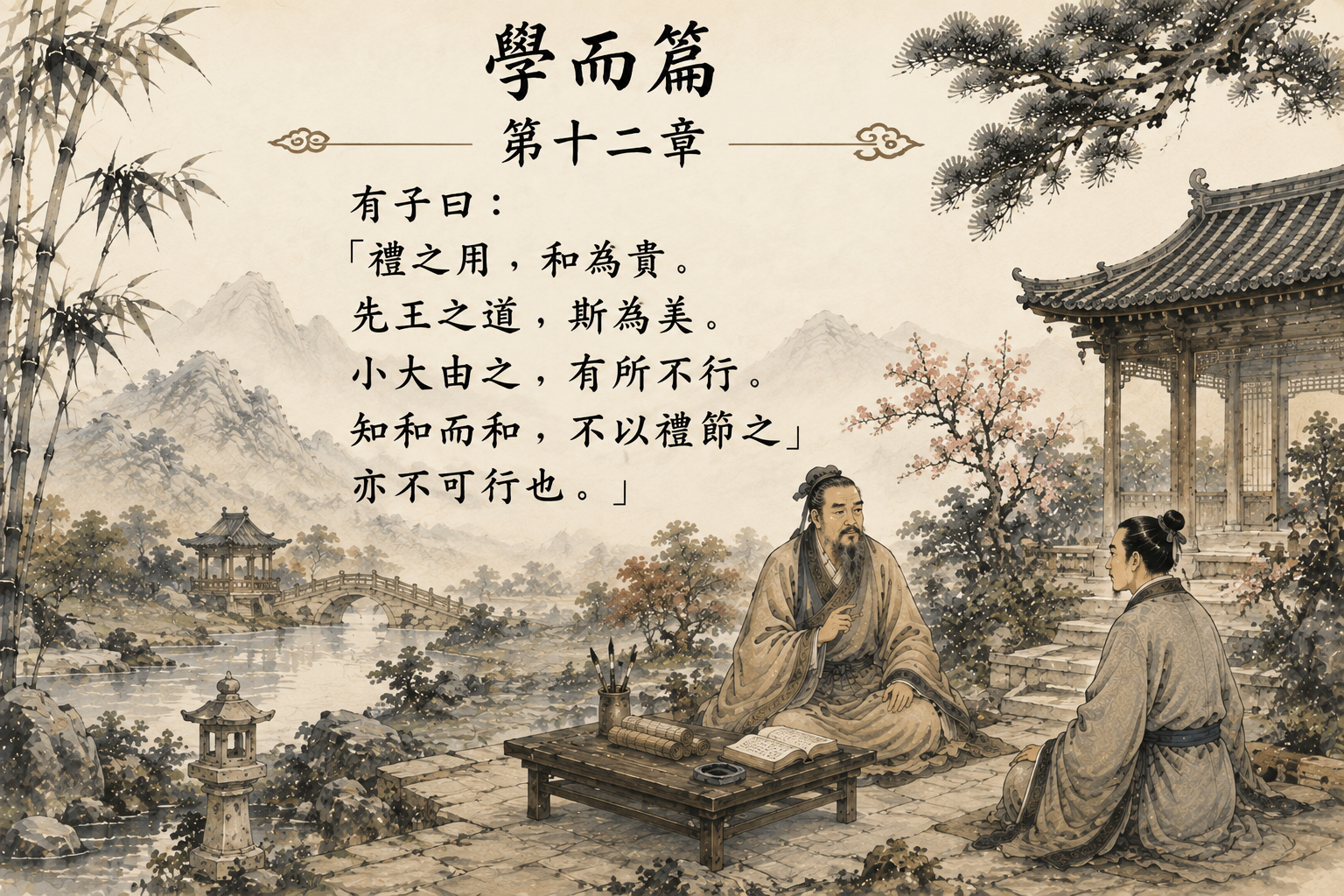
有子曰:「禮之用,和為貴。先王之道,斯為美。小大由之,有所不行。知和而和,不以禮節之,亦不可行也。」
Simplified Chinese
有子曰:“礼之用,和为贵。先王之道,斯为美。小大由之,有所不行。知和而和,不以礼节之,亦不可行也。”
Pinyin
Yǒu Zǐ yuē: “Lǐ zhī yòng, hé wéi guì. Xiān wáng zhī dào, sī wéi měi. Xiǎo dà yóu zhī, yǒu suǒ bù xíng. Zhī hé ér hé, bù yǐ lǐ jié zhī, yì bù kě xíng yě.”
Reading the Passage Literally
Youzi said:
“In the practice of Li (禮), harmony is considered precious. In the Way of the ancient kings, this was regarded as beautiful. In matters great and small, people follow it, yet there are cases in which it does not work. If one understands harmony and pursues harmony for its own sake, but does not regulate it through Li, this too cannot be put into practice.”
Reading the Grammar
This passage is built around the relationship between two important ideas: Li (禮), ritual and proper norms, and He (和), harmony. Youzi begins by praising harmony, but he does not stop there. The second half of the passage introduces an important qualification: harmony cannot become the only standard. It must itself be guided and regulated by Li.
1. 禮之用,和為貴
Lǐ zhī yòng, hé wéi guì
禮 (Li) is often translated simply as “ritual” or “propriety,” but in the Analects its range is broader than modern etiquette. It includes ritual practice, social norms, appropriate conduct, and the patterns through which human relationships are ordered.
之 (zhī) links 禮 and 用 (yòng), giving the sense of “the use of Li” or “in putting Li into practice.” 用 means “use,” “application,” or “practice.”
和 (hé) means harmony, concord, or a state in which different people or elements are able to exist together without destructive conflict. In 為貴, 為 (wéi) means “to regard as” or “to consider,” while 貴 (guì) means “precious,” “valuable,” or “worthy of esteem.”
The structure can be seen as:
禮 / 之 / 用
Li / its / application
和 / 為 / 貴
harmony / is regarded as / precious
The sentence therefore says that in the practice of Li, harmony is what should be especially valued.
Li is not meant merely to bind people to rigid forms. Its proper use should help relationships function in a harmonious way.
Key Characters and Meanings
禮 (lǐ, ritual; propriety; norms of proper conduct) · 之 (zhī, linking particle) · 用 (yòng, use; application) · 和 (hé, harmony; concord) · 為 (wéi, to regard as; to consider) · 貴 (guì, precious; valuable)
2. 先王之道,斯為美
Xiān wáng zhī dào, sī wéi měi
先王 (xiān wáng) literally means “former kings” or “ancient kings.” In early Confucian discourse, however, it often refers more specifically to the exemplary rulers of the past who were regarded as models of good government and proper order.
先王之道 therefore means “the Way of the ancient kings.” Here 道 (Dao) refers not merely to a road, but to the principles and practices by which those exemplary rulers governed and ordered human relationships.
斯 (sī) means “this” or “this very thing.” It refers back to the principle just mentioned: valuing harmony in the practice of Li.
為美 (wéi měi) means “to regard as beautiful” or “to consider excellent.”
The structure is:
先王 / 之 / 道
the ancient kings / their / Way
斯 / 為 / 美
this / was regarded as / beautiful
Youzi therefore presents harmony not as a private technique for avoiding conflict, but as a principle associated with the idealized order of the ancient sage-kings.
Key Characters and Meanings
先 (xiān, former; earlier) · 王 (wáng, king) · 之 (zhī, linking particle) · 道 (dào, way; guiding principle) · 斯 (sī, this) · 為 (wéi, to regard as) · 美 (měi, beautiful; excellent)
3. 小大由之,有所不行
Xiǎo dà yóu zhī, yǒu suǒ bù xíng
小大 (xiǎo dà) literally means “small and great,” and together refers to matters of every scale.
In 由之, 由 (yóu) means “to follow,” “to proceed from,” or “to act according to,” while 之 (zhī) refers back to the principle of harmony.
Thus 小大由之 means that in matters large and small, this principle is followed. But the next phrase introduces a qualification.
有所不行 uses the common Classical Chinese construction 有所…, meaning “there are cases in which…” or “there is something that….” 不行 (bù xíng) means “does not work,” “cannot be carried out,” or “fails to function.”
The structure can be seen as:
小 / 大 / 由 / 之
small matters / great matters / follow / this
有 / 所 / 不行
there are / cases in which / it does not work
The passage therefore says that although harmony is valued and may guide matters large and small, there are still circumstances in which simply following harmony does not work.
This prepares the reader for the limiting principle in the final sentence.
Key Characters and Meanings
小 (xiǎo, small) · 大 (dà, great; large) · 由 (yóu, to follow; to proceed according to) · 之 (zhī, it; this principle) · 有 (yǒu, there is; to have) · 所 (suǒ, that which; cases in which) · 不 (bù, not) · 行 (xíng, to act; to work; to be practicable)
4. 知和而和,不以禮節之,亦不可行也
Zhī hé ér hé, bù yǐ lǐ jié zhī, yì bù kě xíng yě
This final sentence contains the central balance of the chapter.
In 知和而和, 知 (zhī) means “to know” or “to understand.” 知和 can therefore be understood as knowing that harmony is important. The following 而和 means to pursue or produce harmony because one knows its value. The problem arises when harmony becomes the only objective.
In 不以禮節之, 以 (yǐ) means “by means of” or “through.” 禮 (Li) is the standard of ritual and proper conduct. 節 (jié) means “to regulate,” “to restrain,” “to give measure to,” or “to set appropriate limits.” 之 (zhī) refers back to the pursuit of harmony.
Thus the phrase means:
“if one does not regulate it through Li.”
The final 亦不可行也 means “this also cannot be carried out” or “this too will not work.” 亦 (yì) means “also,” 不可 (bù kě) means “cannot,” and 行 (xíng) means “to work” or “to be practicable.”
The structure is:
知 / 和 / 而 / 和
know / harmony / and therefore / pursue harmony
不 / 以 / 禮 / 節 / 之
not / by means of / Li / regulate / it
亦 / 不可 / 行 / 也
also / cannot / work / indeed
The point is a carefully balanced one:
Li should serve harmony, but harmony cannot be pursued by abandoning Li and the standards that make relationships sustainable.
Key Characters and Meanings
知 (zhī, to know; to understand) · 和 (hé, harmony) · 而 (ér, and; therefore) · 不 (bù, not) · 以 (yǐ, by means of) · 禮 (lǐ, ritual; proper norms) · 節 (jié, to regulate; to restrain; to set limits) · 之 (zhī, it) · 亦 (yì, also) · 可 (kě, can; possible) · 行 (xíng, to act; to work) · 也 (yě, sentence-final particle)
Understanding the Meaning
The best-known phrase in Chapter 12 is probably 禮之用,和為貴—“in the practice of Li (禮), harmony is precious.” The shorter expression 和為貴, “harmony is precious,” has often been quoted on its own as a general praise of social harmony. But if we read the chapter only that far, we miss half of Youzi’s argument.
He certainly says that harmony matters. If Li becomes nothing more than rigid form, people may follow the rules while becoming distant from one another. The purpose of proper norms is not simply to control behavior. They should help people live together in ways that are ordered but also humane and harmonious. Yet Youzi immediately introduces a limit.
知和而和,不以禮節之,亦不可行也。
Knowing the value of harmony and pursuing harmony alone, without regulating it through Li, will not work either.
This makes the relationship between Li and harmony much clearer.
Li without harmony can become rigid. Harmony without Li can lose its boundaries.
Getting along with other people matters. But if maintaining a pleasant atmosphere requires us never to say what needs to be said, to ignore conduct that is clearly wrong, or to abandon every principle when disagreement appears, can that still be called genuine harmony?
Outwardly, there may be no conflict. Internally, however, resentment and unresolved problems may continue to accumulate.
The opposite problem also exists. A person who believes strongly in rules and principles can become so focused on correctness that the circumstances and feelings of others disappear from view. A relationship governed only by rules may be orderly, but it can also become cold and inflexible.
The question in this chapter is therefore not whether we should choose harmony or principle.
Youzi’s point is that the two must work together. Human relationships need warmth, accommodation, and the ability to live with difference. But harmony also needs standards and boundaries that keep it from turning into mere avoidance of conflict.
That is the role of Li.
In this sense, the passage speaks to a problem that remains familiar in families, workplaces, organizations, and societies today: How can we preserve relationships without surrendering the principles that make those relationships trustworthy?
Background and Context
The speaker in this chapter is Youzi (有子), also known as You Ruo (有若), one of Confucius’s disciples. He has already appeared in Chapter 2 of Xue Er, where he asks whether filial devotion and respect for elders are not the root of practicing Ren (仁). In Chapter 12, he again turns to human relationships, but this time his focus is the relationship between Li (禮) and He (和), harmony.
In early Chinese thought, Li meant much more than what modern English speakers might call “etiquette.” It could include ritual ceremonies, social roles, patterns of behavior, family relationships, and norms that helped order political and communal life. For that reason, 禮之用 should not be reduced to “using good manners.” It refers more broadly to the practical operation of norms and ritual order within human relationships.
There have also been different emphases in the traditional interpretation of 和. In some commentarial traditions, harmony is discussed in relation to the complementary functions of Li (禮) and music, Yue (樂), within the classical ritual order. Other interpreters understand the term more directly as harmony among people and within society.
Whichever emphasis is adopted, the basic point remains clear: Li is not complete when it becomes rigid form without harmony.
The second half of the chapter, however, is just as important. If 和為貴 is quoted alone, the passage can appear to praise harmony without qualification. But the original immediately adds 不以禮節之,亦不可行也—if harmony is not regulated by Li, it too cannot function properly.
This qualification is essential.
The harmony valued in the Analects does not simply mean the absence of disagreement. Nor does it require differences to disappear. Rather, harmony can be understood as the ability of different people to live and act together within an appropriate structure of mutual expectations, limits, and respect.
Seen this way, Li and harmony are not opposing principles. Li provides boundaries and form; harmony keeps those boundaries from becoming lifeless rigidity. When either is isolated from the other, the original purpose of human relationship can be lost.
Dr. Ryu’s Reflection
Reading this chapter, the first question that comes to mind is a simple one: What makes a good relationship?
We often think that a relationship without conflict must be a good relationship. If family members rarely argue, friends seldom disagree, and colleagues exchange pleasant words at work, we may assume that everything is going well.
I, too, have spent many years living and working with people in different organizations and cultural environments, and I have generally tried to maintain good relationships wherever possible. When people come from different backgrounds, some willingness to understand, accommodate, and yield is absolutely necessary. If I insist that only my own way is correct, it becomes very difficult to live or work together.
In that sense, the words **和為貴—harmony is precious—**are easy to understand. But over time I have learned something else as well.
The absence of conflict does not necessarily mean that a relationship is healthy.
Sometimes we remain silent because we do not want to make another person uncomfortable. In an organization, we may notice a problem but choose not to mention it because we do not want to disturb the atmosphere. Even in close relationships, we sometimes hide what we really think because we are afraid the other person may feel hurt.
For a while, this can look like peace.
But an unspoken problem does not disappear simply because no one mentions it. Small frustrations accumulate, standards slowly weaken, and what looked like harmony may eventually return as a larger conflict.
That is why I find myself lingering over the last sentence of this chapter rather than only the famous opening phrase:
不以禮節之,亦不可行也。
Harmony still needs limits.
I would not transfer Li directly from ancient China into modern life as though the same social rules should govern us today. But I can understand it as the minimum boundaries and principles that allow people to respect one another. Close relationships have boundaries. Organizations need rules that members can recognize as fair. Societies need standards that allow people with very different values to live together.
The relationships that lasted longest in my own life were not necessarily relationships in which everyone agreed. Often they were relationships in which disagreement could be expressed without destroying respect. People could say what they believed, listen to an opposing view, and still understand that there were lines neither side should casually cross.
Living across different cultures makes this issue even more complicated. What counts as “proper” behavior can differ greatly from one culture to another. Something considered natural in one country may appear rude in another. An action I regard as considerate may be experienced by someone else as intrusive.
In those situations, neither extreme works very well. Insisting that my own standards must always prevail makes mutual understanding difficult. But abandoning every standard simply to accommodate the other person does not create a sustainable relationship either.
What is needed is often the patient work of finding boundaries that people with different expectations can share.
Perhaps that is one way to read the relationship between Li and He today.
As I grow older, I sometimes feel that wisdom means knowing which disagreements are not worth having. There is truth in that. Arguing over every small matter can exhaust both ourselves and those around us. Yielding a little, waiting a little longer, and trying once more to see a situation from the other person’s point of view can indeed be part of wisdom.
But yielding is not the same as avoiding.
And harmony is not the same as having no principles.
What makes this short chapter especially interesting is that Youzi did not say 和為貴 and stop there. Almost as if anticipating how easily the phrase could be misunderstood, he immediately added that harmony itself must be regulated by Li.
I would like to remember this chapter in contemporary language like this:
Getting along with people matters. But a good relationship is not one in which everyone abandons their principles; it is one in which people can respect one another’s boundaries and still find a way to remain together.
Seek harmony without losing principle. Hold to principle without losing people. Perhaps learning to find the right balance between those two is another form of study that continues throughout a lifetime.
References
- The Analects (論語), Xue Er (學而), Chapter 12.
- Zhu Xi (朱熹), Sishu Zhangju Jizhu (四書章句集注), commentary on Lunyu, Xue Er.
- He Yan (何晏), collected commentary; Xing Bing (邢昺), subcommentary, Lunyu Zhushu (論語注疏), Xue Er.
- Chinese Text Project, The Analects: Xue Er.
- Edward Slingerland, Confucius: Analects: With Selections from Traditional Commentaries. Hackett Publishing, 2003.
- Burton Watson, The Analects of Confucius. Columbia University Press, 2007.


