Traditional Chinese
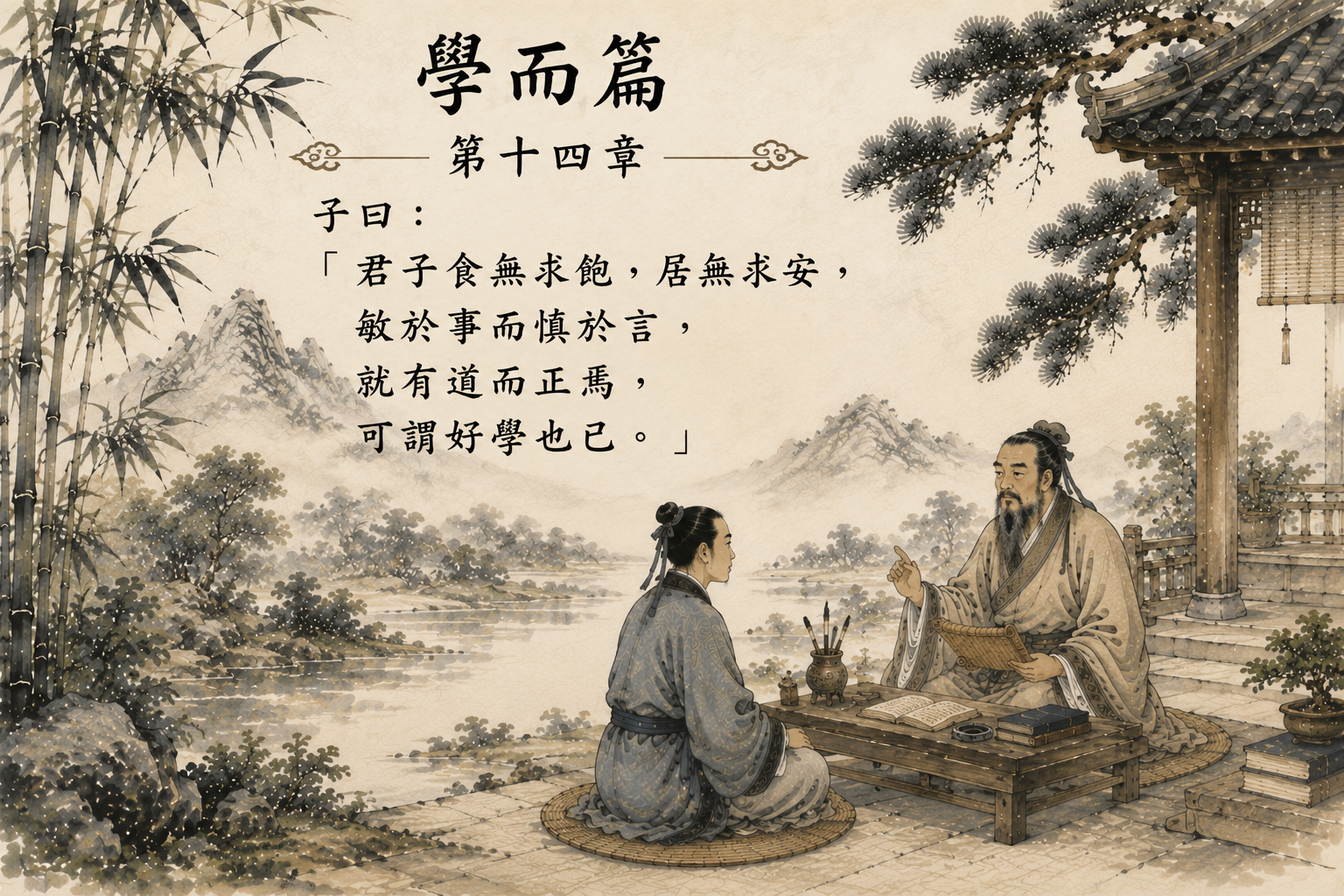
子曰:「君子食無求飽,居無求安,敏於事而慎於言,就有道而正焉,可謂好學也已。」
Simplified Chinese
子曰:“君子食无求饱,居无求安,敏于事而慎于言,就有道而正焉,可谓好学也已。”
Pinyin
Zǐ yuē: “Jūnzǐ shí wú qiú bǎo, jū wú qiú ān, mǐn yú shì ér shèn yú yán, jiù yǒu dào ér zhèng yān, kě wèi hàoxué yě yǐ.”
Reading the Passage Literally
Confucius said:
“The Junzi (君子) does not seek fullness in eating or comfort in dwelling. He is diligent in action and cautious in speech, and he approaches those who possess the Way in order to correct himself. Such a person may be called one who loves learning.”
Reading the Grammar
This chapter offers one of the clearest descriptions in Xue Er of what Confucius means by loving learning, 好學 (hàoxué). What is striking is that he does not define a lover of learning by the number of books read, the amount of knowledge acquired, or even by intellectual ability. Instead, he describes a way of living: not making comfort the highest priority, acting diligently, speaking carefully, seeking out people who embody a sound way of life, and being willing to correct oneself in their presence. Learning, in other words, is shown through the direction of one’s life.
1. 君子食無求飽,居無求安
Jūnzǐ shí wú qiú bǎo, jū wú qiú ān
君子 (Junzi) is one of the most important recurring terms in the Analects. In earlier usage it could carry a social or status-related meaning, but in Confucian thought it increasingly comes to describe a person of cultivated character who seeks to live according to sound moral principles.
食 (shí) means “to eat,” while 居 (jū) means “to dwell” or “to live.” The two clauses are almost perfectly parallel. 無求 (wú qiú) means “does not seek,” 飽 (bǎo) means “fullness” or “being well fed,” and 安 (ān) means “comfort” or “ease.”
The structure is:
君子 / 食 / 無求 / 飽
the Junzi / in eating / does not seek / fullness
居 / 無求 / 安
in dwelling / does not seek / comfort
Confucius is not saying that eating well or living comfortably is itself wrong. The emphasis lies elsewhere. The Junzi does not make physical satisfaction and personal ease the central goals of life. What matters more is the kind of person one is becoming.
The paired expressions 食–居 and 飽–安 therefore describe ordinary human needs while also showing that the life of learning requires priorities beyond immediate comfort.
Key Characters and Meanings
君 (jūn, ruler; part of 君子) · 子 (zǐ, person; master) · 食 (shí, to eat; food) · 無 (wú, not; without) · 求 (qiú, to seek) · 飽 (bǎo, full; satisfied) · 居 (jū, to dwell; to live) · 安 (ān, comfortable; at ease)
2. 敏於事而慎於言
Mǐn yú shì ér shèn yú yán
敏 (mǐn) means quick, diligent, responsive, or energetic. 事 (shì) refers here to affairs, tasks, or things that need to be done. 於 (yú) marks the sphere in which a quality is displayed, so 敏於事 means to be diligent and prompt in action.
The second half creates a deliberate contrast. 而 (ér) links the two expressions, 慎 (shèn) means careful or cautious, and 言 (yán) means speech or words. Thus 慎於言 means to be cautious in speaking.
The structure is:
敏 / 於 / 事
diligent / in / action
而 / 慎 / 於 / 言
and / cautious / in / speech
The contrast is simple but important. The learner should not be someone whose words run ahead of action. One should be ready to act where action is needed, yet restrained where speech is concerned.
This theme also fits the larger movement of Xue Er, where careful speech, trustworthy conduct, and the relationship between words and action appear repeatedly. Learning in the Analects is never separated from the credibility of the person who claims to be learning.
Key Characters and Meanings
敏 (mǐn, diligent; quick; responsive) · 於 (yú, in; with regard to) · 事 (shì, affairs; tasks; action) · 而 (ér, and; while) · 慎 (shèn, cautious; careful) · 言 (yán, speech; words)
3. 就有道而正焉
Jiù yǒu dào ér zhèng yān
This phrase is especially important for understanding the chapter.
就 (jiù) means to approach, draw near to, or go toward. 有道 (yǒu dào) literally means “one who has the Way.” Here 道 (Dao) refers not merely to a road or path, but to a sound and proper way of living. 有道 therefore refers to a person who understands and embodies such a way.
而 (ér) connects the actions, while 正 (zhèng) means “to correct,” “to set right,” or “to make upright.” 焉 (yān) completes the expression in context, giving the sense that one goes to such a person in order to correct oneself.
The structure can be seen as:
就 / 有道 / 而 / 正 / 焉
approach / one who has the Way / and / correct / oneself there
The meaning goes beyond simply spending time with admirable people. Confucius is describing the willingness to measure oneself against a better standard and make corrections where necessary.
This is an important dimension of learning. Studying alone can increase knowledge, but it does not always reveal our own blind spots. Learning also requires people who can show us where our thinking, judgment, or conduct needs adjustment.
Key Characters and Meanings
就 (jiù, to approach; to draw near) · 有 (yǒu, to have) · 道 (dào, the Way; a sound guiding principle) · 而 (ér, and) · 正 (zhèng, to correct; to make right) · 焉 (yān, there; in this context helping complete the sense of self-correction)
4. 可謂好學也已
Kě wèi hàoxué yě yǐ
可 (kě) means “can” or “may,” while 謂 (wèi) means “to call,” “to describe,” or “to say of.” Together, 可謂 means “may be called.” The key expression is 好學 (hàoxué). Here 好 (hào) means “to love” or “to be fond of,” and 學 (xué) means “to learn.” Thus 好學 means “to love learning” or “to be devoted to learning.”
也已 (yě yǐ) brings the judgment to a close and gives the sentence a sense of conclusion: only after the preceding qualities have been described does Confucius say that such a person may properly be called a lover of learning.
The structure is:
可 / 謂 / 好學 / 也已
may / be called / one who loves learning / indeed
The striking point is that Confucius does not define 好學 by academic achievement. The person who loves learning is someone who does not make comfort the center of life, who acts diligently, speaks carefully, seeks out people with sound judgment, and remains willing to correct himself.
Key Characters and Meanings
可 (kě, may; can) · 謂 (wèi, to call; to describe as) · 好 (hào, to love; to be fond of) · 學 (xué, to learn; learning) · 也 (yě, sentence-final particle) · 已 (yǐ, concluding particle; already)
Understanding the Meaning
Chapter 14 can be read as an answer to a simple but important question: What does it really mean to love learning?
We often imagine a person who loves learning as someone who reads many books, enjoys studying, or eagerly acquires new information. Confucius offers a different standard. His description begins not with study materials but with the priorities of one’s life.
食無求飽,居無求安 does not mean that one should deliberately go hungry or seek an uncomfortable life. Rather, it suggests that physical satisfaction and comfort should not become the goals around which everything else is organized. A person genuinely committed to learning must sometimes choose growth over ease, effort over convenience, and correction over the comfort of remaining as one already is.
The next phrase, 敏於事而慎於言, introduces another dimension. The learner should be active in what needs to be done but restrained in speech. It is an image very different from someone who speaks confidently about many things while avoiding the work itself. In Confucius’s description, action comes readily, while words are treated with care.
Yet perhaps the most important phrase is 就有道而正焉.
Learning is not only a matter of adding something new to the mind. It also involves discovering what is wrong within ourselves and correcting it. That is difficult to do entirely alone. We need teachers, colleagues, friends, and others whose judgment and conduct provide a standard against which we can examine our own.
This reveals an important feature of learning in the Analects: to learn is not only to know more, but also to become capable of correcting oneself.
Only after describing all these qualities does Confucius say 可謂好學也已—such a person may truly be called one who loves learning.
The lover of learning is therefore not simply someone with a large store of knowledge. It is someone who does not settle too easily into comfort, who acts rather than merely talks, who exercises care in speech, and who continues to seek people from whom genuine correction is possible.
Background and Context
The opening line of Xue Er begins with 學而時習之, placing 學, learning, at the very beginning of the Analects. Learning is therefore one of the central themes of the entire first book. Yet the chapters that follow steadily broaden the meaning of what learning involves.
In Chapter 6, Confucius says that a young person should first be filial at home, respectful toward elders, careful and trustworthy in conduct, broadly caring toward others, and close to those who practice Ren (仁). Only when there is remaining capacity does the text say 行有餘力,則以學文—then one may devote oneself to the study of texts and cultural learning.
Chapter 14 continues this broader understanding by asking what kind of person can genuinely be called 好學, someone who loves learning. Once again, the answer is not primarily academic. It concerns appetite, comfort, work, speech, relationships, and self-correction.
The phrase 就有道而正焉 is especially revealing because it shows that learning in the Analects takes place through relationships with other people. In the world of early Confucian learning, education did not mean only private reading or formal instruction. It involved observing teachers, learning from companions, accepting correction, and reshaping one’s conduct in response.
Seen this way, the Junzi (君子) in the passage need not be understood as a person who has already reached moral perfection. The Junzi is also someone who knows that he may still be wrong and therefore keeps placing himself where correction remains possible.
Several themes from earlier chapters now begin to converge: 學 (learning), 信 (trustworthiness), 慎 (carefulness), 仁 (Ren), and 君子 (Junzi). They all point toward the same broader understanding. Learning in the Analects is not an activity separated from ordinary life; it is a process through which one’s habits, speech, choices, and relationships are gradually transformed.
Dr. Ryu’s Reflection
When I read this chapter, the phrase that first catches my attention is not 食無求飽,居無求安, but 就有道而正焉—to approach those who possess the Way and correct oneself. When we are young, it is easy to think of learning mainly as acquiring something new. I also spent many years studying in schools and universities, living and working in different countries, and accumulating knowledge and experience, and naturally I thought of all of that as learning. It certainly was. Yet with time, another side of learning has become more visible to me: sometimes it is far more difficult to admit that something I already believe is wrong and to correct it than it is to acquire an entirely new piece of knowledge.
As experience accumulates, knowledge often increases, but so does confidence in one’s own judgment. After working in a particular field for many years, or after reaching a certain position, it becomes natural to rely increasingly on one’s own experience. Experience is an invaluable resource, but it can also become a wall that prevents new understanding from entering. What once helped us judge well can gradually become the reason we no longer listen carefully enough.
For that reason, I read 就有道而正焉 not only as a question of whom I should learn from, but also as a question of whether I am still prepared to be corrected. Meeting a good teacher or a wise colleague matters, but even the best person beside us cannot teach us very much if we have already decided that we know enough.
The phrase 敏於事而慎於言 also feels different as the years pass. When we are younger, speaking quickly and expressing our views clearly can seem like evidence of ability and confidence. Yet after working with people in different organizations and cultural settings, I have often seen that speaking well and working well are not always the same thing. In many situations, the person who speaks carefully but consistently does what needs to be done eventually earns deeper trust than the person whose words are always ahead of action.
At this stage of life, I also find myself reconsidering the meaning of 好學. For a young person, learning is often connected with preparing for the future. For an older person, learning may have another purpose as well: keeping the present self from becoming rigid. The world continues to change whether we are ready or not. New technologies appear, unfamiliar tools become ordinary, writing and communication change, and now AI has entered areas of life that only a few years ago would have seemed difficult to imagine. We can continue living only with what we already know, but if we do, the distance between ourselves and the changing world may gradually grow wider.
Seen in that light, 食無求飽,居無求安 also begins to sound different to me. I do not hear it as a demand to eat poorly or to live uncomfortably. I hear something closer to this: do not let comfort become the reason you stop learning.
As we grow older, it is entirely natural to prefer what is familiar. Familiar programs are easier to use. Familiar methods require less effort. Familiar opinions are more comfortable than admitting that the world may have changed. But learning something new often means opening a program we do not yet understand, repeating a task that does not work the first time, asking a younger person for help, and occasionally accepting the uncomfortable fact that our previous judgment was wrong.
That is why I no longer want to read 可謂好學也已 simply as describing “someone who likes to study.”
For me, it points toward something larger:
To love learning is to believe that I am still capable of changing.
If Confucius’s idea of 好學 still speaks to us after more than two thousand years, perhaps it is because the question is not primarily how much we already know. The more enduring question is whether we can still learn, still listen, still act, and still correct ourselves when correction is needed. If that willingness remains, then perhaps learning never really reaches a final chapter.
References
- The Analects (論語), Xue Er (學而), Chapter 14.
- Zhu Xi (朱熹), Sishu Zhangju Jizhu (四書章句集注), commentary on Lunyu, Xue Er.
- He Yan (何晏), collected commentary; Xing Bing (邢昺), subcommentary, Lunyu Zhushu (論語注疏), Xue Er.
- Chinese Text Project, The Analects: Xue Er.
- Edward Slingerland, Confucius: Analects: With Selections from Traditional Commentaries. Hackett Publishing, 2003.
- Burton Watson, The Analects of Confucius. Columbia University Press, 2007.


