Traditional Chinese
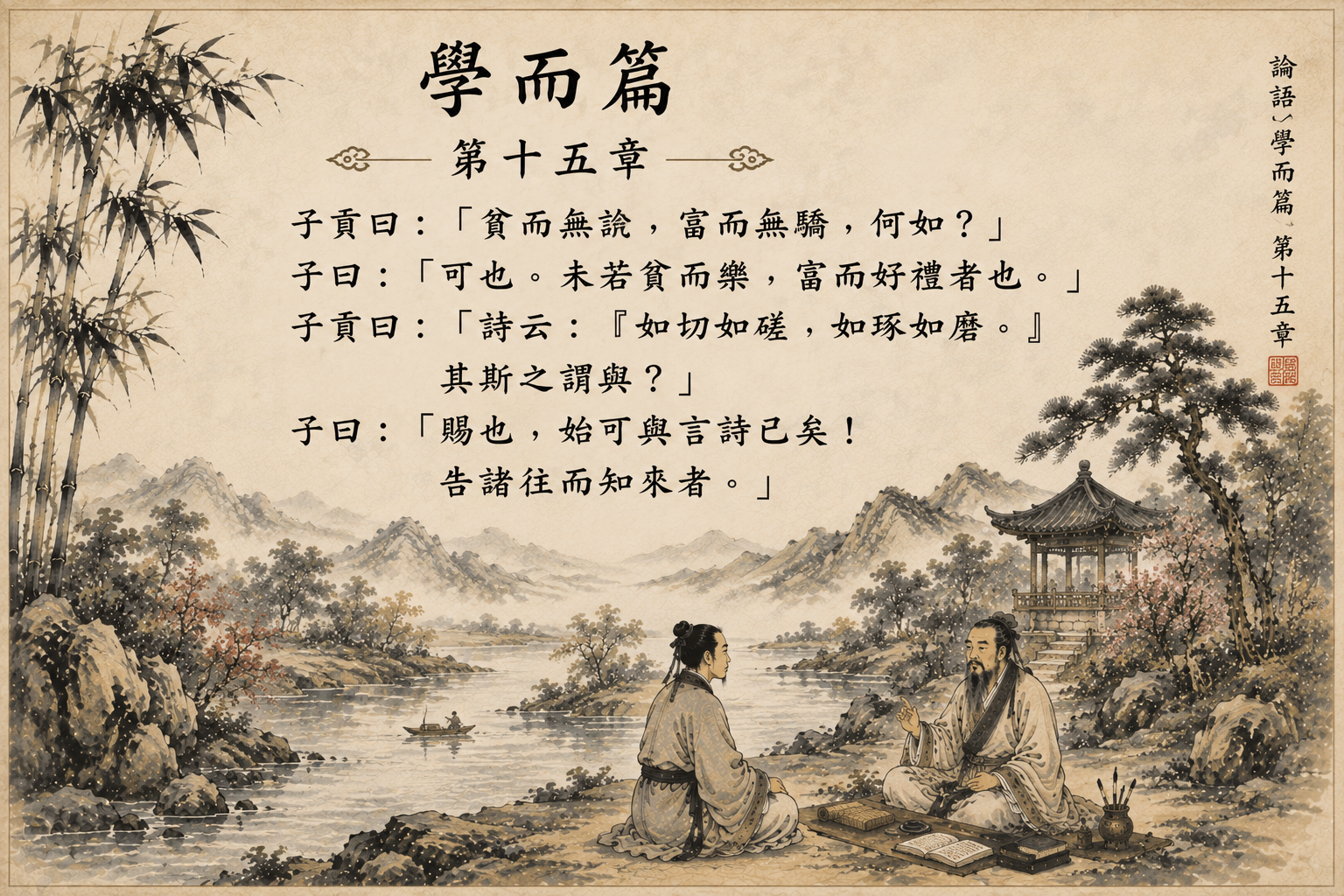
子貢曰:「貧而無諂,富而無驕,何如?」子曰:「可也。未若貧而樂,富而好禮者也。」子貢曰:「詩云:『如切如磋,如琢如磨。』其斯之謂與?」子曰:「賜也,始可與言詩已矣!告諸往而知來者。」
Simplified Chinese
子贡曰:“贫而无谄,富而无骄,何如?”子曰:“可也。未若贫而乐,富而好礼者也。”子贡曰:“诗云:‘如切如磋,如琢如磨。’其斯之谓与?”子曰:“赐也,始可与言诗已矣!告诸往而知来者。”
Pinyin
Zǐ Gòng yuē: “Pín ér wú chǎn, fù ér wú jiāo, hé rú?”
Zǐ yuē: “Kě yě. Wèi ruò pín ér lè, fù ér hào lǐ zhě yě.”
Zǐ Gòng yuē: “Shī yún: ‘Rú qiē rú cuō, rú zhuó rú mó.’ Qí sī zhī wèi yú?”
Zǐ yuē: “Cì yě, shǐ kě yǔ yán Shī yǐ yǐ! Gào zhū wǎng ér zhī lái zhě.”
Reading the Passage Literally
Zigong said:
“If one is poor without being servile, and wealthy without being arrogant, how is that?”
Confucius said:
“That is acceptable. Yet it is not as good as being poor and still joyful, or being wealthy and still loving Li (禮).”
Zigong said:
“The Book of Poetry says, ‘As if cutting and polishing, as if carving and grinding.’ Is this what it means?”
Confucius said:
“Ci, now at last I can discuss the Poetry with you. I tell you what has gone before, and you understand what is to come.”
Reading the Grammar
Chapter 15 begins with a question about poverty and wealth, but it soon becomes a lesson about something larger: the difference between merely avoiding what is wrong and actively refining oneself toward what is better. The conversation then moves one step further when Zigong connects Confucius’s answer with a line from the Book of Poetry, showing that genuine learning does not end with understanding what has been explicitly said. It continues when the learner can extend one insight into another.
1. 貧而無諂,富而無驕,何如
Pín ér wú chǎn, fù ér wú jiāo, hé rú
貧 (pín) means “poor” or “to be in poverty,” while 富 (fù) means “wealthy” or “to possess abundance.” The conjunction 而 (ér) links each condition with the response to it. 無諂 (wú chǎn) means “without flattery” or “without servility,” and 無驕 (wú jiāo) means “without arrogance.”
Here 諂 (chǎn) does not simply mean being kind or agreeable. It refers to ingratiating oneself with others, lowering oneself excessively, or seeking favor because one feels dependent on another person. 驕 (jiāo) points in the opposite direction: pride or arrogance that arises when someone’s wealth, position, or advantage causes him to look down on others.
The structure is:
貧 / 而 / 無諂
poor / yet / without servility
富 / 而 / 無驕
wealthy / yet / without arrogance
何如
how is that?
Zigong is therefore asking something more subtle than whether poverty is bad or wealth is good. He is asking whether a person may be judged well if external circumstances change but inner dignity and restraint remain intact.
Key Characters and Meanings
貧 (pín, poor; poverty) · 而 (ér, and; yet) · 無 (wú, without; not having) · 諂 (chǎn, flattery; servility) · 富 (fù, wealthy; rich) · 驕 (jiāo, arrogant; proud) · 何 (hé, what; how) · 如 (rú, like; as; how)
2. 可也。未若貧而樂,富而好禮者也
Kě yě. Wèi ruò pín ér lè, fù ér hào lǐ zhě yě
Confucius first answers 可也 (kě yě), meaning “that is acceptable,” “that is good enough,” or “that will do.” He does not reject Zigong’s standard.
But he immediately adds 未若 (wèi ruò). 未 (wèi) means “not yet,” while 若 (ruò) means “to be like” or “to equal.” Together, 未若 means “not as good as” or “does not yet equal.”
What, then, is better?
貧而樂 (pín ér lè) means being poor yet still able to live with joy, while 富而好禮 (fù ér hào lǐ) means being wealthy yet loving Li (禮), proper conduct and cultivated restraint.
The structure is:
可 / 也
acceptable / indeed
未若 / 貧而樂
not as good as / being poor yet joyful
富而好禮 / 者也
being wealthy yet loving Li / such a person
The distinction is subtle but important. Not flattering others and not becoming arrogant are forms of self-restraint: the person avoids falling into bad conduct. By contrast, finding joy even in poverty and continuing to value Li even in wealth suggest a more active form of moral cultivation.
One does not merely avoid what is base. One develops a positive way of living.
Traditional interpretation, including Zhu Xi’s commentary, emphasizes this difference. Avoiding servility and arrogance is already good, but the person may still remain inwardly preoccupied with poverty and wealth. The higher stage is one in which the external condition no longer controls the moral direction of the person.
Key Characters and Meanings
可 (kě, acceptable; can) · 也 (yě, sentence-final particle) · 未 (wèi, not yet) · 若 (ruò, to equal; to be like) · 貧 (pín, poor) · 樂 (lè, joy; to take pleasure) · 富 (fù, wealthy) · 好 (hào, to love; to be fond of) · 禮 (lǐ, ritual; propriety; proper conduct) · 者 (zhě, one who; person)
3. 如切如磋,如琢如磨
Rú qiē rú cuō, rú zhuó rú mó
Zigong now quotes a line from the Book of Poetry.
切 (qiē) means to cut. 磋 (cuō) refers to polishing or refining after cutting. 琢 (zhuó) means to carve or work a hard material such as jade or stone, and 磨 (mó) means to grind or polish it further.
The image is therefore:
“as if cutting and polishing, as if carving and grinding.”
The important point is that the work does not end after the first action. A material is cut and then refined; carved and then polished again. Even after shape has been achieved, further work remains.
The line therefore becomes an image of continuous refinement.
Zigong hears Confucius say that “poor without servility” and “wealthy without arrogance” are good, but that an even higher state is possible. He immediately recognizes a parallel with the poetic image: one stage of refinement should lead to another.
A person may already have improved, but improvement itself can become the starting point for deeper cultivation.
Key Characters and Meanings
如 (rú, as if; like) · 切 (qiē, to cut) · 磋 (cuō, to polish; to refine) · 琢 (zhuó, to carve; to chisel) · 磨 (mó, to grind; to polish)
4. 其斯之謂與
Qí sī zhī wèi yú
其 (qí) can introduce a tentative or rhetorical tone, while 斯 (sī) means “this.” The expression 之謂 (zhī wèi) means “to speak of this” or “this is what is meant by.” The final 與 (yú) functions as a question particle.
The sentence therefore means:
“Is this what that expression refers to?”
Zigong is doing more than repeating Confucius’s answer. He has taken the Master’s distinction and connected it with a poetic image from another text, thereby extending the meaning for himself.
That act of connection is precisely what Confucius praises next.
Key Characters and Meanings
其 (qí, perhaps; surely; rhetorical particle) · 斯 (sī, this) · 之 (zhī, linking particle) · 謂 (wèi, to mean; to speak of) · 與 (yú, interrogative particle)
5. 賜也,始可與言詩已矣
Cì yě, shǐ kě yǔ yán Shī yǐ yǐ
賜 (Cì) is Zigong’s personal name. Confucius addresses his disciple directly.
始可 (shǐ kě) means “only now can” or “now at last may.” 與言詩 means “to discuss the Poetry together.” Here 詩 (Shī) refers to the Book of Poetry or Book of Songs.
The structure is:
賜 / 也
Ci / indeed
始 / 可 / 與 / 言詩 / 已矣
now at last / can / with you / discuss the Poetry / indeed
Confucius is not praising Zigong simply because he remembers a line from the Book of Poetry. What matters is that Zigong can use a familiar text to understand something newly taught and then derive a further insight from it.
He has moved from memorization to interpretation.
Key Characters and Meanings
賜 (Cì, Zigong’s personal name) · 始 (shǐ, to begin; only now) · 可 (kě, can; may) · 與 (yǔ, with) · 言 (yán, to speak; discuss) · 詩 (shī, poetry; the Book of Poetry) · 已 (yǐ, already; concluding particle) · 矣 (yǐ, sentence-final particle)
6. 告諸往而知來者
Gào zhū wǎng ér zhī lái zhě
告 (gào) means “to tell” or “to inform.” In this context, 諸 (zhū) is commonly understood in the sense of “to him.” 往 (wǎng) refers to what has already gone before, while 來 (lái) refers to what is to come.
The phrase therefore means something like:
“One who, when told what has gone before, understands what is to come.”
The structure can be seen as:
告 / 諸 / 往
tell / him / what has gone before
而 / 知 / 來 / 者
and / understands / what comes next / one who
Confucius praises Zigong because he does not remain dependent on being told every step. Once shown one direction, he can infer the next.
This is a very different model of learning from passive memorization. It describes a learner who can extend what has been taught into what has not yet been explicitly taught.
Key Characters and Meanings
告 (gào, to tell; to inform) · 諸 (zhū, to him; contracted classical form in context) · 往 (wǎng, what has gone before) · 而 (ér, and; then) · 知 (zhī, to know; to understand) · 來 (lái, what is to come) · 者 (zhě, one who)
Understanding the Meaning
At first, Chapter 15 seems to be about poverty and wealth. Zigong asks whether it is admirable to remain free of servility when poor and free of arrogance when rich. By ordinary standards, the answer would seem obvious. It is difficult to preserve dignity when one lacks resources, and it is equally difficult to preserve humility when one has more than others.
Confucius agrees. 可也—that is good.
But he does not stop there. He says that an even higher state is possible: to be poor and still joyful, and to be wealthy and still love Li. The difference between these two levels is important. “Not flattering” and “not being arrogant” describe things a person successfully avoids. They are moral achievements of restraint. Yet “being joyful” and “loving Li” describe something more positive: a person is not merely resisting corruption by circumstances, but actively shaping a good life within those circumstances.
A poor person who does not become servile has preserved dignity. A poor person who can still find joy has gone further: poverty no longer determines the whole quality of life. A wealthy person who does not become arrogant has exercised restraint. A wealthy person who continues to love Li has gone further: wealth becomes something that can coexist with respect, order, and cultivated conduct.
Zigong immediately recognizes the pattern and quotes:
如切如磋,如琢如磨
Cut, then refine. Carve, then polish.
Human cultivation works in the same way. Reaching one level is not the same as being finished. Once something has been improved, it can be examined again and refined further.
This is why the chapter gradually becomes less about poverty and wealth and more about the nature of learning and growth.
Confucius praises Zigong because he does not simply accept the answer he has been given. He understands the principle behind it, connects it with another text, and uses that connection to see a deeper meaning.
The chapter therefore asks two questions at once:
Can I remain morally steady when my circumstances change?
And beyond that:
When I have already improved, am I willing to refine myself once more?
Background and Context
Chapter 15 begins with Zigong, one of Confucius’s most prominent disciples. His family name was Duanmu (端木), and his personal name was Ci (賜), which is why Confucius addresses him directly as 賜 near the end of the passage.
Traditional commentarial literature sometimes connects Zigong’s question with his known ability in trade and his later wealth. Zhu Xi, for example, discusses Zigong as someone capable in material affairs and reads the question against a background in which poverty and wealth may have been especially concrete issues for him. Whether or not we treat that biographical connection as central, the dialogue clearly becomes more significant than a discussion of economic circumstances alone.
The turning point comes when Zigong quotes the Book of Poetry:
如切如磋,如琢如磨
The line comes from “Qi Ao” (淇奧) in the Airs of Wei (衛風) section of the Book of Poetry. Its imagery is drawn from the careful working of materials such as bone, horn, jade, or stone—cutting, polishing, carving, and grinding until something becomes increasingly refined.
Within the conversation in the Analects, Zigong transforms that poetic image into an image of moral cultivation. Confucius has just shown him that one good condition can be surpassed by a better one. Zigong recognizes that this resembles the process of refining something already shaped.
This is why Confucius responds:
始可與言詩已矣
“Now I can begin to discuss the Poetry with you.”
The praise is not for quotation alone. Zigong has demonstrated that he can take what he has learned and transfer its meaning into a new context.
The final phrase, 告諸往而知來者, makes this explicit. Confucius tells him something about what has already been said, and Zigong is able to see what comes next.
This deepens the theme introduced at the very beginning of Xue Er with 學而時習之. Learning is not merely hearing something and repeating it. By Chapter 15, learning has become the ability to interpret, connect, infer, and discover a new meaning from what has already been learned.
Dr. Ryu’s Reflection
When I read this chapter, the first thing that catches my attention is Zigong’s statement: to be poor without becoming servile, and wealthy without becoming arrogant. Even by today’s standards, that seems admirable enough. It is not easy to preserve dignity when circumstances are difficult, and it is often harder than we imagine to remain humble when circumstances become favorable. We like to think that character is independent of circumstance, but in real life what we possess—and what we lack—can influence our words and behavior more than we sometimes realize.
Confucius, however, moves one step further. He says it is better still to be poor and yet joyful, or wealthy and yet devoted to Li. At first, the difference may seem small. But the more I think about it, the more significant it becomes, because avoiding bad conduct and actively creating a good way of life are not the same thing.
Over the years, I have seen more than a few cases in which changes in circumstance were followed by changes in attitude. Someone who had once been modest could begin treating people differently after gaining money, influence, or position. Someone going through hardship could lose confidence and become excessively dependent on the approval of others. Yet there are also people who remain remarkably steady. Whether they have much or little, the basic way they treat others does not change very much, and they continue doing what they believe they should do without allowing circumstance to define their whole character.
As I grow older, I increasingly think that such people possess a certain kind of strength. But the part of this chapter that stays with me even longer is what follows:
如切如磋,如琢如磨
Cut and then refine. Carve and then polish.
The work does not end after one improvement.
Looking back, perhaps much of life has followed this pattern. Graduation did not end learning. Earning a degree did not end study. Living in another country for many years did not mean I had come to understand everything about that society. Working in a field for a long time did not mean there was nothing left to reconsider. Each new environment required me to look again at what I thought I already knew, and sometimes to revise methods or assumptions I had believed were correct for a long time.
I feel something similar now when learning new technologies and working with AI. At the beginning, simply learning how one function works can feel like a considerable achievement. But once that becomes familiar, another level appears. One problem is solved and another becomes visible. After that, a better method emerges that could not have been seen from the beginning.
Perhaps learning has always worked this way.
Each refinement reveals the possibility of another refinement.
That is why I especially like Confucius’s final description of Zigong:
告諸往而知來者
He is told what has gone before and is able to understand what comes next.
Good learning does not end with remembering exactly what someone has taught us. We take what we have learned, connect it with our own experience, apply it to another problem, and from that process begin to see something that was never directly explained to us.
If I translate this conversation between Confucius and Zigong into a question for today, it sounds something like this:
Am I satisfied with what I already know, or am I refining it once more?
As we grow older, we naturally accumulate experience and knowledge. That is valuable, but it can also create a temptation to explain the present entirely through what we have already learned. The words 如切如磋,如琢如磨 seem to warn against that moment of premature completion. Just when we think the work is finished, they ask us to look again and refine once more.
The later part of life does not have to be the end of that process. It may instead become a time to examine the person shaped by all the years that have already passed, to correct what still needs correction, and to remain open to what has not yet been learned.
Learning is not something that reaches completion. It is something that can continue to deepen.
That is how I would like to read Chapter 15 of Xue Er.
References
- The Analects (論語), Xue Er (學而), Chapter 15.
- Zhu Xi (朱熹), Sishu Zhangju Jizhu (四書章句集注), commentary on Lunyu, Xue Er, Chapter 15.
- Book of Poetry (詩經), “Qi Ao” (淇奧), Airs of Wei (衛風).
- Chinese Text Project, The Analects: Xue Er, Chapter 15.
- Korean Classics Translation Institute, Classical Chinese and Chinese-character reference materials.


