Traditional Chinese
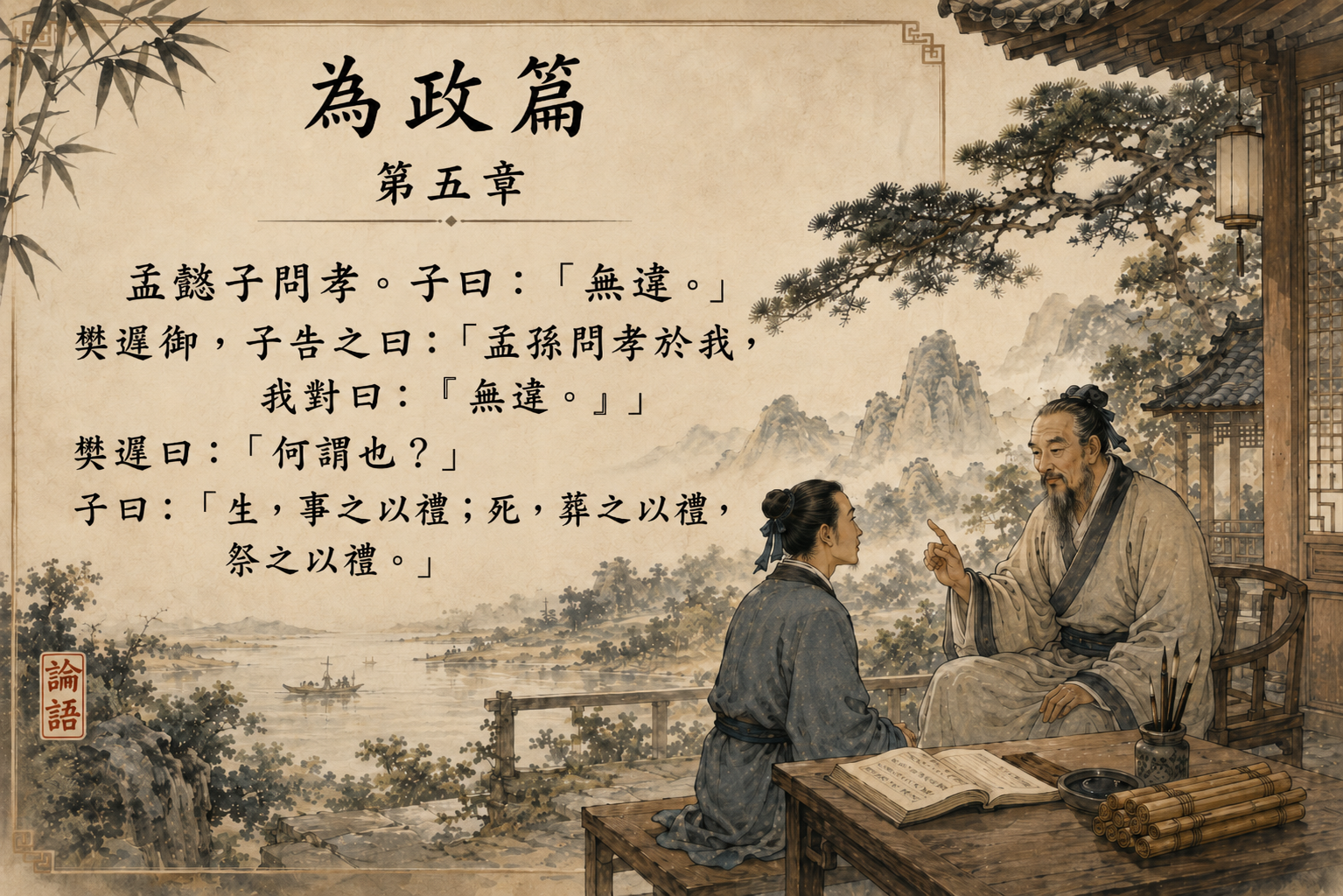
孟懿子問孝。子曰:「無違。」
樊遲御,子告之曰:「孟孫問孝於我,我對曰:『無違。』」
樊遲曰:「何謂也?」
子曰:「生,事之以禮;死,葬之以禮,祭之以禮。」
Simplified Chinese
孟懿子问孝。子曰:“无违。”
樊迟御,子告之曰:“孟孙问孝于我,我对曰:‘无违。’”
樊迟曰:“何谓也?”
子曰:“生,事之以礼;死,葬之以礼,祭之以礼。”
Pinyin
Mèng Yìzǐ wèn xiào. Zǐ yuē: “Wú wéi.”
Fán Chí yù, Zǐ gào zhī yuē: “Mèngsūn wèn xiào yú wǒ, wǒ duì yuē: ‘Wú wéi.’”
Fán Chí yuē: “Hé wèi yě?”
Zǐ yuē: “Shēng, shì zhī yǐ lǐ; sǐ, zàng zhī yǐ lǐ, jì zhī yǐ lǐ.”
Reading the Passage Literally
Meng Yizi asked about filial devotion. Confucius said, “Do not transgress.”
Later, while Fan Chi was driving, Confucius said to him, “Mengsun asked me about filial devotion, and I replied, ‘Do not transgress.’”
Fan Chi asked, “What does that mean?”
Confucius said, “While one’s parents are alive, serve them according to Li (禮). When they die, bury them according to Li, and offer sacrifices to them according to Li.”
Reading the Grammar
This passage turns on one very short expression: 無違. On its own, it can sound as though Confucius is simply saying, “Do not disobey.” Yet the object of 違 is not stated, and the reader is therefore left with an immediate question: what exactly must not be violated? The structure of the passage itself provides the answer. Confucius first gives the brief expression 無違, later repeats it to Fan Chi, and only after Fan Chi asks for clarification does he explain it through the repeated phrase 以禮, “according to Li (禮).” The grammar and narrative movement are therefore closely connected: an initially open expression is gradually given a more precise meaning.
1. 孟懿子問孝
Mèng Yìzǐ wèn xiào
孟懿子 (Meng Yizi) was a high-ranking noble of the state of Lu. 問 (wèn) means “to ask,” and 孝 (xiào) means filial devotion or filial piety. The expression 問孝 should not be understood merely as asking for the definition of a word. In context, Meng Yizi is asking what proper filial conduct requires and how a person ought to relate to his parents.
The structure is:
孟懿子 / 問 / 孝
Meng Yizi / asked / about filial devotion
Thus:
“Meng Yizi asked about filial devotion.”
Beginning with this chapter, four consecutive passages in Wei Zheng deal with Xiao (孝). Meng Yizi, Meng Wubo, Ziyou, and Zixia all ask essentially the same question, yet Confucius gives each of them a different answer. This sequence suggests from the outset that filial devotion cannot be reduced to one simple action or rule; different dimensions of the relationship become important depending on the person and the situation.
Key Characters and Meanings
孟 (mèng, eldest; surname Meng) · 懿 (yì, admirable; virtuous) · 子 (zǐ, master; son) · 問 (wèn, to ask) · 孝 (xiào, filial devotion)
2. 子曰:「無違。」
Zǐ yuē: “Wú wéi.”
無 (wú) means “not,” “without,” or in this construction “do not,” while 違 (wéi) means “to go against,” “to violate,” or “to depart from.” The difficulty lies in what is not said: there is no explicit object after 違. The phrase tells us not to transgress, but it does not yet identify what must not be transgressed.
The structure is:
無 / 違
do not / transgress
Thus:
“Do not transgress.”
If the expression is isolated from what follows, it can easily be taken to mean that filial devotion consists in never going against one’s parents. Yet Confucius later explains 無違 by saying that parents should be served, buried, and honored in sacrifice according to Li (禮). The later explanation therefore gives shape to the earlier phrase. Zhu Xi also interpreted 無違 as 不背於理, not departing from what is right according to principle, which fits the movement of the passage: the point is not simply that a child should obey every parental wish, but that filial conduct itself should not depart from what is proper.
Key Characters and Meanings
子 (zǐ, Master) · 曰 (yuē, to say) · 無 (wú, not; without) · 違 (wéi, to go against; to violate)
3. 樊遲御,子告之曰
Fán Chí yù, Zǐ gào zhī yuē
樊遲 (Fan Chi) was one of Confucius’s disciples. Here, 御 (yù) means “to drive a carriage,” rather than its other common meanings connected with governing or controlling. 告 (gào) means “to tell” or “to inform,” and 之 (zhī) refers to Fan Chi.
The structure is:
樊遲 / 御 / 子 / 告之 / 曰
Fan Chi / was driving / Confucius / told him / saying
Thus:
“While Fan Chi was driving, Confucius said to him.”
The conversation with Meng Yizi has already ended, but Confucius brings it up again while traveling with Fan Chi. This brief narrative transition is important because it creates the opportunity for the original answer to be examined more closely. What seemed complete when spoken to Meng Yizi becomes the subject of a second conversation, and the meaning of 無違 is gradually unfolded.
Key Characters and Meanings
樊 (fán, surname Fan) · 遲 (chí, slow; Chi) · 御 (yù, to drive a carriage) · 子 (zǐ, Master) · 告 (gào, to tell) · 之 (zhī, him) · 曰 (yuē, to say)
4. 孟孫問孝於我,我對曰:「無違。」
Mèngsūn wèn xiào yú wǒ, wǒ duì yuē: “Wú wéi.”
孟孫 (Mengsun) refers to the same person previously called Meng Yizi. He belonged to the Mengsun clan, one of the powerful aristocratic families of Lu. In 問孝於我, 於 (yú) marks the person to whom the question is directed, so the phrase means “asked me about filial devotion.” 對 (duì) here means “to answer” or “to reply.”
The structure is:
孟孫 / 問孝 / 於我
Mengsun / asked about filial devotion / of me
我 / 對曰 / 無違
I / replied / do not transgress
Thus:
“Mengsun asked me about filial devotion, and I replied, ‘Do not transgress.’”
Confucius repeats his original answer without changing it. In doing so, the text deliberately places the ambiguity of 無違 before Fan Chi and before the reader. The repetition is therefore not unnecessary duplication; it prepares the central question that follows.
Key Characters and Meanings
孟 (mèng, Meng) · 孫 (sūn, grandson; clan designation) · 問 (wèn, to ask) · 孝 (xiào, filial devotion) · 於 (yú, to; toward) · 我 (wǒ, I; me) · 對 (duì, to reply) · 曰 (yuē, to say) · 無 (wú, not) · 違 (wéi, to violate)
5. 樊遲曰:「何謂也?」
Fán Chí yuē: “Hé wèi yě?”
何 (hé) means “what,” while 謂 (wèi) can mean “to say,” “to call,” or “to mean.” 也 (yě) is a sentence-final particle. The phrase therefore asks for the meaning of what has just been said.
The structure is:
何 / 謂 / 也
what / does it mean / final particle
Thus:
“What does that mean?”
Fan Chi asks exactly the question that 無違 invites. What is it that should not be violated: the parent’s wishes, the parent’s commands, or some larger standard? Confucius’s answer shifts the reader’s attention toward Li (禮), which then becomes the interpretive center of the passage.
Key Characters and Meanings
樊 (fán, Fan) · 遲 (chí, Chi) · 曰 (yuē, to say) · 何 (hé, what) · 謂 (wèi, to mean; to call) · 也 (yě, sentence-final particle)
6. 生,事之以禮
Shēng, shì zhī yǐ lǐ
Here, 生 (shēng) refers to the period when one’s parents are alive. 事 (shì) functions as a verb meaning “to serve,” 之 (zhī) refers to the parents, and 以禮 (yǐ lǐ) means “according to Li” or “in accordance with proper ritual and conduct.”
The structure is:
生 / 事之 / 以禮
while they are alive / serve them / according to Li
Thus:
“While one’s parents are alive, serve them according to Li (禮).”
Li should not be understood here merely as outward ceremony. It includes the forms, standards, roles, and patterns of conduct appropriate to a relationship. Confucius therefore places filial devotion within a framework of proper conduct: good intention matters, but intention must also take an appropriate form.
Key Characters and Meanings
生 (shēng, to live; alive) · 事 (shì, to serve) · 之 (zhī, them) · 以 (yǐ, by; according to) · 禮 (lǐ, ritual propriety; proper conduct)
7. 死,葬之以禮,祭之以禮
Sǐ, zàng zhī yǐ lǐ, jì zhī yǐ lǐ
死 (sǐ) refers to the death of one’s parents. 葬 (zàng) means “to bury” or “to conduct burial rites,” while 祭 (jì) means “to perform sacrificial or ancestral rites.” The significant feature of the sentence is that both actions are again followed by 以禮.
The structure is:
死 / 葬之 / 以禮 / 祭之 / 以禮
when they die / bury them / according to Li / offer sacrifices to them / according to Li
Thus:
“When they die, bury them according to Li, and offer sacrifices to them according to Li.”
The repeated 以禮 gives the passage its clearest internal pattern. The same standard governs the relationship while parents are alive, at the time of burial, and in the rites that follow. This repetition finally explains the earlier 無違: filial devotion means not allowing one’s conduct toward one’s parents to depart from what Li properly requires.
Key Characters and Meanings
死 (sǐ, to die) · 葬 (zàng, to bury) · 之 (zhī, them) · 以 (yǐ, by; according to) · 禮 (lǐ, ritual propriety; proper conduct) · 祭 (jì, to sacrifice; to perform ancestral rites)
Understanding the Meaning
The most striking words in this passage are Confucius’s first answer, 無違 — “Do not transgress.” Taken by itself, the phrase can easily be understood as saying that filial devotion means never going against one’s parents, and in cultures where Xiao (孝) has long been associated with obedience, that reading can feel almost automatic. Yet the passage itself does not allow 無違 to remain undefined. When Fan Chi asks what Confucius means, the explanation that follows repeats one expression three times: 以禮 — according to Li (禮). Parents are to be served according to Li while alive, buried according to Li after death, and honored through ancestral rites according to Li.
That repetition changes the center of the passage. Confucius does not make the wishes or emotions of the parent the final measure of filial conduct; instead, he places the child’s intention and action within a larger framework of what is proper. A person may sincerely wish to honor a parent, but sincerity does not automatically make every action appropriate. The form that devotion takes also matters, because filial feeling, like any other virtue, can become distorted if it ignores proportion, role, and proper limits.
For this reason, 無違 should not be reduced to unconditional obedience. Within the logic of the chapter, what must not be violated is the proper order represented by Li. At the same time, it would be equally misleading to turn the passage into a modern argument that children are free simply to disregard their parents. Confucius is not choosing between obedience and disobedience as abstract alternatives. He is asking how the relationship itself can remain rightly ordered, so that respect is genuine without becoming excessive and devotion is sincere without losing its proper form.
Xiao, in this sense, requires both a desire to honor one’s parents and an appropriate way of expressing that desire. The inner feeling and the outward conduct should support rather than contradict each other, and Li is the principle that connects them.
Background and Context
Meng Yizi (孟懿子), whose personal name was He Ji (何忌), was a high-ranking noble of the state of Lu. He belonged to the Mengsun (孟孫氏), also known as the Zhongsun (仲孫氏), one of the powerful hereditary families that exercised considerable political influence in Lu. Together with the Jisun and Shusun families, the Mengsun formed what later came to be known as the Three Huan (三桓). These aristocratic houses possessed substantial political power, and Confucius’s public life repeatedly brought him into contact with members of these families.
This background matters because traditional commentators did not understand Confucius’s answer to Meng Yizi as a purely abstract definition of filial devotion. Zhu Xi, for example, connected the passage with the tendency of powerful families in Lu to perform rituals beyond what was appropriate to their social rank. From this perspective, a man might sincerely believe that an unusually elaborate funeral or ancestral rite demonstrated greater devotion to his parents, yet if the act exceeded what Li properly permitted, the very attempt to honor them could become a violation of proper order. The emphasis on Li therefore carried particular force when addressed to a member of a powerful aristocratic household: good intention did not remove the need for proper measure.
This chapter is also the first of four consecutive discussions of filial devotion in Wei Zheng. Meng Yizi receives an answer centered on 無違 and Li (禮); in Chapter 6, Meng Wubo is reminded of the anxiety parents feel when their children are ill; in Chapter 7, Ziyou is told that merely providing material support is not enough without respect; and in Chapter 8, Zixia is taught that maintaining the proper expression and attitude toward one’s parents can itself be difficult. The same broad question—what is Xiao?—therefore receives several different answers.
Taken together, these passages show that filial devotion in the Analects is not a single act or a simple formula. It includes conduct, concern, respect, attitude, and the proper ordering of the relationship itself. Confucius seems less interested in offering one universal definition than in drawing attention to the particular dimension of filial devotion that each questioner most needs to understand.
Dr. Ryu’s Reflection
When I was young, the word “filial devotion” naturally brought to mind the idea of listening to one’s parents. A child who obeyed, did not talk back, and followed the wishes of elders was easily described as filial, so when I first encounter Confucius’s answer 無違, “do not go against,” it is easy to hear it in much the same way. Perhaps, at first glance, filial devotion seems simply to mean not disobeying one’s parents.
But when I read the passage slowly, another word begins to stand out much more strongly: Li (禮). Confucius does not go on to say, “Do whatever your parents ask.” Instead, he says that while they are alive, serve them according to Li; when they die, bury them according to Li; afterward, honor them according to Li. The standard he repeats is not how intense the child’s emotion is or how large the sacrifice becomes, but whether that devotion is expressed in a proper way.
When we are younger, we naturally think about the parent-child relationship mostly from the position of the child. We ask what we should do for our parents, whether we have listened to them enough, whether we are providing enough care, and whether we have fulfilled our responsibilities. As we grow older, however, especially when we ourselves have become the older generation, the same relationship begins to look different.
Another question gradually becomes unavoidable: what should parents expect from their children, and where should those expectations stop?
Love can make boundaries difficult to see. A parent may interfere deeply in a child’s life while sincerely believing, “I am only trying to help,” and a son or daughter may accept a burden beyond what is reasonable because refusing it feels like a failure of filial duty. Neither side may intend harm; in fact, both may be acting out of genuine affection. Yet good intentions do not always create good relationships, because affection without proportion can slowly become pressure, and responsibility without limits can eventually become resentment.
For that reason, Li in this passage has begun to sound different to me as I grow older. I do not have to understand it only as a collection of ancient rituals or formal rules. At a broader level, it reminds me that even the closest relationships need an appropriate form, a proper distance, and boundaries that allow respect to survive. Doing more is not always the same as loving more. A large financial sacrifice may sometimes matter less than the tone of an ordinary conversation, while fulfilling every request may appear harmonious for a time but can also create dependence, frustration, or expectations that neither generation can comfortably sustain.
This does not make filial devotion less important. If anything, it asks us to understand it more carefully. Xiao should perhaps not remain a virtue that parents simply expect from their children; as we grow older, it can also become a question that parents ask themselves. Do I respect my children’s lives as lives that belong to them? Can I receive their care with gratitude without turning that care into an unlimited obligation? Can affection remain affection without slowly becoming control? These questions become increasingly important because respect in a family cannot move in only one direction. A child has responsibilities toward a parent, but closeness does not erase the dignity, independence, or proper place of either person.
Love begins in the heart, but relationships need more than feeling if they are to endure well. They need a way of being lived, a sense of proportion, and a form that protects respect on both sides. Perhaps that is why Confucius did not explain filial devotion simply by saying, “Love your parents,” or even, “Obey your parents.” He spoke instead of not departing from what is proper, and as I grow older, that seems to me an increasingly meaningful way to think not only about being a son or daughter, but also about learning how to be a parent.
References
- The Analects (論語), Wei Zheng (為政), Chapter 5.
- Zhu Xi (朱熹), Sishu Zhangju Jizhu (四書章句集注), Lunyu Jizhu (論語集注), Wei Zheng.
- He Yan (何晏), commentary, and Xing Bing (邢昺), subcommentary, Lunyu Zhushu (論語注疏), Wei Zheng.
- Yang Bojun (楊伯峻), Lunyu Yizhu (論語譯注), Zhonghua Book Company.
- Chinese Text Project, The Analects: Wei Zheng.


