Traditional Chinese
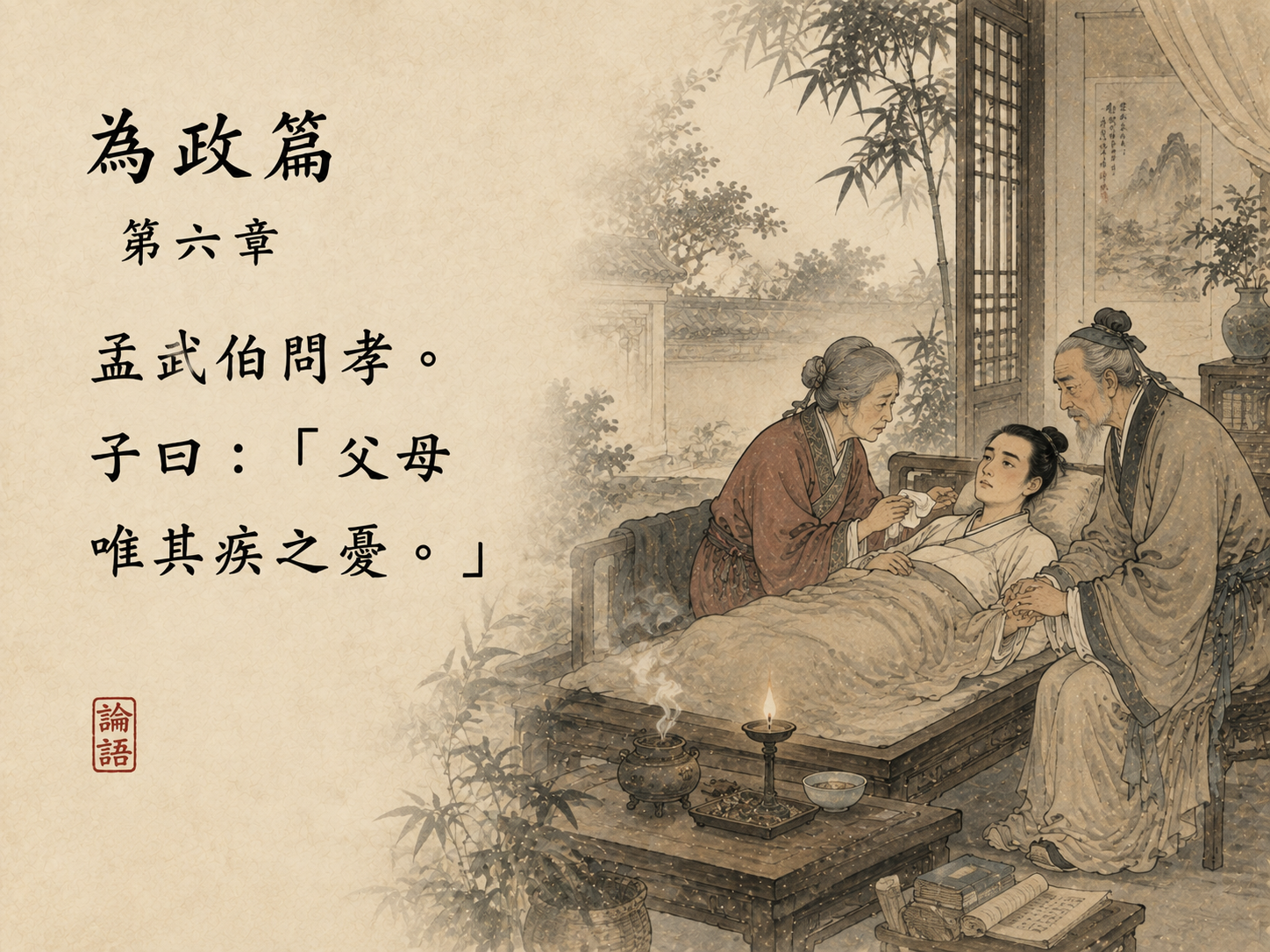
孟武伯問孝。子曰:「父母唯其疾之憂。」
Simplified Chinese
孟武伯问孝。子曰:“父母唯其疾之忧。”
Pinyin
Mèng Wǔbó wèn xiào. Zǐ yuē: “Fùmǔ wéi qí jí zhī yōu.”
Reading the Passage Literally
Meng Wubo asked about filial devotion. Confucius said:
“Parents worry especially about their child’s illness.”
Reading the Grammar
This is a remarkably short passage, but its meaning depends on more than simply translating the individual characters. The first sentence identifies Meng Wubo and his question, while the second contains a compact Classical Chinese construction whose grammatical form and larger implication have both attracted considerable attention.
The central expression is 父母唯其疾之憂. On the most widely accepted traditional reading, Confucius begins with the natural anxiety parents feel when their child is ill and turns that parental concern into a reflection on Xiao (孝): if a child understands how deeply parents worry, that awareness should affect the way the child cares for his or her own body and conduct.
1. 孟武伯問孝
Mèng Wǔbó wèn xiào
孟武伯 (Meng Wubo) is the name by which this nobleman of Lu is known in the Analects. 問 (wèn) means “to ask,” and 孝 (xiào) means filial devotion or filial piety. The sentence itself is therefore grammatically straightforward.
The structure is:
孟武伯 / 問 / 孝
Meng Wubo / asked / about filial devotion
Thus:
“Meng Wubo asked about filial devotion.”
Meng Wubo was the son of Meng Yizi, who had asked Confucius about Xiao in the preceding chapter. This connection is significant because father and son ask essentially the same question but receive very different answers. Meng Yizi is taught through 無違 and Li (禮), while Meng Wubo hears about the worry parents feel when their child becomes ill. The difference reinforces a pattern that becomes increasingly clear across these chapters: Confucius does not define Xiao by repeating one universal formula, but draws attention to different aspects of filial devotion according to the question and the person before him.
Key Characters and Meanings
孟 (mèng, eldest; surname Meng) · 武 (wǔ, martial) · 伯 (bó, eldest; noble designation) · 問 (wèn, to ask) · 孝 (xiào, filial devotion)
2. 父母唯其疾之憂
Fùmǔ wéi qí jí zhī yōu
父母 (fùmǔ) means “parents,” 唯 (wéi) means “only,” “especially,” or “nothing but,” 疾 (jí) means “illness,” and 憂 (yōu) means “to worry” or “to be anxious.” In the traditional mainstream reading, 其 (qí) refers to the child, so 其疾 means “the child’s illness.”
The function of 之 (zhī) is important. It should not be read here simply as the modern possessive marker “of.” In Classical Chinese, 之 can appear in a construction that brings an object or topic forward for emphasis. Here, 其疾之憂 places “the child’s illness” before 憂, giving a sense close to “it is the child’s illness that they worry about.”
The structure is:
父母 / 唯 / 其疾 / 之 / 憂
parents / especially / their child’s illness / — / worry about
Thus:
“Parents worry especially about their child’s illness.”
The sentence, however, is not merely making an observation about parental affection. Confucius is answering a question about Xiao. Traditional commentators therefore understood the words as implying that a filial child should take seriously the anxiety that his or her life and conduct can cause the parents. Illness is something that cannot always be prevented, but other causes of unnecessary parental worry may often be avoided through greater care, self-restraint, and responsibility.
Zhu Xi’s interpretation places particular emphasis on the depth of parental concern. Parents love their children so intensely that they continually fear for their health and safety. If children can recognize that concern and make it their own concern, they will naturally become more careful about their bodies and conduct. In this reading, filial devotion is not only something one does directly for one’s parents; it also includes living in a way that does not needlessly add to their anxiety.
Key Characters and Meanings
父 (fù, father) · 母 (mǔ, mother) · 唯 (wéi, only; especially) · 其 (qí, his; their; that) · 疾 (jí, illness) · 之 (zhī, structural particle) · 憂 (yōu, to worry; anxiety)
Understanding the Meaning
Confucius’s answer may at first seem almost too obvious: “Parents worry especially about their child’s illness.” Parents worrying when a son or daughter becomes sick is one of the most natural features of family life, and the statement appears to require little explanation. Yet its significance changes when we remember the question that produced it. Meng Wubo did not ask what parents feel; he asked what filial devotion means. Confucius therefore begins with parental love but directs the lesson toward the life of the child.
The traditional interpretation develops this thought in a subtle way. Illness can come even when a person has lived carefully, and no one can guarantee that parents will never have cause for concern. But many other forms of worry arise from choices that can be influenced: reckless behavior, irresponsible conduct, neglect of one’s health, unnecessary danger, or a life repeatedly thrown into disorder. If children understand how deeply their parents worry about them, that understanding should encourage them to treat their own lives with greater care.
In this sense, Xiao is not confined to actions directed outward toward parents; it also concerns the way one takes responsibility for one’s own life. This gives the passage a different emphasis from the preceding chapter. In Chapter 5, Confucius speaks of serving parents according to Li (禮), placing filial devotion within a proper form of conduct. Here, he begins from the emotional reality of parental concern. A child who truly understands that concern may come to recognize that caring for oneself is not entirely a private matter. The condition of one’s life affects those who love and worry about it.
That does not mean that filial devotion requires living timidly or avoiding every risk merely so that one’s parents never feel anxious. Such a conclusion would go beyond the text. The more careful point is that unnecessary carelessness has consequences beyond oneself. To live responsibly, to protect one’s health when possible, and to avoid bringing preventable distress into the family can all become part of what it means to respond to parental love.
Seen in this way, the chapter enlarges the meaning of filial devotion. Xiao is not only about what we give to our parents. It can also be expressed in how carefully and responsibly we carry the life that they care about so deeply.
Background and Context
Meng Wubo (孟武伯), traditionally identified by the personal name Zhi (彘), was the son of Meng Yizi (孟懿子), who appears in the immediately preceding chapter. Both belonged to the powerful Mengsun lineage of Lu. The placing of the two passages side by side is therefore especially interesting: a father and his son both ask Confucius about Xiao, but Confucius answers them in entirely different ways.
To Meng Yizi, Confucius says 無違, later explaining that parents should be served, buried, and honored according to Li (禮). To Meng Wubo, he says that parents worry especially about their child’s illness. This contrast illustrates a recurring feature of the Analects: the same ethical question does not always receive the same verbal answer.
Confucius often responds to the particular person before him rather than offering a single abstract definition detached from circumstance. Some traditional commentators have suggested that Confucius’s answer may have been directed toward a particular weakness in Meng Wubo’s character or conduct. The Analects itself, however, does not provide enough detail here to establish exactly what behavior Confucius might have had in mind. It is therefore safer to preserve the broader point supported by the text: Confucius uses the question to bring attention to the burden of parental worry and to the child’s responsibility to understand that concern.
The phrase 其疾 has also allowed more than one interpretation in the history of commentary. The dominant traditional reading understands it as the child’s illness: parents worry about their child being sick, and the child should therefore take care not to cause them other unnecessary anxieties. Other interpretations have understood the sentence differently, including readings that connect the illness with the parents themselves. Because the Classical Chinese is extremely compact, some ambiguity remains possible.
The present reading follows the major traditional line represented by commentators such as Zhu Xi, while acknowledging that the brevity of the original has produced interpretive variation.
This chapter also belongs to a sequence extending from Wei Zheng Chapters 5 through 8, all of which ask what filial devotion means. Chapter 5 emphasizes Li, Chapter 6 parental concern, Chapter 7 the inadequacy of material support without respect, and Chapter 8 the difficulty of maintaining the right expression and attitude. Read together, they make increasingly clear that Xiao in the Analects cannot be reduced to obedience, financial support, ritual practice, or emotion alone. It is a relationship expressed through conduct, concern, respect, and attitude.
Dr. Ryu’s Reflection
When I was young, I do not think I fully understood why parents worried so much about their children. Coming home a little late could be enough to make them anxious; traveling somewhere far away could produce a long list of concerns; and even a minor health problem that seemed insignificant to me could feel much more serious to them. From the child’s side, that kind of worry can sometimes seem excessive, and when we are young it is easy to think that parents simply worry too much.
But the perspective changes when we become parents ourselves and then watch our children grow into adults. A child may become fully capable of making decisions and managing his or her own life, but parental concern does not disappear simply because the child is now grown. In some ways, it can become more complicated. When children are small, parents can hold their hands, take them to the doctor, make decisions for them, or physically protect them from danger. As they become adults, the number of things parents can directly control decreases, while the number of things they can only watch from a distance often increases. There comes a point when caring for a child means learning to let go of the hand while the concern remains.
That is why 父母唯其疾之憂 sounds different to me now than it might have many years ago. Confucius does not tell Meng Wubo to perform some extraordinary act for his parents. Instead, the sentence seems to ask him to recognize how deeply parents worry about the life of their child. If we genuinely understand that concern, it becomes harder to treat our own bodies and lives carelessly. And I do not think “taking care of the body” needs to be limited to exercise, diet, or avoiding illness. It can also include refusing to place one’s life repeatedly in unnecessary danger, avoiding decisions one knows are reckless, not allowing destructive habits to govern one’s days, and accepting responsibility for the consequences of one’s choices.
When we speak of filial devotion, we often measure what we have done for our parents: how frequently we visit, how much time we spend with them, what gifts we provide, whether we support them financially, or whether we are present when they need us. All of these things can certainly matter. Yet this passage makes me consider filial devotion from another direction. Living one’s own life well may itself be one of the forms of peace a child can give to a parent. A parent may not need a grand gesture as much as the quiet confidence that the son or daughter they love is living responsibly, caring for himself or herself, and not repeatedly creating crises that could have been avoided.
As I grow older, however, I also find that the thought can move in the opposite direction. Parents are not the only people who worry. Adult children begin to worry about their aging parents as well. If it can be filial for a child to care for his or her own life so that parents are not burdened with unnecessary anxiety, perhaps there is also a form of consideration in older parents doing what they reasonably can to care for their own health and daily lives so that their children are not left with avoidable worry. The direction of concern gradually becomes mutual. At one stage of life, parents stay awake waiting for their children to come home; at another, children begin calling to make sure their parents are safe.
Family, in the end, is a relationship in which people worry about one another because they matter to one another. The goal cannot be to eliminate all worry, because love itself makes complete indifference impossible. What we can sometimes do, however, is avoid creating unnecessary worry through carelessness and try to live in a way that gives the people who love us a little more peace.
Perhaps one of the quiet gifts we can offer those who care about us is a life that allows us to say:
“I am taking care of myself. You do not have to worry more than you already do.”
References
- The Analects (論語), Wei Zheng (為政), Chapter 6.
- Zhu Xi (朱熹), Sishu Zhangju Jizhu (四書章句集注), Lunyu Jizhu (論語集注), Wei Zheng.
- He Yan (何晏), commentary, and Xing Bing (邢昺), subcommentary, Lunyu Zhushu (論語注疏), Wei Zheng.
- Yang Bojun (楊伯峻), Lunyu Yizhu (論語譯注), Zhonghua Book Company.
- Chinese Text Project, The Analects: Wei Zheng.


