Traditional Chinese
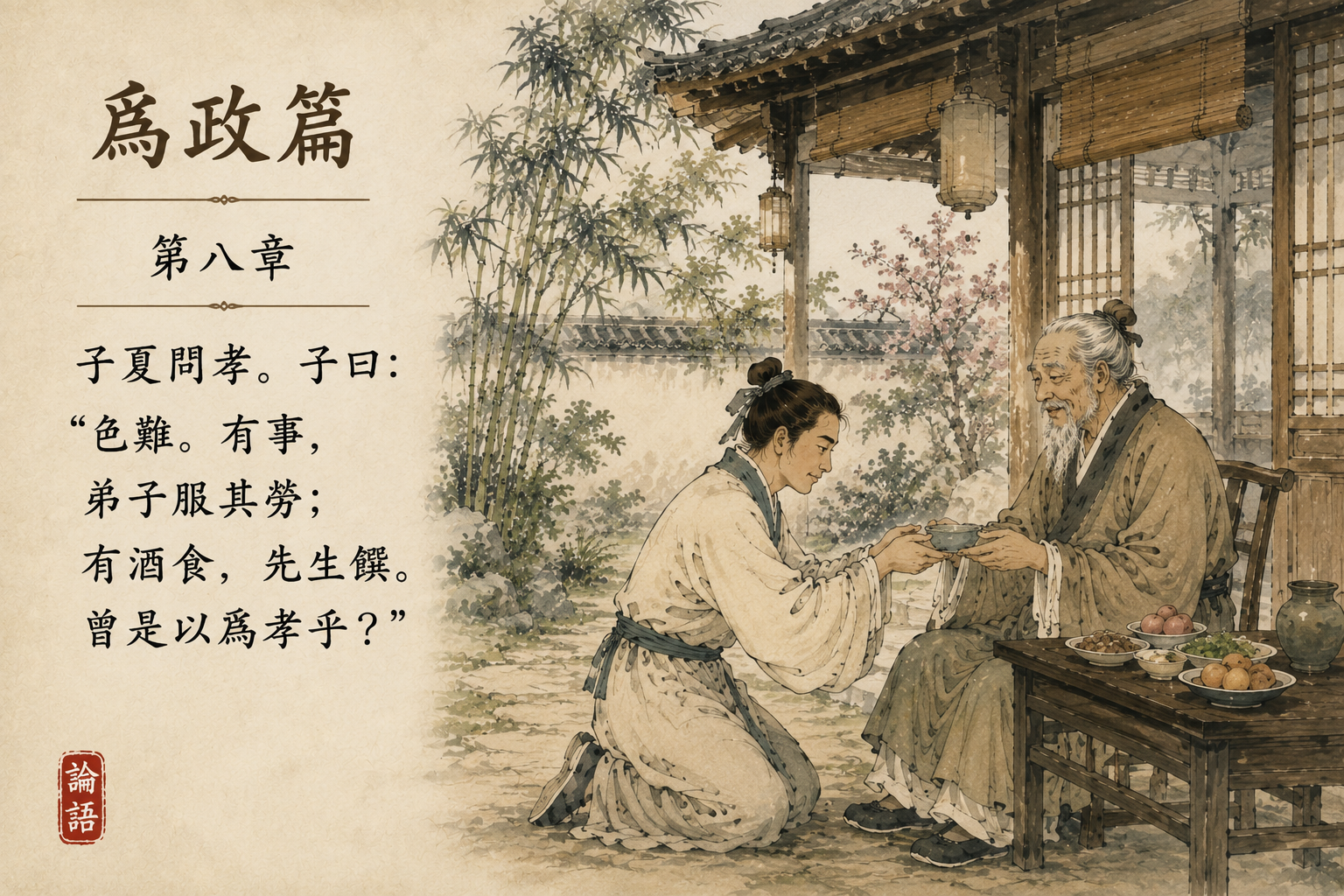
子夏問孝。子曰:「色難。有事,弟子服其勞;有酒食,先生饌。曾是以為孝乎?」
Simplified Chinese
子夏问孝。子曰:“色难。有事,弟子服其劳;有酒食,先生馔。曾是以为孝乎?”
Pinyin
Zǐ Xià wèn xiào. Zǐ yuē: “Sè nán. Yǒu shì, dìzǐ fú qí láo; yǒu jiǔ shí, xiānshēng zhuàn. Zēng shì yǐ wéi xiào hū?”
Reading the Passage Literally
Zixia asked about filial devotion. Confucius said:
“Maintaining the right expression is difficult. When there is work to be done, the younger person takes on the labor; when there is wine and food, the elder is served first. Can this alone really be considered filial devotion?”
Reading the Grammar
This passage begins with only two characters, 色難, yet those two characters contain the central idea of the entire chapter. Confucius contrasts visible acts of service with something more difficult to measure: the expression and attitude with which those acts are performed. Taking on hard work and giving elders the better food are concrete actions that can be seen from the outside, but filial devotion cannot be judged by actions alone. What matters is whether respect and affection have become so deeply rooted that they are also visible in one’s face, tone, and manner.
1. 子夏問孝
Zǐ Xià wèn xiào
子夏 (Zixia) was one of Confucius’s disciples. His family name was Bu (卜), and his personal name was Shang (商). 問 (wèn) means “to ask,” and 孝 (xiào) means filial devotion or filial piety.
The structure is:
子夏 / 問 / 孝
Zixia / asked / about filial devotion
Thus:
“Zixia asked about filial devotion.”
This is the fourth consecutive discussion of Xiao (孝) in Wei Zheng. Meng Yizi was taught through Li (禮), Meng Wubo through the anxiety parents feel for their children, and Ziyou through Jing (敬), or respect. When Zixia asks the same question, Confucius turns to 色 (sè)—the expression and demeanor through which one’s inner attitude toward parents becomes visible. The sequence once again shows that Confucius does not define filial devotion with a single formula, but approaches it from several related directions.
Key Characters and Meanings
子 (zǐ, master; son) · 夏 (xià, summer; Xia) · 問 (wèn, to ask) · 孝 (xiào, filial devotion)
2. 色難
Sè nán
色 (sè) literally means “color,” but when applied to a person it can refer to the face, facial expression, appearance, or demeanor. 難 (nán) means “difficult.” A strictly literal rendering would therefore be something like “the expression is difficult.”
The structure is:
色 / 難
expression / is difficult
Thus, in context:
“Maintaining the right expression is difficult.”
Confucius is not simply advising children to smile whenever they are with their parents. Traditional commentators understood 色 as the outward expression of an inner attitude of respect and affection. The difficulty lies in allowing genuine care and reverence to appear naturally in one’s face and manner, rather than performing the required actions while showing impatience, resentment, or reluctance.
The following sentences help explain why Confucius calls this difficult. Taking on hard work or serving good food can be clearly defined and completed. Maintaining a respectful and warm manner while doing those things reaches more deeply into a person’s inner disposition. The outward expression cannot easily be separated from what one truly feels.
Key Characters and Meanings
色 (sè, color; facial expression; demeanor) · 難 (nán, difficult)
3. 有事,弟子服其勞
Yǒu shì, dìzǐ fú qí láo
有事 (yǒu shì) means “when there is work to be done” or “when there is some task.” Here 弟子 (dìzǐ) should not be understood only in the modern sense of “disciple” or “student.” In this context, it refers more broadly to the younger or junior person in relation to an elder.
服 (fú) can mean “to undertake,” “to perform,” or “to carry out,” while 勞 (láo) means labor, toil, or difficult work. Thus 服其勞 means to undertake the labor involved.
The structure is:
有事 / 弟子 / 服 / 其勞
when there is work / the younger person / undertakes / the labor
Thus:
“When there is work to be done, the younger person takes on the labor.”
Taking difficult work upon oneself rather than leaving it to an older person is clearly an appropriate form of service. Confucius does not criticize the action itself. His point becomes clear only when this sentence is read together with what follows: performing visible acts of service does not by itself prove that the deeper attitude of filial devotion is present.
Key Characters and Meanings
有 (yǒu, to have; there is) · 事 (shì, matter; task) · 弟 (dì, younger brother; junior) · 子 (zǐ, person; son) · 服 (fú, to undertake; to perform) · 其 (qí, its; that) · 勞 (láo, labor; toil)
4. 有酒食,先生饌
Yǒu jiǔ shí, xiānshēng zhuàn
酒食 (jiǔ shí) means “wine and food.” 先生 (xiānshēng) should not be read here in its modern meaning of “teacher” or “Mr.” Literally, it refers to someone who was “born earlier,” and in this context it means an elder or senior person.
饌 (zhuàn) is related to serving or partaking of prepared food. In this sentence, it conveys the idea that when good food and drink are available, they are offered to the elder first.
The structure is:
有酒食 / 先生 / 饌
when there is wine and food / the elder / is served
Thus:
“When there is wine and food, the elder is served first.”
Like taking on hard work, giving elders priority in food and drink is a recognizable act of respect. Yet Confucius places these actions inside a rhetorical question because he wants to challenge the assumption that visible service alone is sufficient. One may perform all the proper duties and still reveal irritation, indifference, or resentment in one’s face and manner.
Key Characters and Meanings
有 (yǒu, there is) · 酒 (jiǔ, wine) · 食 (shí, food) · 先 (xiān, earlier; first) · 生 (shēng, to be born) · 饌 (zhuàn, prepared food; to serve or partake of food)
5. 曾是以為孝乎
Zēng shì yǐ wéi xiào hū
Here 曾 (zēng) strengthens the rhetorical force of the question. 是 (shì) refers back to the two actions just described: taking on labor and serving food to one’s elders. 以為 (yǐ wéi) means “to regard as” or “to consider to be,” while 乎 (hū) marks the question.
The structure is:
曾 / 是 / 以為 / 孝 / 乎
can it really be / this / regarded as / filial devotion / ?
Thus:
“Can this alone really be considered filial devotion?”
The word 是 is important because it gathers the previous actions together and subjects them to Confucius’s challenge. The actions are not wrong; they are simply insufficient when separated from the respectful disposition introduced by 色難. The rhetorical question therefore sends the reader back to the beginning of the passage. The truly difficult part is not merely performing the duty, but performing it with an attitude that genuinely reflects respect.
Key Characters and Meanings
曾 (zēng, indeed; used rhetorically) · 是 (shì, this) · 以 (yǐ, to; by) · 為 (wéi, to regard as; to make) · 孝 (xiào, filial devotion) · 乎 (hū, interrogative particle)
Understanding the Meaning
Confucius answers Zixia with two unexpectedly simple words: 色難 — “The expression is difficult.” At first, the statement may seem strange. In the preceding chapter, Confucius had already said that providing material support is not enough without Jing (敬), or respect. Here he takes the discussion one step further and asks how that respect actually becomes visible in everyday life. His answer is that it appears not only in what we do, but also in the expression, tone, and manner with which we do it.
Taking on difficult work for one’s parents and giving them the better food are clear and measurable actions. They can be seen and completed. Yet a person may perform all of these duties while showing impatience, annoyance, or emotional distance. Someone may do everything that is expected and still make the parent feel as though he or she has become a burden. Confucius therefore shifts attention from the outward action to the quality of the relationship expressed through that action.
This is why 色 should not be reduced to simply “smiling.” The point is not to put on a cheerful face regardless of what one feels. Rather, the outward manner should arise from genuine respect and affection. A calm expression, a considerate tone, patience in conversation, and a willingness to remain emotionally present can reveal whether service is being offered as an act of care or merely as an obligation to be completed.
In this sense, Chapter 8 follows naturally from Chapter 7. There Confucius asked, “Without respect, what is there to distinguish the two?” Here he shows that respect cannot remain hidden entirely inside the mind. If Jing is real, it should influence the way one looks at, speaks to, and responds to one’s parents.
Filial devotion therefore concerns not only what is done, but also how it is done. Taking on burdens and providing good food may be part of Xiao, but Confucius asks whether these actions can truly count as complete filial devotion when the face and manner communicate irritation or indifference.
The difficulty of filial devotion lies partly in this gap between duty and disposition. It is possible to complete a task without warmth, but much harder to continue treating someone with patience and respect over many years. The deepest test may therefore appear not in extraordinary acts of sacrifice, but in the ordinary expression with which we meet those closest to us.
Background and Context
Zixia (子夏), whose family name was Bu (卜) and personal name Shang (商), was an important disciple of Confucius and appears frequently throughout the Analects. He is often associated with learning, literature, ritual, and careful study of the classical tradition. In this chapter, however, the subject is not scholarship but Xiao (孝), and Confucius responds to his question by emphasizing 色, the outward expression of one’s inner attitude.
Traditional commentators generally understood 色難 as referring to the difficulty of maintaining a gentle, respectful, and harmonious expression when serving one’s parents. The idea is not simply that a filial child should appear cheerful at all times, but that genuine affection and reverence should naturally influence the face and demeanor. If service is accompanied by visible resentment or impatience, the outward act may remain correct while its deeper relational meaning has been weakened.
The expressions 弟子 and 先生 also need historical care. In modern usage, 弟子 commonly means “disciple” and 先生 may mean “teacher” or a polite form of address. In this passage, however, the contrast is generational: 弟子 refers to the younger or junior person, while 先生 literally means one who was born earlier and therefore refers to an elder. Confucius is describing familiar forms of deference in which younger people undertake difficult work and elders receive priority when food and drink are available.
The rhetorical force of the passage lies precisely in the fact that these are respectable actions. Confucius does not choose obviously bad behavior as his example. He chooses behavior that already looks filial from the outside and then asks whether that appearance is enough. His answer is clearly no. The attitude expressed through the relationship remains essential.
This chapter concludes the sequence of four discussions of filial devotion beginning in Wei Zheng Chapter 5. Meng Yizi is taught through Li (禮), Meng Wubo through parental worry (憂), Ziyou through Jing (敬), and Zixia through Se (色), the expression and demeanor in which respect becomes visible. Taken together, the four passages show that Confucius does not reduce Xiao to a single action. Proper form, awareness of parental concern, respect, and the everyday manner in which that respect is expressed all belong to the larger picture.
The different answers are therefore not competing definitions of filial devotion. They reveal different dimensions of the same relationship. Xiao is not simply something one performs according to a checklist; it asks how one’s inner attitude and outward behavior come together in the long, ordinary experience of living with and caring for one’s parents.
Dr. Ryu’s Reflection
The two characters that stay with me most strongly in this passage are 色難. Confucius says that the expression is difficult. At first, that can sound almost exaggerated. Surely taking on difficult work, giving financial help, or caring for aging parents through illness must be harder than managing one’s facial expression. But the more I think about close family relationships, the more realistic Confucius’s observation begins to seem.
With strangers, colleagues, or people we meet in public, we are often surprisingly careful about our expression and tone. Even when we are tired or irritated, we try to remain polite. We listen until the other person has finished speaking, control our reactions, and avoid showing every emotion that passes through our minds. With family, however, the situation can be quite different. Because the relationship feels safe and familiar, we may allow impatience to appear immediately. We may answer abruptly because we have heard the same story many times, show annoyance because a request seems inconvenient, or complete something for a parent while making it obvious through our face that we would rather be doing something else.
Perhaps that is precisely why 色難 is difficult. The closer the relationship becomes, the harder it can be to maintain the same care in our manner that we would instinctively show to someone less familiar. The challenge is not to wear a false smile at home, but to avoid treating familiarity as permission to abandon respect. What we feel toward those closest to us eventually appears in the small details of everyday life—in the eyes, the voice, the speed of a reply, the willingness to listen one more time, and the expression on the face while doing something we would rather not do.
This chapter therefore makes me think that filial devotion cannot be measured only by what a child has done for a parent. A person may have paid every expense, arranged every hospital visit, taken care of difficult tasks, and made sure that nothing practical was missing. Yet the parent may still remember something else just as strongly: whether those acts were accompanied by warmth or by irritation, whether conversation still felt respectful, and whether care made the parent feel loved or merely managed.
As I grow older, I also see that this question does not belong only to children. Parents have expressions too. When children help us, do we receive that help with gratitude, or do we treat it as something naturally owed to us? When our adult children make choices different from the ones we would have preferred, do we allow disappointment to appear as silent pressure in our face and manner? If we expect children to show respect through their expression, parents may also need to ask what kind of expression they bring into the relationship.
People often read a face before they hear the words. Someone may say, “It is fine,” while the face communicates disappointment. Someone may say, “Of course I will help,” while every gesture reveals reluctance. On the other hand, a person may say very little and still communicate care through a patient look, a gentle voice, or the willingness to remain present.
That is why 色難 feels surprisingly modern to me. Confucius is speaking about filial devotion, but the insight reaches into many close relationships. The people we love most are often the people before whom we are least guarded, and that very closeness can make it easy to forget how much our ordinary expressions affect them.
Before asking what more I should do for the people closest to me, perhaps I also need to ask what they see in my face and hear in my voice when I am doing it. In the end, one of the hardest forms of filial devotion may not be performing a great act of sacrifice, but continuing, after many years of familiarity, responsibility, and occasional frustration, to meet those closest to us with a face that still carries respect and warmth.
References
- The Analects (論語), Wei Zheng (為政), Chapter 8.
- Zhu Xi (朱熹), Sishu Zhangju Jizhu (四書章句集注), Lunyu Jizhu (論語集注), Wei Zheng.
- He Yan (何晏), commentary, and Xing Bing (邢昺), subcommentary, Lunyu Zhushu (論語注疏), Wei Zheng.
- Yang Bojun (楊伯峻), Lunyu Yizhu (論語譯注), Zhonghua Book Company.
- Chinese Text Project, The Analects: Wei Zheng.


