Traditional Chinese
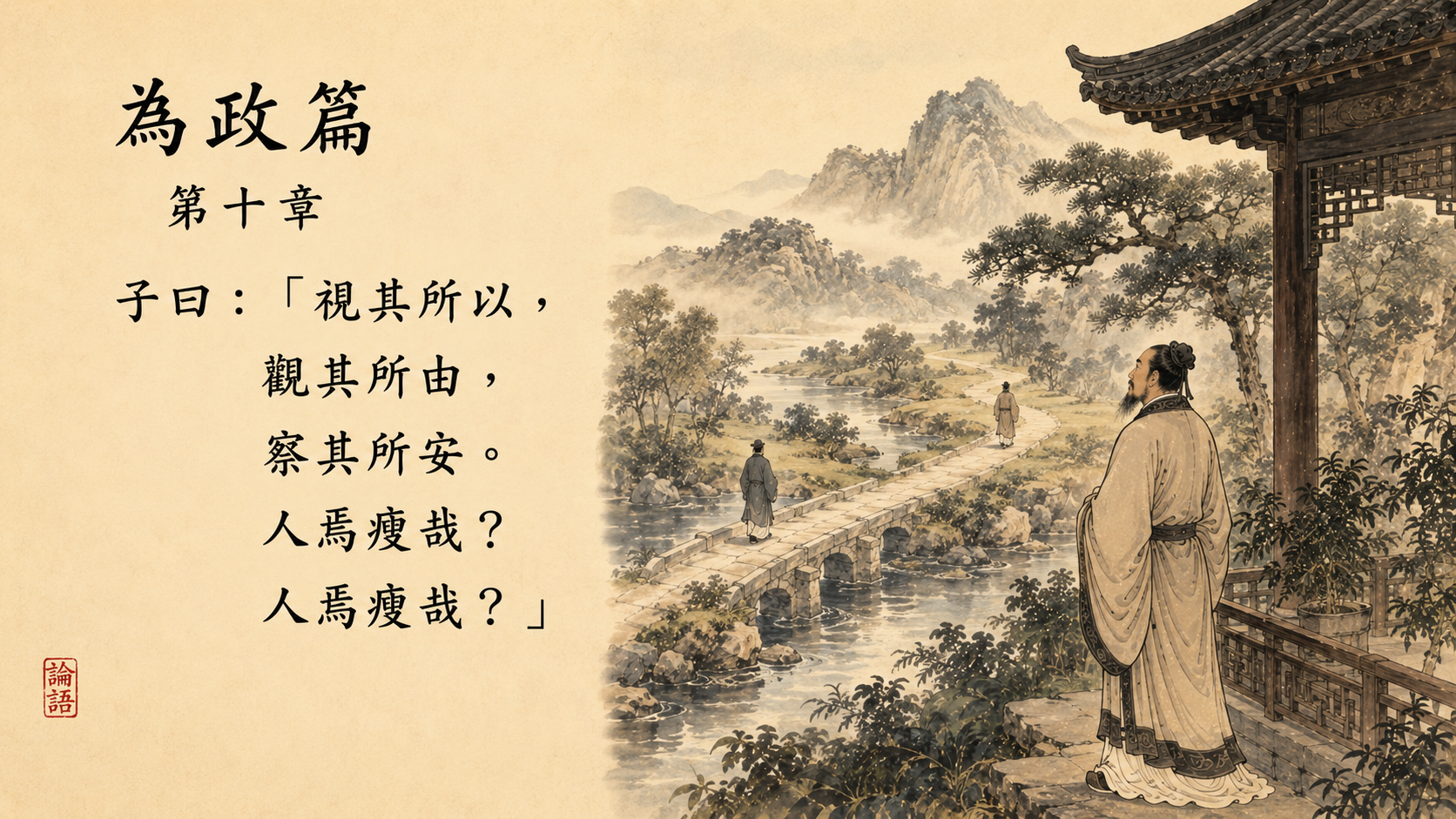
子曰:「視其所以,觀其所由,察其所安。人焉廋哉?人焉廋哉?」
Simplified Chinese
子曰:“视其所以,观其所由,察其所安。人焉廋哉?人焉廋哉?”
Pinyin
Zǐ yuē: “Shì qí suǒ yǐ, guān qí suǒ yóu, chá qí suǒ ān. Rén yān sōu zāi? Rén yān sōu zāi?”
Reading the Passage Literally
Confucius said:
“Look at what a person does, observe the path by which he acts, and examine where he finds ease. How can a person hide himself? How can a person hide himself?”
Reading the Grammar
This passage is built around three verbs of seeing—視 (shì), 觀 (guān), and 察 (chá)—that move from ordinary observation toward increasingly careful examination. Confucius begins with what a person visibly does, then turns to the path or basis from which that conduct arises, and finally asks where the person’s mind naturally settles and finds satisfaction. The repeated rhetorical question 人焉廋哉? then brings the sequence to its conclusion: if these dimensions are observed carefully, a person’s deeper character becomes increasingly difficult to conceal.
1. 視其所以
Shì qí suǒ yǐ
視 (shì) means “to look at” or “to see,” and 其 (qí) means “his,” “her,” or “that person’s.” The expression 所以 (suǒ yǐ) requires particular care because it should not be read here in the modern Chinese sense of “therefore.”
Traditional commentary understands 以 in this expression in connection with action or doing. Zhu Xi, for example, explains the phrase as beginning with what the person actually does. The focus is therefore on visible conduct rather than on stated intentions.
The structure is:
視 / 其 / 所以
look at / the person’s / way of acting
Thus:
“Look at what the person actually does.”
This is Confucius’s first level of observation. Before judging a person by what he says about himself, one should look at what he actually does. Yet visible conduct is only the beginning, because similar actions can arise from very different reasons.
Key Characters and Meanings
視 (shì, to look at; to observe) · 其 (qí, his; her; that person’s) · 所 (suǒ, that which; what) · 以 (yǐ, to act; by means of)
2. 觀其所由
Guān qí suǒ yóu
觀 (guān) also means “to observe,” but it can suggest a more sustained or careful kind of looking than 視. 由 (yóu) means “to follow,” “to proceed from,” “to pass through,” or “the route by which something comes about.” 所由 therefore points toward the path, source, or process through which a person’s conduct develops.
The structure is:
觀 / 其 / 所由
observe / the person’s / path or source of conduct
Thus:
“Observe the path and basis from which the person acts.”
Traditional interpretations differ somewhat in how precisely 所由 should be understood, but they share a common movement beyond outward behavior. Two people may perform what appears to be the same good action, yet one may act from sincere concern while another acts for reputation, advantage, or some other purpose. The second level of observation therefore asks us to look not only at the deed, but also at how and why the person came to act in that way.
Key Characters and Meanings
觀 (guān, to observe; to examine) · 其 (qí, his; her) · 所 (suǒ, that which; what) · 由 (yóu, to follow; source; path)
3. 察其所安
Chá qí suǒ ān
察 (chá) means “to examine closely,” “to inspect carefully,” or “to discern.” It is stronger and more detailed than the preceding verbs 視 and 觀. 安 (ān) means “to be at ease,” “to be settled,” or “to feel comfortable.” 所安 therefore refers to what a person naturally rests in, enjoys, or finds deeply satisfying.
The structure is:
察 / 其 / 所安
examine closely / the person’s / place of ease
Thus:
“Examine carefully what the person truly finds comfortable and satisfying.”
Zhu Xi interprets 安 in relation to what a person genuinely enjoys or takes pleasure in. This takes observation to a deeper level. A person may perform good actions and may even explain those actions in convincing terms, but what he repeatedly enjoys, seeks out, and returns to can reveal a more enduring direction of character.
The movement of the three phrases therefore becomes increasingly clear:
視 → 觀 → 察
look → observe → examine closely
and
what a person does → the path from which the action arises → what the person truly feels at ease with
Confucius begins from the outside and gradually moves inward.
Key Characters and Meanings
察 (chá, to examine carefully) · 其 (qí, his; her) · 所 (suǒ, that which; what) · 安 (ān, at ease; settled; comfortable)
4. 人焉廋哉?人焉廋哉?
Rén yān sōu zāi? Rén yān sōu zāi?
人 (rén) means “a person.” 焉 (yān) here carries the sense of “where” or “how,” while 廋 (sōu) means “to hide” or “to conceal.” 哉 (zāi) gives the sentence the force of a rhetorical question or exclamation.
The structure is:
人 / 焉 / 廋 / 哉
a person / where / hide / indeed?
Thus:
“How can a person hide himself?”
Confucius immediately repeats the same question:
人焉廋哉?
“How can a person hide himself?”
The repetition intensifies the conclusion. If one looks only at a single action, a person may be easy to misunderstand. But if one considers conduct, the path behind that conduct, and the deeper preferences in which the person repeatedly finds ease, the true direction of character becomes progressively harder to conceal.
Key Characters and Meanings
人 (rén, person) · 焉 (yān, where; how) · 廋 (sōu, to hide; to conceal) · 哉 (zāi, rhetorical particle)
Understanding the Meaning
At first glance, this chapter can sound like a simple method for judging other people. Confucius gives three instructions: look at what a person does, observe the path from which that conduct arises, and examine what that person finds naturally comfortable or satisfying. Yet the sequence is more subtle than a checklist. It describes a movement from what is immediately visible toward something progressively deeper.
The first step is action. People can say many things about themselves, but actual conduct provides a different kind of evidence. What a person repeatedly does often matters more than what he claims to value. Confucius therefore begins with 視其所以, looking at what is actually being done.
But behavior alone is not enough. The same outward act can come from different intentions, pressures, habits, or circumstances. Someone may act generously because of genuine concern, because social expectations require it, or because recognition is expected in return. That is why the second step, 觀其所由, asks us to look at the path or basis from which the action comes.
The final step goes deeper still. 察其所安 asks where a person’s mind naturally settles. What does the person repeatedly enjoy? What choices feel most comfortable when there is no external pressure? Where does the person return when free to choose? These patterns can reveal a direction that occasional actions or carefully chosen explanations may not.
The progression from 視 to 觀 to 察 therefore matters. Confucius does not recommend jumping immediately to claims about another person’s hidden motives. He begins with observable conduct and moves gradually toward a deeper understanding based on repeated patterns.
This is also why the final question is repeated:
「人焉廋哉?人焉廋哉?」
How can a person hide himself?
The point need not be understood as an invitation to expose another person’s secrets. A more useful reading is that human character becomes visible over time. One isolated word or deed may mislead us, but repeated choices, the paths a person habitually follows, and the things in which that person consistently finds satisfaction eventually form a recognizable pattern.
A person is therefore revealed less by a single moment than by the direction of a life repeatedly chosen.
Background and Context
This passage appears in Wei Zheng, Chapter 10, and has traditionally been read as a discussion of knowing people, or understanding character through careful observation. The Lunyu Zhushu explicitly treats the chapter as explaining a way of knowing a person, while later commentators further developed the progressive relationship among 視, 觀, and 察.
Zhu Xi does not treat these three verbs as simple synonyms for “to look.” His interpretation moves from ordinary observation toward more penetrating examination.
One first looks at what a person does, then considers what lies behind or leads to that conduct, and finally examines what the person genuinely enjoys and finds satisfying. A seemingly good action may have an uncertain basis, and even a plausible motive may not fully reveal character if the person’s deeper preferences point elsewhere.
There are differences among traditional commentators over the precise meanings of 所以 and 所由. Earlier commentary may place greater emphasis on what a person does and the route through which the person proceeds, while Zhu Xi develops the progression more explicitly toward the source or intention behind conduct. For that reason, it is useful not to turn the three expressions too rigidly into modern psychological categories such as “behavior, motive, and preference.” The safer reading is that Confucius urges us to observe a person progressively, moving from the visible toward the deeper and more enduring dimensions of conduct.
The placement of this passage immediately after Chapter 9 is also suggestive. In the preceding chapter, Confucius initially remarks that Yan Hui appears foolish because he listens without contradiction, but he does not stop with that impression. He observes Hui’s conduct after the conversation and concludes, 回也不愚 — “Hui was not foolish.”
Chapter 10 then presents a broader principle of observation. Confucius says to look at what a person does, the path the person follows, and what the person finds comfortable. It would be too strong to claim that Chapter 10 was deliberately written as an explicit explanation of Chapter 9, but reading the two passages together reveals a striking thematic continuity.
In Chapter 9, Confucius demonstrates the danger of judging someone from one visible trait. In Chapter 10, he describes a more patient and layered way of knowing a person.
Both chapters therefore caution against quick judgments based on limited appearances.
Dr. Ryu’s Reflection
After meeting many people and spending years in different organizations, I have often found that first impressions and longer experience do not always agree. Someone may appear reliable at first because the words are careful, the manners are good, and the attitude seems sincere, yet after enough time a rather different pattern can emerge. Another person may seem ordinary or even difficult to read at first, but trust grows steadily because the person repeatedly does what was promised and behaves consistently when no special recognition is at stake.
Perhaps that is why the familiar saying that “you have to spend time with a person to know them” begins to make more sense as we grow older. Confucius’s 視其所以,觀其所由,察其所安 seems to express something similar in a much more compact form. To understand someone, it is not enough to see what that person is doing at this moment. We need to watch what is repeatedly done, consider the path and reasons that lie behind those choices, and eventually notice what the person genuinely values and where the person’s mind seems most naturally to settle.
The phrase that interests me most is 察其所安. People can manage their public behavior to some extent. We know how to be polite when necessary, how to choose appropriate words, and how to present reasonable explanations for our actions. But what we repeatedly choose over a long period of time is harder to disguise. When no one is forcing us, where do we go? What do we spend time on? What repeatedly excites us, angers us, or gives us satisfaction? Those patterns may reveal more about us than a carefully prepared description of who we believe ourselves to be.
That thought becomes even more challenging when I turn the passage away from other people and toward myself. It is easy to say, “I value this,” or “I am this kind of person.” But what do I actually do repeatedly? What direction have my choices taken over many years? When no one is asking anything of me and I am free to choose, where does my attention naturally go and what gives me the deepest sense of satisfaction?
There can be a distance between the person we describe in words and the person revealed by our habits. We may say that family matters most, yet continually give our best time elsewhere. We may say that learning is important, yet rarely create time to learn. We may believe that we are not especially concerned with recognition, yet discover how much our mood changes depending on whether other people notice what we have done. The point is not to accuse ourselves of hypocrisy every time actions and ideals fail to match. Human beings are inconsistent. But repeated choices still tell us something worth hearing.
For that reason, I do not want to read this passage only as a technique for seeing through other people. Used carelessly, such a reading could make us suspicious, as though every action must conceal some hidden motive waiting to be exposed. Confucius’s sequence seems more patient than that. Look, observe, examine. Do not rush. Give patterns enough time to appear.
This also matters more as we grow older. Experience gives us useful judgment, but it can also make us overconfident in our ability to read people quickly. After meeting enough people, it becomes tempting to hear a few sentences, notice a few habits, compare someone with a person from the past, and conclude, “I know what kind of person this is.” Sometimes experience helps us see clearly; at other times, it becomes a shortcut that prevents us from seeing the person actually in front of us.
The preceding chapter about Yan Hui offers a useful reminder. Confucius did not allow the impression 如愚, “as though foolish,” to become his final judgment. He looked again. Perhaps the deepest lesson connecting these chapters is not the ability to judge people quickly, but the discipline to observe them long enough that our first judgment can be corrected.
A person’s character rarely appears completely in one conversation, one success, or one mistake. It becomes clearer through repeated choices, familiar paths, and the places where the mind repeatedly comes to rest.
And when I turn that principle back toward myself, an even more basic question remains:
Who I am may be revealed less by how I describe myself than by what I repeatedly choose and where I allow my mind to settle.
References
- The Analects (論語), Wei Zheng (為政), Chapter 10.
- Zhu Xi (朱熹), Sishu Zhangju Jizhu (四書章句集注), Lunyu Jizhu (論語集注), Wei Zheng.
- He Yan (何晏), commentary, and Xing Bing (邢昺), subcommentary, Lunyu Zhushu (論語注疏), Wei Zheng.
- Yang Bojun (楊伯峻), Lunyu Yizhu (論語譯注), Zhonghua Book Company.
- Chinese Text Project, The Analects: Wei Zheng.


