Traditional Chinese
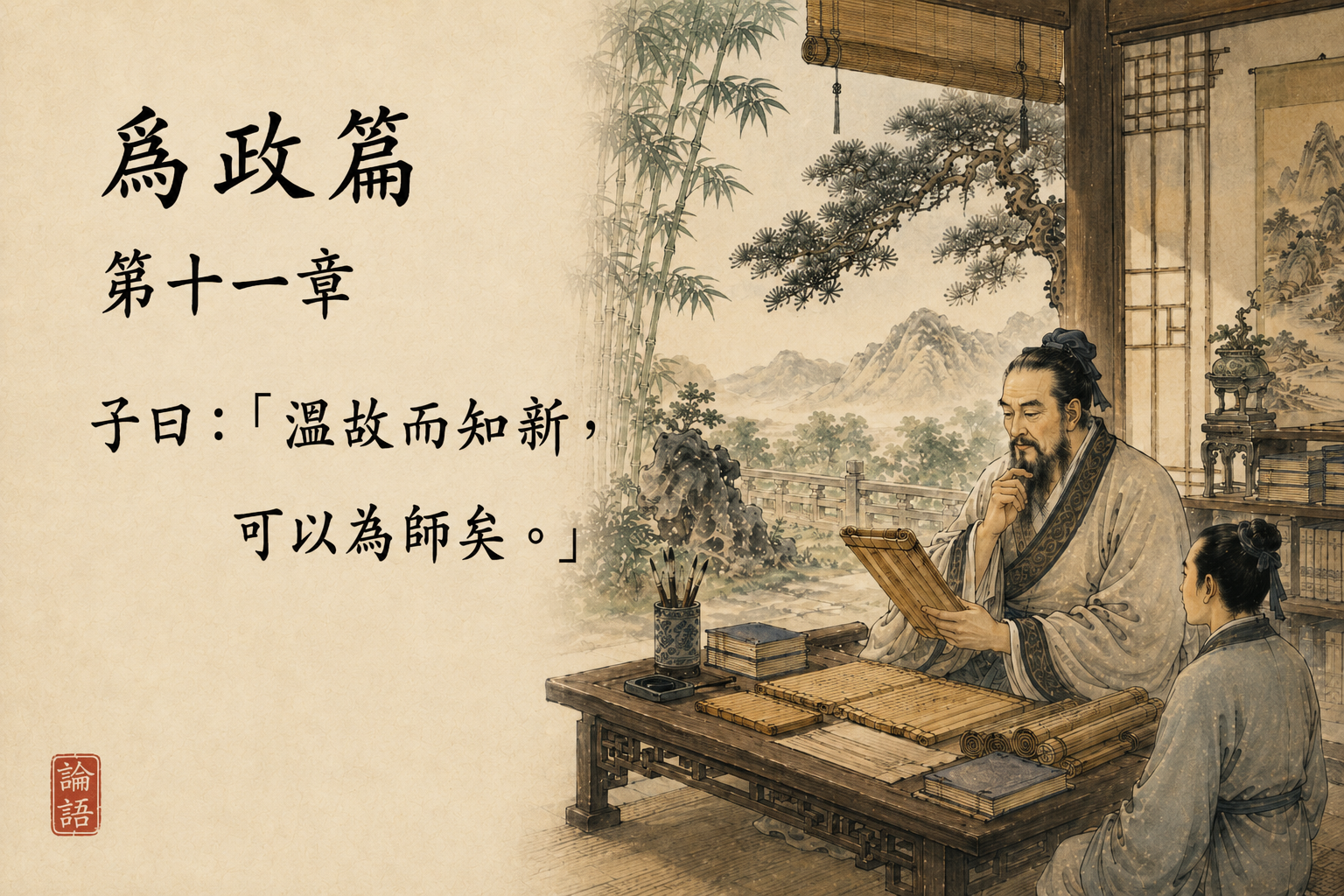
子曰:「溫故而知新,可以為師矣。」
Simplified Chinese
子曰:“温故而知新,可以为师矣。”
Pinyin
Zǐ yuē: “Wēn gù ér zhī xīn, kě yǐ wéi shī yǐ.”
Reading the Passage Literally
Confucius said:
“By revisiting what is old and coming to understand what is new, one can become worthy of being a teacher.”
Reading the Grammar
This short passage contains one of the best-known expressions in the Analects: 溫故而知新. It is often summarized simply as “review the old and learn the new,” but the Classical Chinese suggests something more dynamic. Confucius is not describing two unrelated activities—first preserving old knowledge and then separately acquiring new knowledge.
The conjunction 而 connects them into one movement: by returning to what has already been learned and examining it again, one becomes capable of discovering something new within or through it. The second half of the sentence then makes this process the basis for becoming a teacher.
1. 溫故而知新
Wēn gù ér zhī xīn
溫 (wēn) literally means “to warm,” but in this context it refers to revisiting, reviewing, and working again through something previously learned. Zhu Xi explains 溫 through the idea of 尋繹, repeatedly returning to what one already knows and drawing out its meaning. 故 (gù) means “the old” or “what was known before,” while 新 (xīn) means “the new,” here referring to fresh understanding that emerges through renewed study.
The structure is:
溫 / 故 / 而 / 知 / 新
revisit / what is old / and thereby / understand / what is new
Thus:
“By revisiting what is old, one comes to understand what is new.”
The importance of 而 (ér) lies in the connection it creates between the two halves. Confucius is not saying merely that a learner should remember old material and also collect new information. The process of returning to earlier learning itself becomes the source of new insight. Something once understood at one level may reveal another meaning when read again with greater experience, a different question, or a more mature perspective.
For this reason, 溫故 should not be reduced to memorization or repetition. To review the old is to engage it again. Likewise, 知新 need not mean acquiring something completely unrelated to what came before. It can mean seeing something newly in what one had thought was already familiar.
Key Characters and Meanings
溫 (wēn, to warm; to review; to revisit) · 故 (gù, old; what was known before) · 而 (ér, and; thereby) · 知 (zhī, to know; to understand) · 新 (xīn, new; fresh)
2. 可以為師矣
Kě yǐ wéi shī yǐ
可以 (kě yǐ) means “can,” “is able to,” or “is qualified to.” 為 (wéi) here means “to become” or “to be,” and 師 (shī) means “teacher” or “master.” The final particle 矣 (yǐ) gives the sentence a sense of completed judgment.
The structure is:
可以 / 為 / 師 / 矣
can / become / a teacher / indeed
Thus:
“One can become worthy of being a teacher.”
The important point is that the qualification for teaching lies in the preceding phrase. Confucius does not say that someone becomes a teacher simply by having studied for a long time or by accumulating a large quantity of information. A teacher must be able to return to what has already been learned and continue drawing new understanding from it.
Traditional commentary makes this distinction especially clear. A person who merely remembers answers received from others may possess knowledge, but that knowledge remains limited to what has been stored. Someone who can revisit prior learning and continually discover new meaning has made the learning more fully his or her own and is therefore better able to respond to new situations and new questions.
Key Characters and Meanings
可 (kě, can; may; worthy) · 以 (yǐ, to; by means of) · 為 (wéi, to become; to be) · 師 (shī, teacher; master) · 矣 (yǐ, final particle indicating completion or judgment)
Understanding the Meaning
溫故而知新 is often remembered as a recommendation to respect the past while remaining open to the new. That is certainly part of its lasting appeal, but the passage becomes more interesting when the two halves are read as one continuous process of learning.
Confucius is not telling us to preserve old knowledge on one side and gather new knowledge on the other. He is describing how returning to what we already know can itself produce new understanding.
This happens because learning changes as the learner changes. A text read at twenty may not mean exactly the same thing when read again at fifty. A principle that once seemed simple may become more complex after years of experience, and something that once appeared abstract may suddenly become clear because life has provided the situation needed to understand it. The words may remain the same, but the person returning to them is no longer the same person.
In that sense, 溫故 is not merely remembering. It is re-entering something already learned with a different level of understanding. The purpose is not to reproduce the past unchanged, but to allow what was learned earlier to become active again in the present.
This is why 知新 naturally follows. New understanding does not always require completely new material. Sometimes it appears because an old idea is reconsidered under new conditions, connected with a different experience, or questioned from a perspective that was previously unavailable.
The final phrase, 可以為師矣, then gives the passage a broader educational meaning. A teacher cannot simply be a person who possesses old answers. Students bring new questions, changing circumstances, and problems that previous formulations may not address directly. Someone who can only repeat what was once learned may eventually reach the limit of that stored knowledge. A person capable of revisiting earlier learning and allowing it to generate fresh understanding is much better prepared to help others learn.
A teacher, in this sense, is not simply a guardian of established knowledge.
A teacher is someone who can make past learning live again in the presence of new questions.
Background and Context
This passage appears in Wei Zheng, Chapter 11, and its phrase 溫故而知新 became one of the most widely remembered expressions associated with the Analects. In later East Asian intellectual traditions, it was condensed into the familiar four-character expression 溫故知新, often used to describe the relationship between inherited knowledge and new understanding.
Zhu Xi explains 溫 as 尋繹, repeatedly returning to and working through what has already been learned. 故 refers to what was previously heard or known, while 新 refers to what is newly gained in the process. His interpretation emphasizes that a learner should revisit earlier learning from time to time and, through that process, repeatedly arrive at fresh insights. When this happens, learning becomes something internally possessed rather than merely remembered.
This distinction also appears strongly in discussions of 記問之學, learning based mainly on remembering what one has heard and storing answers to questions. Such knowledge can certainly be useful, but traditional commentary regards it as insufficient for a true teacher because it remains confined to what has already been transmitted. When a genuinely new question appears, stored answers may no longer be enough.
The Zhuzi Yulei develops this contrast in vivid terms, describing the learning of 溫故而知新 as something “alive,” while learning that consists only of remembered questions and answers is characterized as “dead.” The distinction is not between old knowledge and new knowledge, but between knowledge that continues to generate understanding and knowledge that has become fixed and inert.
The placement of this chapter after Wei Zheng Chapter 10 is also suggestive. In Chapter 10, Confucius warns against judging a person from only one visible feature and instead urges progressively deeper observation. Chapter 11 similarly refuses to treat learning as something finished once it has first been acquired. What is already known must be revisited, examined again, and allowed to produce further understanding.
There is no need to claim a deliberate textual argument linking the two chapters, but both reflect a recurring concern in Wei Zheng: understanding should not remain at the surface or become fixed too quickly. Whether we are trying to understand another person or something we have learned, deeper insight requires returning, observing again, and allowing what seemed familiar to become newly intelligible.
Dr. Ryu’s Reflection
溫故而知新 is a phrase I have known for a very long time, but it seems to change meaning as I grow older. When I was younger, I understood it mainly as a lesson about studying the past in order to create something new. Old knowledge provided the foundation, and new knowledge was built on top of it. That interpretation still makes sense, but now I find myself paying more attention to the word 故.
As we grow older, each of us accumulates more “old things.” They are not only books we have read or lessons we once studied. They include work we have done, decisions we have made, places we have lived, people we have known, successes we remember with satisfaction, and failures we might still prefer not to revisit. For a younger person, “the old” may primarily mean inherited knowledge. For someone who has lived through several decades, personal experience itself becomes a large part of what can be revisited.
But experience does not automatically become wisdom. A person can repeat the same type of experience many times without necessarily learning more from it. In fact, experience can sometimes create the opposite problem. “I have already done this,” “I know how this works,” or “I have seen this before” can become reasons not to look again. What once gave us knowledge can gradually become a barrier to new understanding if familiarity convinces us that there is nothing more to see.
That is why the verb 溫 now seems important to me. It does not suggest simply remembering the past with nostalgia. It suggests returning to it and examining it again. A decision I once considered successful may look more complicated when I consider what it cost other people. An experience I once classified simply as a failure may, years later, reveal something I could not see at the time. Even a belief I have carried for decades may need to be reconsidered when new circumstances expose a weakness that was not previously visible.
When the old is revisited in this way, 知新 becomes possible. The new does not always arrive from somewhere completely unfamiliar. Sometimes the new appears because we look differently at something that has been with us for a long time.
This seems especially important in a period when change is so rapid. New technologies, new forms of work, and new ways of communicating continually appear. Relying only on what worked in the past can gradually separate us from the world as it changes. Yet abandoning experience and chasing every new development would be equally unwise. The challenge is to let old experience help us understand the new while also allowing new knowledge to change the way we interpret the old.
Perhaps this is why 溫故而知新 may become even more important in the second half of life. The longer we have lived, the more 故 we possess. But whether that accumulated experience continues to produce 新 is another matter entirely. A long life can become a storehouse of fixed conclusions, or it can become material that is repeatedly reconsidered and transformed into new understanding.
Confucius’s final words, 可以為師矣, also feel different to me now. A teacher, in this passage, does not sound like someone who simply has more answers than other people. The teacher is someone whose own learning is still alive. Because that person can return to what is already known and understand it again under new conditions, he or she can respond when another learner asks a question that was not part of the original lesson.
That principle extends beyond professional teachers. Parents, senior colleagues, mentors, and older people working with younger generations all face a similar challenge. Experience can be genuinely helpful, but only if it is not offered as a fixed answer to every new situation. If we can reinterpret what we have lived through in light of the circumstances facing another person, experience becomes guidance. If we simply insist that what worked for us must work in the same way for everyone else, experience may become a burden instead.
This is one reason I find learning new things meaningful in the later part of life. New learning does not require erasing what came before. It allows earlier experience and present knowledge to meet, and sometimes that meeting produces an understanding that neither could have produced alone.
So when I read this passage now, I find myself asking not only, “What new thing should I learn next?”
Another question feels just as important:
What do I think I already know that deserves to be looked at again?
Perhaps new learning does not always begin with something unfamiliar.
Sometimes it begins when we return to something we have known for years—and finally see something in it that we could not see before.
References
- The Analects (論語), Wei Zheng (為政), Chapter 11.
- Zhu Xi (朱熹), Sishu Zhangju Jizhu (四書章句集注), Lunyu Jizhu (論語集注), Wei Zheng.
- Zhu Xi (朱熹), Zhuzi Yulei (朱子語類), discussions on “Wen Gu Er Zhi Xin” in the Wei Zheng section.
- Chinese Text Project, The Analects: Wei Zheng.


