Traditional Chinese
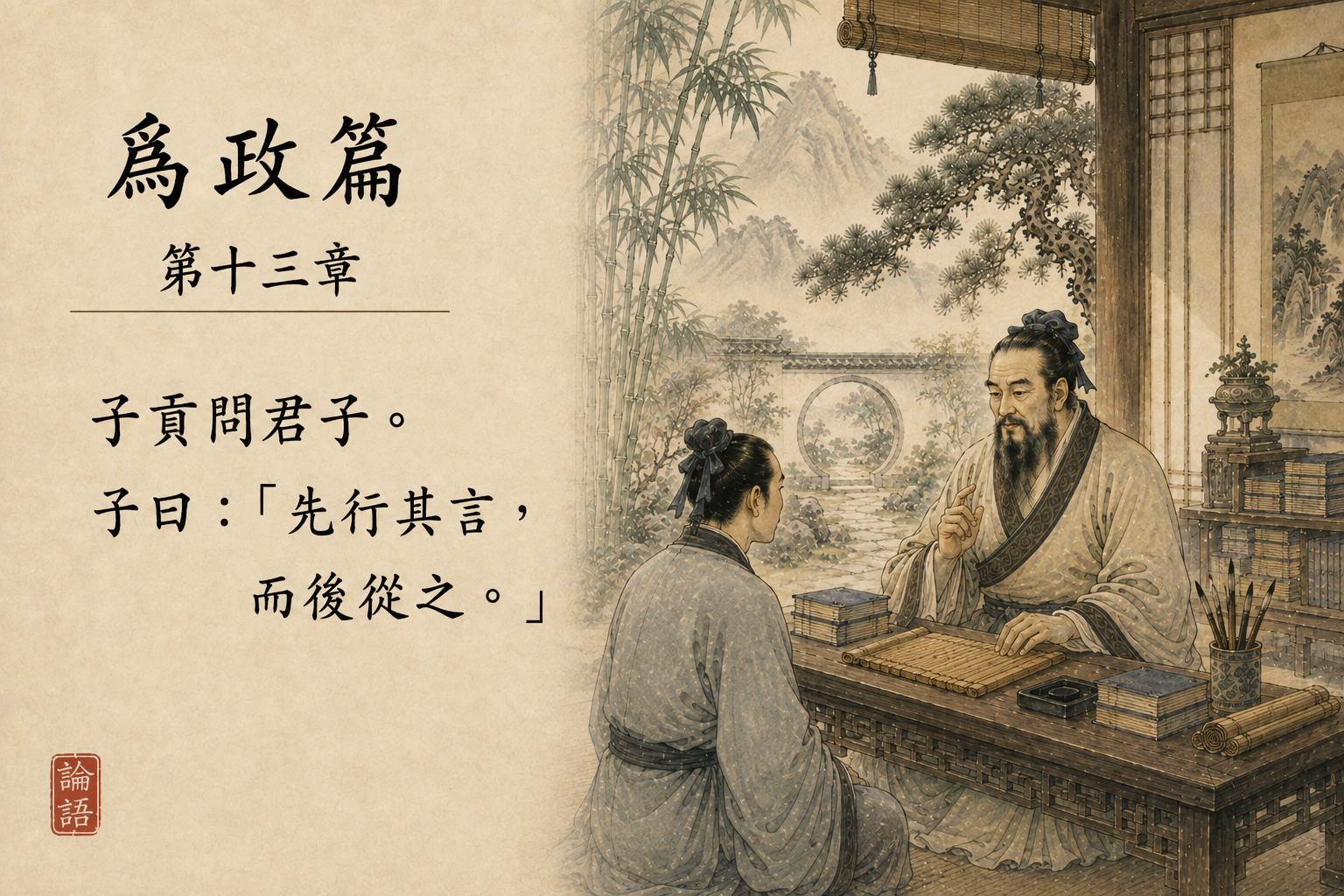
子貢問君子。子曰:「先行其言,而後從之。」
Simplified Chinese
子贡问君子。子曰:“先行其言,而后从之。”
Pinyin
Zǐ Gòng wèn jūnzǐ. Zǐ yuē: “Xiān xíng qí yán, ér hòu cóng zhī.”
Reading the Passage Literally
Zigong asked about the Junzi (君子). Confucius said:
“First put into practice what you intend to say, and only afterward let your words follow.”
Reading the Grammar
This passage is short, but its meaning depends on the order contained in the sentence. Confucius does not merely say that words and actions should agree. He places action first. The cultivated person does not begin by announcing what he intends to do and then struggle to make his conduct match the statement. He first acts, and only afterward allows words to follow what has already been done. The sequence 先 → 而後 therefore gives the passage its central force.
1. 子貢問君子
Zǐ Gòng wèn jūnzǐ
子貢 (Zigong) was one of Confucius’s prominent disciples. 問 (wèn) means “to ask,” and 君子 (Junzi) is one of the central ethical concepts in the Analects, referring to the cultivated or exemplary person.
The structure is:
子貢 / 問 / 君子
Zigong / asked / about the Junzi
Thus:
“Zigong asked what it means to be a Junzi.”
This question follows immediately after Chapter 12, where Confucius says 君子不器, that the Junzi is not confined to a single use or function. Here, the discussion becomes more concrete. Zigong asks directly about the Junzi, and Confucius answers not with a definition of status or knowledge, but with a principle governing the relationship between speech and action.
Key Characters and Meanings
子 (zǐ, master; son) · 貢 (gòng, tribute; Gong) · 問 (wèn, to ask) · 君 (jūn, ruler; noble) · 子 (zǐ, person; master)
2. 先行其言
Xiān xíng qí yán
先 (xiān) means “first” or “beforehand.” 行 (xíng) means “to act,” “to carry out,” or “to put into practice.” 其言 (qí yán) literally means “his words” or “what he would say.”
The structure is:
先 / 行 / 其言
first / put into practice / what one intends to say
Thus:
“First put into practice what you intend to say.”
The wording may initially seem unusual because it appears to say “act on one’s words” before the words have been spoken. Traditional commentary resolves this by understanding 其言 as referring to the content one is about to express. The point is therefore not simply, “Once you have made a promise, keep it.” Confucius establishes a stricter order: do not let speech run ahead of conduct.
Before presenting oneself through words, one should already have begun to embody what those words claim.
Key Characters and Meanings
先 (xiān, first; before) · 行 (xíng, to act; to practice) · 其 (qí, his; that) · 言 (yán, words; speech)
3. 而後從之
Ér hòu cóng zhī
而後 (ér hòu) means “and afterward” or “only then.” 從 (cóng) means “to follow,” while 之 (zhī) refers back to what has already been enacted.
The structure is:
而後 / 從 / 之
only afterward / follow / it
Thus:
“Only afterward let the words follow what has already been done.”
Traditional interpretations explain the line as speaking only after the action has been carried out. This gives the passage a clear sequence:
action → speech
The point is not silence for its own sake. Confucius does not reject speech, because the words still come afterward. What matters is that speech should arise from conduct rather than substitute for it.
The Lunyu Zhushu also emphasizes the problem of abundant speech without corresponding action and reads the chapter in terms of bringing words and deeds into agreement. Later commentary sharpens the same idea by stressing that conduct should come first.
Key Characters and Meanings
而 (ér, and; then) · 後 (hòu, afterward) · 從 (cóng, to follow) · 之 (zhī, it; what has been done)
Understanding the Meaning
When Zigong asks about the Junzi, Confucius gives an answer that is strikingly practical. He does not describe the Junzi as someone who possesses great learning, high status, eloquence, or public recognition. He begins instead with a simple question of order: what comes first, speech or action?
We often speak before we act. We explain what we intend to do, announce our goals, describe the values we believe in, and tell others what kind of person we hope to become. Speech is necessary, and making intentions public can sometimes strengthen commitment. Yet words are much easier than action. A plan can be described in minutes, while carrying it out may require months or years.
Confucius reverses the usual sequence.
First act. Then speak.
This is more demanding than the familiar principle that one should keep one’s promises. Keeping a promise means making a statement first and then ensuring that one’s behavior matches it. 先行其言 asks for something earlier still: before speaking, begin by living what you intend to say.
In this way, words become a description of conduct rather than a substitute for it. The person does not create an image through speech and then try to catch up with that image. What has already been done gives the later words their credibility.
This does not mean that the Junzi should never speak about plans, teach principles, or explain intentions. The second half of the sentence explicitly allows words to follow. The issue is not whether one speaks, but whether speech has outrun reality.
The passage therefore places the source of trust in conduct. A person may speak beautifully about responsibility, generosity, discipline, or courage, but listeners eventually ask whether those words are visible in the way that person lives.
The Junzi does not demand that words disappear.
He simply refuses to let them arrive before the life that gives them weight.
Background and Context
This passage appears in Wei Zheng, Chapter 13: 子貢問君子。子曰:「先行其言,而後從之。」 Traditional commentary often pays attention both to the general principle of the sentence and to the fact that Zigong is the questioner.
Zigong was known in the Analects as a capable and articulate disciple, and later commentary sometimes interprets Confucius’s answer as particularly suited to him. Zhu Xi cites Fan Zuyu’s observation that speaking was not Zigong’s chief difficulty; the harder task was acting. On this reading, Confucius directs him toward the part of cultivation that most needs attention: not better words, but stronger practice.
The Lunyu Zhushu emphasizes the broader concern that words and actions should correspond. A person whose speech is abundant while conduct remains insufficient lacks the reliability expected of the Junzi. The later interpretive tradition goes further by stressing the temporal sequence contained in 先 and 後: action should not merely agree with speech after the fact; it should precede it.
The chapter also follows directly after 君子不器 in Chapter 12. There, Confucius presents the Junzi as someone who cannot be confined to a single practical function. Here, another dimension is added: the Junzi is someone whose speech is grounded in prior conduct. The two sayings should not necessarily be treated as one deliberately constructed definition, but read side by side they show how the concept of Junzi develops through several complementary qualities.
The next chapter continues this pattern.
In Chapter 14, Confucius contrasts the Junzi with the petty person through the distinction between 周 and 比, often understood as broad, principled association on the one hand and narrow factional attachment on the other. Thus, this portion of Wei Zheng presents a series of concise sayings that gradually fill out the character of the Junzi from different angles.
Dr. Ryu’s Reflection
先行其言,而後從之.
This passage naturally makes me think about the weight of words. When we are young, speaking confidently about what we intend to do can feel like a form of strength. We make plans, announce goals, describe the values we want to live by, and sometimes tell other people what we are going to accomplish. Publicly stating a plan can even help create a sense of responsibility.
But over time, we discover how wide the distance can be between saying something and actually doing it.
At the beginning of a new project, almost everything seems possible. It is easy to say, “I will do this,” “I am going to change this,” or “From now on, I will live differently.” The statement takes only a few seconds. The reality that follows may require daily effort, unexpected adjustments, repeated failures, and long periods in which enthusiasm is no longer enough.
That is why, as I grow older, I find myself paying less attention to what a person says he intends to do and more attention to what he has already begun doing.
Someone who says, “This matters to me,” may sound convincing, but a person who has quietly lived according to that principle for years speaks with a different kind of credibility. Someone who repeatedly explains what he plans to accomplish may appear ambitious, but someone who has already begun the work and produced even a small result often inspires more trust.
What strikes me about Confucius’s answer is that he does not merely say words and actions should match. He says action should come first.
That difference is important.
When action comes first, there is less need to make ourselves look larger through explanation. What has already been done can carry part of the message. We no longer need quite as many words to convince others that we are serious, because conduct has begun to speak on our behalf.
This principle also feels relevant whenever I begin something new. At the start of a new learning project, a new piece of writing, or another undertaking, it can be tempting to spend a great deal of time explaining the plan—what will be created, how far it will go, and what it may eventually become. Talking about a project can sometimes create the satisfying feeling that meaningful progress has already occurred, even when the real work has barely started. But change begins elsewhere.
Study for one day. Write one piece. Make one thing. Revise it. Do it again. Eventually, what has accumulated becomes more convincing than the original plan.
In that sense, 先行其言 does not feel to me only like a severe moral command. It is also a very practical way of making life more solid. Do not allow speech to move too far ahead of reality. Begin the work first, and let the explanation come later.
The principle becomes even more important when a person is in a position to teach, lead, or advise others. Instructions lose force when the person giving them consistently fails to practice the same standard. By contrast, someone who has already demonstrated a way of working or living may need far fewer words. A short statement carries more weight because others have seen the conduct behind it.
Perhaps trust is built in much the same way. It is rarely created by one impressive explanation. It grows through actions repeated over time until words and conduct no longer seem separate.
So this passage leaves me with a simple question worth asking before I announce another intention:
Have I already begun, even in a small way, to do what I am about to say I will do?
Confucius’s order is simple. Act first. Then let the words follow.
References
- The Analects (論語), Wei Zheng (為政), Chapter 13.
- Zhu Xi (朱熹), Sishu Zhangju Jizhu (四書章句集注), Lunyu Jizhu (論語集注), Wei Zheng.
- He Yan (何晏), commentary, and Xing Bing (邢昺), subcommentary, Lunyu Zhushu (論語注疏), Wei Zheng.
- Chinese Text Project, The Analects: Wei Zheng.


