Traditional Chinese
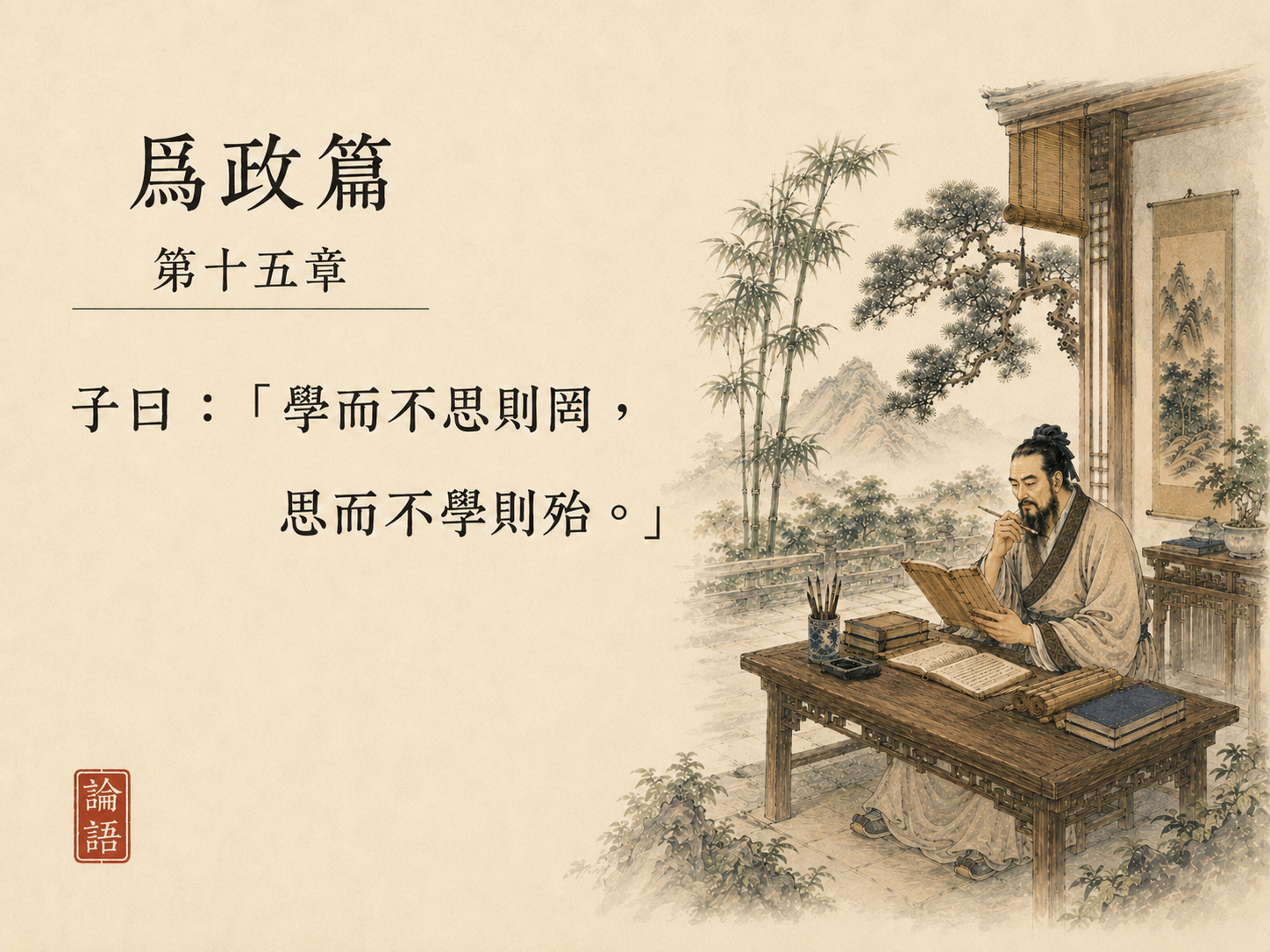
子曰:「學而不思則罔,思而不學則殆。」
Simplified Chinese
子曰:“学而不思则罔,思而不学则殆。”
Pinyin
Zǐ yuē: “Xué ér bù sī zé wǎng, sī ér bù xué zé dài.”
Reading the Passage Literally
Confucius said:
“To learn without reflecting leads to no real understanding; to reflect without learning leads to danger.”
Reading the Grammar
This passage is built on a carefully balanced contrast between 學 (xué), learning, and 思 (sī), reflection or thought. The two clauses mirror each other almost exactly: first there is learning without reflection, and then reflection without learning. Confucius criticizes neither learning nor thinking. His point is that each becomes incomplete when separated from the other. The final words 罔 (wǎng) and 殆 (dài) describe the different problems that arise when that balance is lost.
1. 學而不思則罔
Xué ér bù sī zé wǎng
學 (xué) means “to learn” or “to study,” while 思 (sī) means “to think,” “to reflect,” or “to consider carefully.” 而 (ér) connects the two parts of the condition, and 則 (zé) introduces the consequence: “then,” “in that case,” or “therefore.”
The most difficult word is 罔 (wǎng). It has been translated in different ways, including “perplexed,” “lost,” “confused,” or “without understanding.” Traditional commentary helps clarify the sense. The Lunyu Zhushu explains that if a person learns but does not reflect carefully on the meaning, he becomes 罔然無所得—unclear and without any real gain.
The structure is:
學 / 而 / 不思 / 則 / 罔
learn / but / do not reflect / then / remain without real understanding
Thus:
“To learn without reflecting leads to no real understanding.”
The problem is not that learning itself is ineffective. Confucius assumes that learning is necessary. But receiving information, listening to a teacher, or reading a text does not automatically turn knowledge into understanding. Without asking why something is so, how it connects with what one already knows, or how it might apply in practice, learning may remain external.
The person may possess information while still having little that has become firmly understood.
Key Characters and Meanings
學 (xué, to learn; to study) · 而 (ér, and; but) · 不 (bù, not) · 思 (sī, to think; to reflect) · 則 (zé, then; therefore) · 罔 (wǎng, confused; without real gain or understanding)
2. 思而不學則殆
Sī ér bù xué zé dài
The second clause reverses the structure of the first. Now there is 思, reflection, but no 學, learning.
殆 (dài) literally carries meanings such as “dangerous,” “precarious,” or “uncertain.” Traditional commentators explain the condition in somewhat different ways. The Lunyu Zhushu emphasizes that thinking without learning fails to reach a secure understanding and can leave the mind exhausted. Later commentary also associates the condition with instability and the danger of reasoning without adequate grounding.
The structure is:
思 / 而 / 不學 / 則 / 殆
reflect / but / do not learn / then / become precarious
Thus:
“To reflect without learning leads to a precarious state.”
A person who thinks only from within his or her existing experience has limited material with which to work. If no new knowledge, alternative perspective, or disciplined learning enters the process, thinking can circle repeatedly around the same assumptions. An error in the starting point may remain invisible because nothing from outside challenges it.
The first clause therefore warns against learning without making it one’s own, while the second warns against thinking without sufficient grounding. Together they give the passage its balance.
Key Characters and Meanings
思 (sī, to think; to reflect) · 而 (ér, and; but) · 不 (bù, not) · 學 (xué, to learn; to study) · 則 (zé, then; therefore) · 殆 (dài, dangerous; precarious; uncertain)
Understanding the Meaning
This chapter consists of two perfectly balanced warnings:
「學而不思則罔,思而不學則殆。」
First comes the person who learns but does not reflect. Such a person may listen carefully, read many books, memorize facts, and accumulate a great deal of information. Yet if that knowledge is never examined, questioned, connected, or interpreted, it may remain something received from outside rather than something genuinely understood.
That is the condition Confucius describes with 罔.
Knowing more and understanding more are not necessarily the same thing. A person may remember a principle but not know why it matters, recognize a correct answer but not know when it applies, or repeat another person’s explanation without being able to express the idea independently.
Reflection gives learning depth.
The second half of the sentence reverses the danger. Thinking is necessary, but thinking alone is not enough. Every person begins from limited experience, limited information, and assumptions that may contain errors. If we continue thinking only within those boundaries without learning from texts, teachers, experience, evidence, or other people, our reasoning can become increasingly self-contained.
That is the danger expressed by 殆.
Thinking without learning may feel independent, but independence is not the same as accuracy. A person can think intensely and still remain trapped inside a mistaken premise.
Confucius therefore does not place learning above thinking or thinking above learning.
They need each other.
Learning provides material, standards, and perspectives that thought can work with. Reflection tests, connects, and transforms what has been learned so that it becomes part of one’s own understanding. When reflection reveals a gap, one must return to learning. When new learning raises another question, reflection begins again.
The relationship is therefore not linear but circular:
learn → reflect → discover a gap → learn again → reflect again
Seen this way, the passage is more than advice about study technique. It is a principle for developing judgment.
Do not accept everything merely because someone has taught it. But do not trust your own thoughts merely because they are your own.
Learn enough to challenge your thinking, and think enough to make learning truly yours.
Background and Context
This saying appears in Wei Zheng, Chapter 15: 學而不思則罔,思而不學則殆. It stands between Chapter 14, where Confucius contrasts the Junzi and the petty person through 周 and 比, and Chapter 16, which turns to the problem of 攻乎異端.
The Lunyu Zhushu treats this chapter directly as a discussion of the method of learning and teaching. After receiving instruction from a teacher, the learner must think through its meaning. If one learns without reflection, there is no clear internal grasp of what has been learned. If one thinks independently without continuing to learn, one fails to reach a stable understanding and may exhaust oneself in ungrounded thought.
Later interpretations associated with Zhu Xi also emphasize the mutual dependence of 學 and 思. In discussions preserved in the Zhuzi Yulei, 學 is not restricted to reading books. It includes learning how things are actually done and developing familiarity through practice. Reflection then examines the principle within what has been learned, while learning and practice in turn test whether one’s reflection is adequate.
The important point is that learning and reflection illuminate one another.
This connects naturally with other passages in Wei Zheng concerned with the quality of learning. Chapter 11 says 溫故而知新, that by revisiting what has already been learned one can arrive at new understanding. Chapter 15 now makes clearer one of the processes through which such new understanding can emerge: what has been learned must not simply be stored but must be reflected upon.
It would be too strong to claim that these chapters form a deliberately systematic theory of education, but together they repeatedly resist the idea that learning is merely the accumulation of information. Learning becomes meaningful when it is revisited, reflected upon, tested, and gradually transformed into understanding.
Traditional interpretations also vary somewhat in the precise nuance of 罔 and 殆. 罔 may suggest confusion, obscurity, or having no real gain, while 殆 may suggest danger, uncertainty, exhaustion, or instability. Despite those differences, the central contrast remains consistent: learning without thought and thought without learning are both incomplete.
Dr. Ryu’s Reflection
學而不思則罔,思而不學則殆.
This passage makes me think less about how much we study and more about how learning actually becomes understanding.
When we are young, learning can easily be measured by accumulation. We read more books, attend more classes, memorize more information, and acquire more skills. It is natural to feel that knowing more means learning more.
But over time, I have come to see that having more knowledge and having deeper understanding are not always the same thing.
A person may read many books and still struggle to explain an idea in his own words. Someone may work in the same field for many years yet be unable to answer a simple question about why a familiar practice is done in that particular way. Information can accumulate without becoming connected.
That is why 學而不思則罔 feels so realistic.
At some point, learning requires a pause. We need to ask what we have actually learned, why it matters, how it connects with what we already know, and whether it still makes sense when applied to a real situation. Without that reflective moment, information can continue arriving while understanding remains surprisingly shallow.
Yet the second half of the passage now feels equally important to me.
思而不學則殆.
As we grow older, we accumulate not only knowledge but also opinions. Experience allows us to recognize patterns and sometimes make decisions much more quickly than when we were younger. That is one of the real advantages of having lived and worked through many situations.
But experience can also make us too confident in our own thinking.
“I already know this.”
“I have seen this before.”
“My experience tells me how this works.”
Statements like these are not necessarily wrong. Experience is valuable precisely because it gives us something to think with. But circumstances change, new information appears, technology changes what is possible, and younger people may encounter the same problem from perspectives that were not available to us before.
If experience begins to convince us that further learning is unnecessary, thinking can gradually turn into repetition.
That is why learning may become even more necessary as our opinions become stronger.
Learning does not require abandoning our previous judgment. It means placing that judgment beside new evidence, another person’s experience, a new method, or an unfamiliar way of seeing the problem. Sometimes what we already believe becomes stronger after that encounter. Sometimes it needs adjustment. Either way, the thinking becomes better grounded.
I find the balance between 學 and 思 especially meaningful when thinking about lifelong learning. When we are young, perhaps the danger is to focus too much on the quantity of what we learn. Later in life, another danger can appear: relying too heavily on what we already think we know.
Confucius leaves little room for either extreme.
After learning, reflect. After reflecting, return to learning.
There seems to be no final point at which this process is completed.
Perhaps lifelong learning does not mean continuously adding new information forever. It may mean repeatedly reconsidering what we already know, allowing new learning to challenge our conclusions, and gradually changing the way we understand things.
This is especially relevant today, when information is easier to obtain than ever. We can search, watch, listen, and receive explanations almost instantly. The amount of information available to us has increased dramatically, but access to information does not guarantee understanding. In fact, the more rapidly information arrives, the more important it may become to stop and ask what deserves to be believed, how different pieces fit together, and what remains uncertain.
At the same time, personal reflection without learning can become an echo chamber of one. Thinking deeply is valuable, but if the only voice we continue to hear is our own, depth can gradually become repetition.
So this passage leaves me with two questions rather than one:
Am I taking enough time to think about what I am learning?
And:
Am I still learning enough to challenge what I already think?
If neither learning nor reflection is sufficient by itself, perhaps good learning is simply the lifelong practice of moving back and forth between the two.
References
- The Analects (論語), Wei Zheng (為政), Chapter 15.
- He Yan (何晏), commentary, and Xing Bing (邢昺), subcommentary, Lunyu Zhushu (論語注疏), Wei Zheng.
- Zhu Xi (朱熹), Zhuzi Yulei (朱子語類), discussions on “Xue Er Bu Si” in the Wei Zheng section.
- Chinese Text Project, The Analects: Wei Zheng.


